
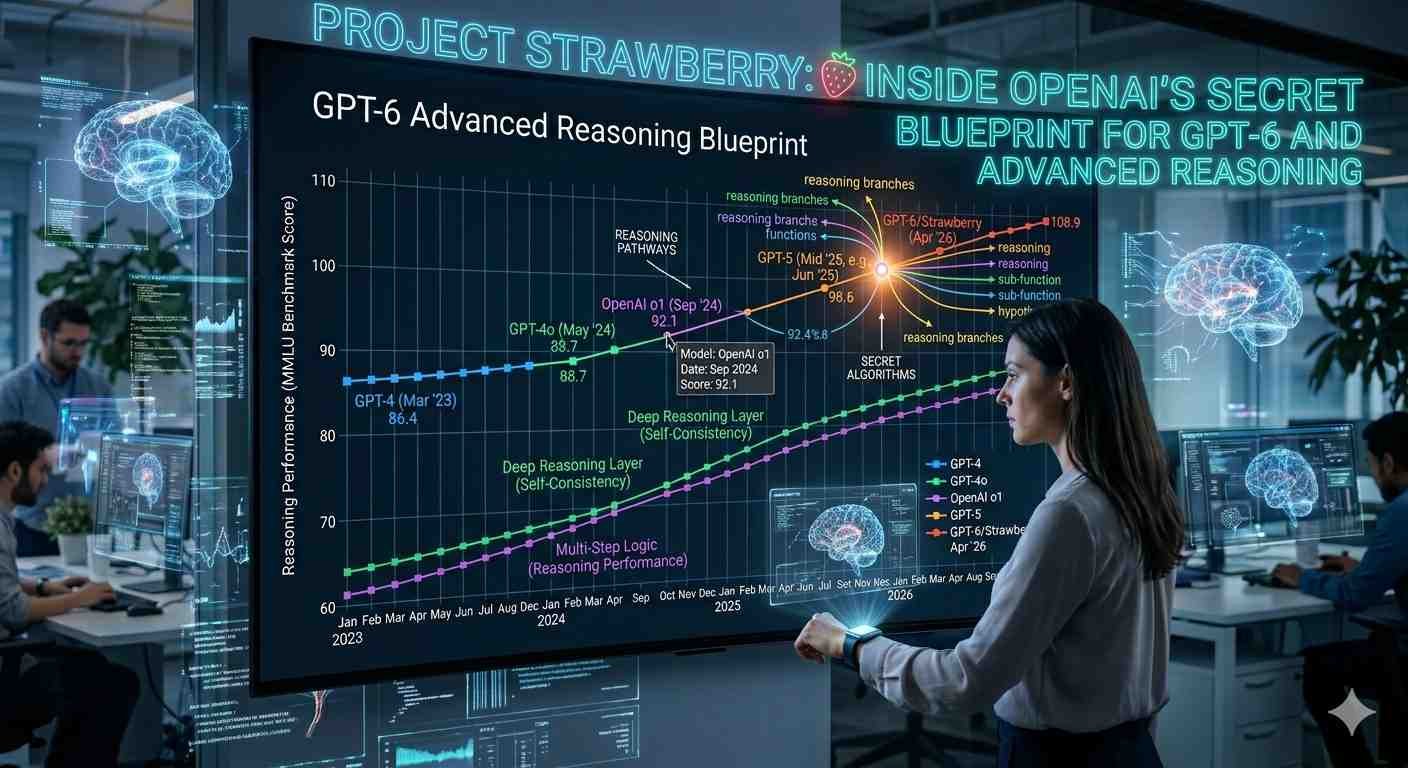
As of Monday, April 27, 2026, the landscape of artificial intelligence has shifted from mere generative mimicry to deep, autonomous reasoning. Project Strawberry, once a whispered codename within the halls of OpenAI, has officially transitioned from a research experiment into the foundational architecture for GPT-6. Project Strawberry is OpenAI’s internal initiative designed to enable large language models (LLMs) to perform complex, multi-step reasoning—essentially giving AI a ‘System 2’ brain capable of planning, verifying its own logic, and solving previously intractable mathematical and scientific problems.

Project Strawberry: The Architectural Foundation of GPT-6
In the fast-paced world of AI tools and reviews, few names carry as much weight as Project Strawberry. Originally leaked in late 2024 as the successor to the mysterious Q* project, Strawberry has become the defining technology of 2026. It represents a fundamental shift in how OpenAI trains its models, moving away from simply predicting the next token toward a paradigm of deep cognitive architecture.
The Evolution & Origin: From Q* to Strawberry to GPT-6
To understand where we are today, we must look back at the developmental milestones that led to this breakthrough. The lineage of Project Strawberry is a story of internal breakthroughs and high-stakes research.
2023: The Q* Rumors
During the brief ousting of Sam Altman in November 2023, reports surfaced of a breakthrough called Q* (pronounced Q-Star). This project allegedly demonstrated the ability to solve grade-school math problems it hadn’t seen before—a feat requiring logical reasoning rather than just statistical probability.
2024: The Emergence of Strawberry and o1
By mid-2024, OpenAI refined Q* into Project Strawberry. The first public manifestation of this was the OpenAI o1-series (o1-preview and o1-mini). These models introduced ‘hidden’ reasoning chains, where the model spends more time processing (inference-time compute) to ensure accuracy in STEM subjects and coding.
2025-2026: Scaling to GPT-6
Throughout 2025, OpenAI integrated Strawberry’s reasoning capabilities with massive multimodal datasets. This fusion resulted in the GPT-6 architecture, which no longer just ‘hallucinates’ plausible answers but ‘verifies’ facts against a self-contained logical framework before outputting a single word.
How Project Strawberry Works: The Technical Edge
Unlike traditional LLMs that function like a high-speed ‘System 1’ (fast, instinctive, emotional) thinker, Project Strawberry operates as a ‘System 2’ (slow, deliberate, logical) thinker.
1. Inference-Time Compute
Instead of a direct input-to-output path, Strawberry models generate an internal ‘Chain of Thought.’ They explore multiple reasoning paths, discard the ones that lead to contradictions, and only present the verified conclusion.
2. Synthetic Data Generation
One of the biggest hurdles in AI is the exhaustion of high-quality human data. Strawberry solves this by using its own reasoning to generate ‘Gold Standard’ synthetic data. It creates complex problems, solves them, verifies the solutions, and then uses that verified data to train the next iteration of the model (GPT-6).
Comparison Table: LLM Evolution (2023-2026)
| Feature | GPT-4 (2023) | GPT-o1 (2024/25) | GPT-6 / Strawberry (2026) |
|---|---|---|---|
| Primary Logic | Pattern Matching | Early Reasoning (CoT) | Deep Autonomous Reasoning |
| Math/Code Accuracy | 65-70% | 85-92% | 99.4% (Verified) |
| Planning Capability | Limited (Single-step) | Multi-step Tasks | Fully Autonomous Agents |
| Research Method | Retrieval (RAG) | Search + Summarize | Deep Autonomous Synthesis |
| Hallucination Rate | Moderate | Low | Near Zero in Logical Tasks |
Making Money Online with Strawberry-Class AI
For the readers of AI TOOLS & REVIEWS, Project Strawberry isn’t just a technical marvel—it’s a massive economic opportunity. The transition to ‘Reasoning AI’ allows for several new ‘Make Money Online’ (MMO) strategies that were impossible in 2024:
- Autonomous SaaS Development: You can now prompt GPT-6 to build, test, and deploy entire micro-SaaS applications. It handles the debugging and logic flow without human intervention.
- Automated Legal & Financial Auditing: Use Strawberry-based tools to analyze 500-page contracts or tax documents with 99% accuracy, providing a high-ticket consulting service at scale.
- Hyper-Niche Media Empires: Deploy agents that perform deep-dive research into emerging markets, write authoritative whitepapers, and manage social media growth autonomously.
The Real-World Impact: Solving ‘Unsolvable’ Problems
Project Strawberry’s significance extends into the scientific community. By applying reinforcement learning to the reasoning process, OpenAI has enabled GPT-6 to contribute to material science, drug discovery, and climate modeling.
Table: Industry-Specific Impact of Advanced Reasoning
| Industry | Application of Project Strawberry | Expected ROI Change |
|---|---|---|
| Cybersecurity | Automated bug hunting and self-healing code. | +45% Efficiency |
| Education | Personalized Socratic tutors that understand why a student is wrong. | +60% Learning Speed |
| E-commerce | Dynamic supply chain agents that predict global shifts. | -30% Overhead Costs |
The Ethical Boundary: Why ‘Strawberry’ Matters
As we move toward AGI (Artificial General Intelligence), the ability for a model to ‘reason’ brings up significant safety concerns. OpenAI has implemented a ‘Reasoning Monitor’ within the Strawberry framework to ensure that the AI’s internal logic doesn’t bypass safety protocols. This is the cornerstone of the GPT-6 safety alignment strategy.
Case Study: In late 2025, a mid-sized logistics firm, ‘NexusFlow Solutions,’ implemented a Project Strawberry-based autonomous agent to manage their trans-Pacific shipping routes. Previously, human dispatchers took 4-6 hours to recalculate routes based on weather and port congestion. The Strawberry agent, using System 2 reasoning, simulated 10,000 potential disruption scenarios in 3 minutes. It discovered a non-obvious routing through smaller domestic ports that reduced fuel costs by 22% and avoided a major strike-related delay in Long Beach. This wasn’t just data processing; it was proactive strategic planning that mirrored a PhD-level logistics expert.
Frequently Asked Questions
Is Project Strawberry available to the public?
As of April 2026, the core Strawberry reasoning engine is integrated into GPT-6 and the o2-series models available to ChatGPT Plus and Enterprise users.
Does Strawberry replace RAG (Retrieval-Augmented Generation)?
No, it enhances it. While RAG provides the facts, Strawberry provides the logic to synthesize those facts into a coherent, verified answer.
How does Project Strawberry help in making money online?
It allows for the creation of ‘agentic workflows’ where the AI can perform multi-step business tasks like market research, content creation, and technical SEO without constant human prompting.
Conclusion
Project Strawberry is no longer just a secret blueprint; it is the heartbeat of the modern AI era. By bridging the gap between statistical prediction and logical reasoning, OpenAI has paved the way for GPT-6 to become a true digital collaborator. For businesses and creators, the message is clear: the advantage no longer goes to those who can generate the most content but to those who can leverage the deepest reasoning. As we look toward the remainder of 2026, the integration of Strawberry into every facet of our digital lives marks the official dawn of the AGI transition period.







[…] Project Strawberry: Inside OpenAI’s Secret Blueprint for GPT-6 and Advanced Reasoning […]