The AI Water Crisis Nobody’s Talking About
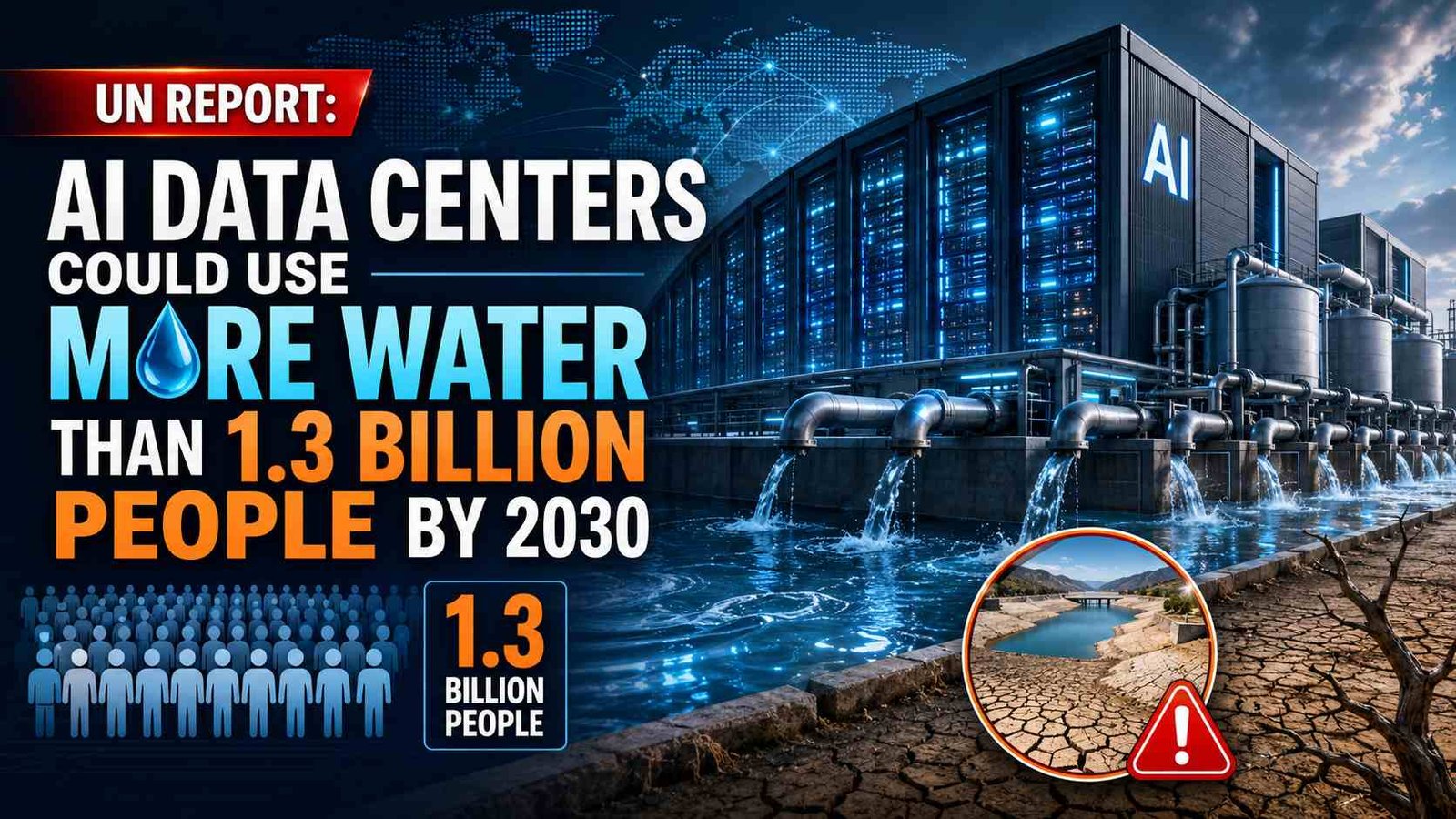
UN Report:Every time you ask ChatGPT to write an email, generate code, or brainstorm ideas, something invisible happens behind the scenes — servers roar to life, GPUs heat up, and millions of gallons of water get consumed to keep those data centers cool. A groundbreaking new UN report released in June 2026 has put a staggering number on this hidden cost: AI data centers could be using as much water as 1.3 billion people by 2030.
That’s not a typo. If AI’s water consumption continues on its current trajectory, the technology that promised to solve the world’s problems could end up creating one of its biggest resource crises.
In this article, we’ll break down what the UN report actually found, why AI data centers are so thirsty, which communities are already feeling the squeeze, and what Big Tech is doing about it. We’ll also explore whether new cooling technologies can turn the tide before it’s too late.
What the UN Report Actually Found
The United Nations University report, titled “The Environmental Cost of Artificial Intelligence: Carbon, Water, and Land Footprints,” dropped in early June 2026 and immediately sent shockwaves through the tech industry. The findings were sobering, to say the least. Here are the key numbers:
- Water consumption by AI data centers could double by 2030, reaching levels equivalent to the water needs of 1.3 billion people
- Energy use from AI infrastructure is projected to rival entire countries’, with some estimates putting it on par with Japan’s total electricity consumption
- Land footprint for data center construction is consuming significant acreage, particularly in rural and agricultural regions
- Carbon emissions from AI operations continue to climb despite renewable energy pledges from major tech companies
The report’s authors, led by researchers at United Nations University, didn’t just flag the problem — they called for urgent government intervention and international coordination. According to Reuters reporting, the researchers emphasized that voluntary corporate pledges are nowhere near sufficient to address the scale of the crisis.
Why AI Data Centers Are So Incredibly Thirsty
To understand the water problem, you need to understand what happens inside an AI data center. Training large language models like GPT-5, Gemini, and Claude requires thousands of GPUs running at full throttle for weeks or even months. These chips generate enormous heat, and without aggressive cooling, they’d literally melt.
There are two main cooling approaches, and both are water-intensive in different ways:
Evaporative Cooling — The Water Guzzler
Most data centers use evaporative cooling systems. Hot air from server racks gets blown over water-saturated media. As the water evaporates, it absorbs heat and cools the air, which cycles back into the server rooms. The catch? That water evaporates into the atmosphere and is essentially gone. A single large data center can evaporate millions of gallons per day — water that’s permanently removed from local supplies.
Chilled Water Systems — The Energy Trade-Off
More sophisticated facilities use chilled water loops — giant refrigeration systems that pump cold water through heat exchangers attached to server racks. While these systems recycle water rather than consuming it directly, they require enormous electricity to run the compressors and pumps. More electricity means more power plants, which means more water used for electricity generation elsewhere. It’s a vicious cycle.
The Training Problem
Here’s what really multiplies the water footprint: training a single large language model can consume more water than a small city uses in a year. Research from the University of California, Riverside has previously estimated that training GPT-3 alone consumed roughly 700,000 liters of clean freshwater. GPT-5 and its competitors are orders of magnitude larger.
And it’s not just training. Every time you send a prompt to ChatGPT, Gemini, or Claude, inference runs on GPUs that need cooling. With billions of queries processed daily across all AI platforms, the cumulative water cost is staggering.
Communities Already Feeling the Squeeze
This isn’t a theoretical future problem — it’s happening right now, and communities across the United States and around the world are already paying the price.
The Utah Stratos Project
Perhaps no data center proposal has sparked more controversy than the Stratos Project in Utah. Backed by investors including Shark Tank’s Kevin O’Leary, the facility would span an area nearly three times the size of Manhattan and could consume an estimated 16 billion gallons of water annually. Local residents and water conservation groups have mounted fierce opposition, arguing the project would drain aquifers that sustain agriculture and drinking water supplies across the region.
The controversy has drawn national attention, with some Republican lawmakers even requesting FBI investigations into whether foreign adversaries are stoking anti-data center sentiment to slow American AI development.
Communities Left High and Dry
The Guardian reported in June 2026 that communities across the US are finding themselves “high and dry” as data center water demands escalate. In places like Arizona, Texas, and Virginia — already facing water stress — data centers are competing directly with farmers, residents, and ecosystems for dwindling water supplies.
Global Implications
Chatham House, the international affairs think tank, published a report in May 2026 warning that AI water usage requires governments to fundamentally rethink their approach to water policy. The think tank argued that current water allocation frameworks were designed for an era before AI existed and are woefully unprepared for the coming surge in demand.
What Big Tech Says vs. What They’re Actually Doing
The tech industry is acutely aware of the PR problem — and the actual problem. Their responses have been a mix of genuine innovation, greenwashing, and community appeasement.
Google’s Water Pledge
Google has been among the most vocal about addressing water consumption. In June 2026, the company announced a commitment to invest $10 million in Texas water infrastructure amid growing backlash over data center water use. Google also pushed for new water stewardship standards and published a blog post detailing its local community water commitments.
Meanwhile, Google also signed a compute deal with SpaceX — similar to Anthropic’s earlier arrangement — to help meet “surging customer demand” for its Gemini Enterprise platform. More demand means more compute, which means more water. The math doesn’t change.
Microsoft’s Closed-Loop Claim
Microsoft CEO Satya Nadella made a bold claim in June 2026: new AI data centers use “as little water annually as a restaurant” thanks to closed-loop cooling systems. These systems recirculate water rather than consuming it, theoretically slashing water use from millions of gallons to a trickle.
Skeptics, however, point out that closed-loop systems still require significant water for initial filling, maintenance, and electricity generation. Additionally, these advanced cooling systems are expensive and not yet deployed at scale across Microsoft’s entire fleet of data centers.
Amazon’s Data Center Spending Spree
According to Fortune, Amazon engineers have publicly called out the company for planning $200 billion in data center spending — even after slashing 30,000 workers. This massive infrastructure expansion will inevitably drive up water and energy consumption regardless of efficiency improvements.
The Regulatory Response — Is Anybody in Charge?
One of the most striking aspects of the UN report is how unprepared governments are to regulate AI’s environmental impact. Multiple regulatory efforts are underway, but they’re fragmented and slow.
The EU Steps Up
In June 2026, Reuters reported that the European Union proposed new energy standards specifically for data centers. These standards would require data center operators to disclose their energy and water consumption, set efficiency targets, and report on their environmental impact. It’s a significant step, though implementation will take years.
The US Bipartisan Framework
Reps. Jay Obernolte (R-CA) and Lori Trahan (D-MA) released a highly anticipated 269-page draft bill in early June 2026 that could preempt state AI laws for three years while establishing a national framework. In a Bloomberg Law op-ed, the lawmakers argued that America needs “one national framework for artificial intelligence” rather than a patchwork of state regulations.
Separately, President Trump signed an executive order allowing voluntary federal vetting of top AI models for national security risks — though this focused more on capability concerns than environmental impact.
The Pope Weighs In
Even the Vatican has entered the conversation. Pope Francis’s encyclical on AI lent church support to calls for slowing the rapid expansion of data centers, arguing that the environmental costs are incompatible with moral responsibility to protect communities and the planet.
Can New Technology Fix the Problem?
The good news is that the industry is actively developing solutions. The question is whether they can scale fast enough.
Closed-Loop and Liquid Cooling
Wired reported in June 2026 that data center operators are “trying to fix their water use problems” through a variety of approaches. Liquid cooling — where coolant flows directly over or through server components — is emerging as the most promising alternative to evaporative cooling. These systems can reduce water consumption by 80-90% compared to traditional cooling towers.
AI-Optimized Cooling
In a twist of irony, AI itself is being used to reduce AI’s water footprint. Machine learning models are optimizing cooling systems in real-time, predicting server load patterns to minimize energy waste, and identifying the most efficient cooling strategies for different conditions.
Location Strategy
Some companies are building data centers in colder climates (Scandinavia, Canada) where natural ambient temperatures reduce cooling needs. Others are locating facilities near coastlines to use seawater cooling. Microsoft even experimented with an underwater data center to test whether ocean temperatures could provide free cooling.
The Bigger Picture — What This Means for AI’s Future
Here’s the uncomfortable truth that the tech industry doesn’t like to acknowledge: AI’s environmental costs are not just a side effect — they’re a fundamental constraint on how big AI can get.
The UN report makes clear that we’re approaching collision points between AI ambitions and water, energy, and land availability. The tech industry can innovate around these problems for a while, but physics and resource limits are unforgiving.
Some key implications worth watching:
- Water-rich regions will become the new battlegrounds for data center construction, potentially reshaping real estate and economic development patterns
- AI companies that invest early in sustainable cooling will have a competitive advantage as regulations tighten and water costs rise
- Smaller, more efficient AI models may become more valuable than massive ones, simply because the infrastructure costs are sustainable
- Community pushback could slow AI infrastructure development in water-stressed areas, creating geographic AI deserts
Frequently Asked Questions
How much water does a single AI data center use?
A large AI data center can consume 1 to 5 million gallons of water per day, with mega-facilities like the proposed Utah Stratos Project potentially using 16 billion gallons annually.
Why does artificial intelligence need so much water?
AI needs water primarily for cooling the GPUs and servers that run large language models. Without water-based cooling, the hardware would overheat and fail during the intensive training and inference processes.
What does the UN report say about AI and water by 2030?
The UN predicts AI data centers could double their water consumption by 2030, reaching levels equivalent to the needs of 1.3 billion people, while energy use could rival entire countries.
Are tech companies doing anything to reduce AI water consumption?
Companies like Microsoft, Google, and Amazon are investing in closed-loop cooling, liquid cooling, and building in colder climates, but improvements are being outpaced by explosive growth in AI compute demand.
How can AI water usage affect local communities?
AI data centers can strain local water supplies, leading to higher costs, depleted aquifers, and reduced water quality, particularly in water-stressed regions like Arizona and Texas.
What is closed-loop cooling and can it solve the water problem?
Closed-loop cooling recirculates coolant without evaporating water, reducing consumption by 80-90%, but requires more electricity and is not yet deployed at sufficient scale.
Key Takeaways
The UN report has put numbers to what environmentalists have been warning about for years: AI’s water footprint is massive and growing fast. With data centers projected to consume as much water as 1.3 billion people by 2030, the tech industry faces an unavoidable reckoning.
Big Tech is making moves — closed-loop cooling, liquid immersion, location strategy, AI-optimized systems — but these innovations are racing against exponential demand growth. Meanwhile, communities from Utah to Texas are already feeling the pressure on their water supplies.
What’s clear is that the era of unchecked AI expansion regardless of environmental cost is ending. Whether through regulation, community pushback, or simple resource limits, something has to give. The companies that recognize this reality and invest in sustainable infrastructure now will be the ones that thrive in the AI landscape of the 2030s.
What do you think about AI’s growing water footprint? Should tech companies be required to disclose their water consumption? Drop a comment below — we’d love to hear your perspective.