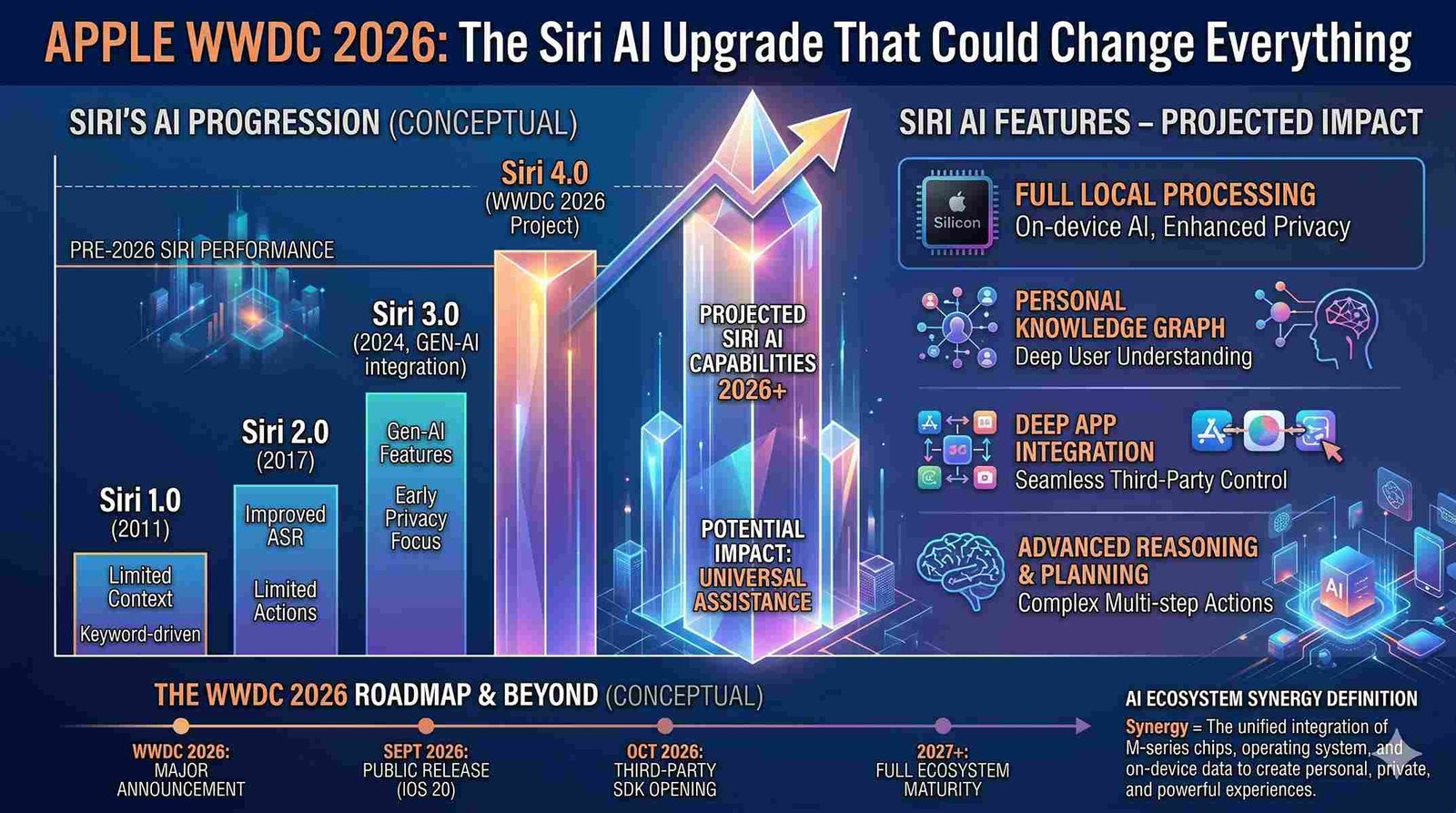
Today marks one of the most anticipated tech events of the year — Apple WWDC 2026 — and all eyes are on what could be the biggest Siri overhaul in the assistant’s history. After years of playing catch-up to ChatGPT, Google Gemini, and Amazon Alexa, Apple appears ready to finally make Siri a genuinely intelligent AI assistant. But here’s the question: is this the Siri upgrade we’ve been waiting for, or just another incremental tweak wrapped in marketing flair?
In this article, we’re breaking down everything we know about Apple’s AI strategy for 2026, what the Siri upgrade means for everyday users, and how it fits into the broader battle for AI assistant supremacy. Let’s get into it.
Apple WWDC 2026: The AI Turning Point
Apple’s Worldwide Developers Conference has always been the stage for major software announcements, but WWDC 2026 feels different. The company has been quietly assembling one of the most impressive AI research teams in Silicon Valley, poaching talent from Google DeepMind, Meta, and even OpenAI. Now, it looks like those investments are about to pay off.
According to multiple reports from The Verge, Bloomberg, and 9to5Mac, Apple is preparing to unveil a dramatically upgraded Siri that leverages large language models (LLMs) to handle complex, multi-step conversations — something the current Siri has never been able to do convincingly.
The timing couldn’t be more critical. Google just launched its AI Mode for search, OpenAI rolled out an upgraded ChatGPT memory system, and Anthropic is making waves with its recursive self-improvement research. Apple risks being left behind if it doesn’t deliver something substantial this time around.
What We Know About the New Siri AI Upgrade
While Apple hasn’t officially confirmed the details, leaks and industry sources have painted a fairly clear picture of what to expect from the new Siri.
On-Device AI Processing
One of the biggest differentiators for Apple’s approach is its focus on on-device processing. Unlike cloud-dependent assistants, Apple’s new Siri is expected to run much of its AI processing directly on the device’s Neural Engine and A-series chips. This means faster response times, better privacy, and the ability to work without an internet connection for basic tasks.
This is a huge selling point for privacy-conscious users who don’t want their conversations sent to a server. Apple has been positioning itself as the privacy-first tech company for years, and an on-device AI assistant reinforces that narrative perfectly.
Conversational Memory and Context
The current Siri forgets everything the moment you close a conversation. The upgraded version is expected to maintain persistent conversational memory, similar to ChatGPT’s recent “dreaming” feature that was rolled out to all users in early June 2026.
This means Siri could remember your preferences, previous requests, and context across multiple interactions. Ask it to “book a restaurant like the one we went to last Friday” and it would actually know what you’re talking about.
App Integration and Actions
Perhaps the most exciting upgrade is deeper app integration. The new Siri is rumored to be able to navigate through apps, fill out forms, schedule meetings, and execute multi-step workflows — essentially acting as an agentic AI assistant rather than just a voice-activated search bar.
Think about it: instead of saying “set an alarm for 7 AM” and calling it a day, you could say “Prepare my morning briefing — check my calendar, summarize yesterday’s emails, and order my usual coffee.” That’s the kind of leap Apple needs to make.
Multimodal Capabilities
Rumors suggest the new Siri will also gain multimodal capabilities, meaning it can understand and respond to images, screen content, and potentially video. If true, this would put it on par with Google Gemini and GPT-4o’s vision features — a massive step up from Siri’s current text-and-voice-only interactions.
How Apple’s AI Strategy Compares to Competitors in 2026
Apple isn’t entering an empty field. The AI assistant space is more competitive than ever in mid-2026. Here’s how the landscape looks:
| Feature | Apple Siri (2026) | Google Gemini | OpenAI ChatGPT | Amazon Alexa+ |
|---|---|---|---|---|
| On-Device Processing | Yes (likely) | Partial | No | Partial |
| Conversational Memory | Yes (expected) | Yes | Yes | Yes |
| App Actions/Agents | Deep iOS integration | Android + web | GPTs/plugins | Smart home focus |
| Multimodal Input | Expected | Yes | Yes | Limited |
| Privacy Focus | Strong | Moderate | Moderate | Moderate |
| Ecosystem Lock-in | Apple only | Google ecosystem | Platform-agnostic | Amazon ecosystem |
Apple’s key advantage is its closed ecosystem. While ChatGPT and Gemini are available everywhere, Apple can deeply integrate Siri into the iPhone, iPad, Mac, Apple Watch, AirPods, and HomePod in ways that third-party assistants simply can’t match. That tight integration, combined with on-device processing, could make Siri feel more natural and responsive than cloud-based alternatives.
The Bigger Picture: AI Regulation Heating Up
While Apple works on making Siri smarter, the regulatory landscape around AI is shifting rapidly. Just this week, several major developments underscore how seriously governments are taking AI governance:
- New York’s AI Companion Ban: New York state lawmakers passed a bill (S9051) that would bar AI chatbots from acting like companions to children. If signed by Governor Kathy Hochul, companies would be restricted from letting teens use chatbots that suggest they’re human. This comes after lawsuits against Character.ai and OpenAI over allegations their chatbots harmed teen users.
- Federal AI Framework: Representatives Jay Obernolte (R-CA) and Lori Trahan (D-MA) released a 269-page draft bipartisan bill that could preempt state AI laws for three years, aiming to establish a unified national standard for AI regulation.
- Trump’s AI Stance: The Trump administration has been eying stakes in major AI companies, with Sam Altman reportedly pitching the White House on the government taking an equity position in OpenAI. Meanwhile, the top Trump AI adviser recently left the White House.
These regulatory moves will directly impact how Apple, Google, OpenAI, and others develop and deploy their AI assistants — especially when it comes to child safety, data privacy, and transparency.
What the Siri Upgrade Means for Developers
WWDC isn’t just about consumers — it’s a developer conference, and Apple’s Siri upgrade is expected to come with new APIs and frameworks that let third-party apps integrate with the new AI-powered assistant.
This could be a game-changer for the app ecosystem. Imagine your favorite productivity app, fitness tracker, or e-commerce platform being able to interact with Siri in a natural, conversational way. Developers who get ahead of this curve could see significant advantages in discoverability and user engagement.
Apple is also expected to announce updates to its Core ML framework and potentially new tools for on-device model training and optimization — making it easier for developers to build AI features that run entirely on Apple hardware.
Key Stats to Watch
📊 Quick Numbers:
• Apple spent an estimated $10+ billion on AI R&D in 2025
• The current Siri handles 25 billion requests per year across Apple devices
• ChatGPT’s upgraded memory system rolled out to all users in June 2026
• New York’s AI companion ban could affect millions of teen users if signed into law
• The federal AI regulation framework covers 269 pages of proposed rules
Frequently Asked Questions
What is Apple announcing at WWDC 2026?
Apple is expected to announce a major Siri AI upgrade at WWDC 2026, featuring on-device AI processing, conversational memory, deep app integration, and multimodal capabilities. The conference is also likely to include new developer APIs for AI integration, updates to Core ML, and improvements across iOS, macOS, and other Apple platforms.
How is the new Siri different from the current Siri?
The new Siri is expected to be fundamentally different from the current version. Key upgrades include persistent conversational memory (remembering previous interactions), the ability to execute multi-step actions across apps, on-device AI processing for faster and more private responses, and multimodal understanding that can process images and screen content — none of which the current Siri can do effectively.
Will the Siri upgrade work on older iPhones?
While Apple hasn’t confirmed device requirements, the emphasis on on-device AI processing suggests that newer devices with more powerful Neural Engines (likely iPhone 15 Pro and later, and potentially iPhone 16 and later for full features) will get the best experience. Some features may be available on older devices through a hybrid approach that combines on-device and cloud processing.
How does Apple’s AI approach compare to Google and OpenAI?
Apple’s key differentiator is on-device processing and deep ecosystem integration. While Google Gemini and OpenAI’s ChatGPT rely heavily on cloud computing, Apple is focusing on running AI directly on its devices, which offers better privacy and faster responses. However, cloud-based assistants currently have an edge in raw capability and knowledge breadth. Apple’s approach trades some power for privacy and seamless device integration.
What AI regulation changes are happening in 2026?
Several major AI regulation developments are happening in mid-2026: New York passed a bill banning AI chatbots from acting as companions to children, a bipartisan federal framework (the Obernolte-Trahan bill) proposes to preempt state AI laws for three years with a unified national standard, and the Trump administration has been exploring government stakes in AI companies. These regulations will shape how AI assistants like Siri are developed and deployed.
When will the new Siri be available to users?
Based on Apple’s typical release cycle, the new Siri features announced at WWDC 2026 will likely be available as part of the iOS 20 developer beta immediately after the keynote, with a public beta in July 2026 and a stable release alongside new iPhone hardware in September 2026. Some features may roll out in stages depending on device capability.
Final Thoughts
WWDC 2026 could be a defining moment for Apple’s AI ambitions. The company has been building toward this for years — hiring top researchers, investing in custom silicon, and laying the groundwork for a truly intelligent assistant. If the new Siri delivers on even half of what’s rumored, it could reshape how we interact with our devices.
But Apple also faces immense pressure. The AI landscape has evolved dramatically since Siri first launched in 2011. Competitors like Google, OpenAI, and Anthropic have pushed the boundaries of what AI assistants can do, and Apple can no longer afford to be seen as lagging behind.
What do you think? Are you excited about the potential Siri upgrade, or has Apple burned too much goodwill with years of mediocre assistant performance? Drop a comment below — we’d love to hear your take.