OpenAI Daybreak Explained: Codex Security, GPT-5.5-Cyber, and the New Race to Patch Software Faster
AI security is entering a very different phase.
For the last few years, most of the conversation has been about whether AI can find bugs, scan code, and spot risky patterns faster than humans.
OpenAI’s new Daybreak expansion points to the next question:
Can AI help teams actually fix vulnerabilities before attackers can use them?
On June 22, 2026, OpenAI announced a major expansion of Daybreak, its defensive cybersecurity initiative. The announcement includes an updated Codex Security plugin, the full limited-release version of GPT-5.5-Cyber, a partner program for security companies, and a new open-source patching effort called Patch the Planet.
That may sound like a niche security release.
It is not.
This is one of the clearest signs yet that AI coding tools are moving beyond writing features and fixing syntax errors. They are becoming part of the security workflow: scanning code, explaining impact, producing evidence, generating patches, and helping maintainers land fixes.
In my view, this is where the AI coding story gets more serious. A chatbot that helps you write a React component is useful. An agent that can trace a vulnerability across a large codebase and propose a reviewable patch changes the economics of software maintenance.
| Daybreak piece | What it does | Why it matters |
|---|---|---|
| Codex Security | Scans code, validates issues, creates reports, and helps generate patches. | Moves AI security from alerts toward remediation. |
| GPT-5.5-Cyber | A more capable model for authorized defensive cybersecurity work. | Gives trusted defenders stronger analysis for complex codebases. |
| Patch the Planet | Supports open-source maintainers with expert review, AI tools, and patching help. | Targets the real bottleneck: landing safe fixes in widely used projects. |
| Partner program | Lets security providers use OpenAI models inside approved products and services. | Brings AI defense into existing enterprise security workflows. |
What Is OpenAI Daybreak?
OpenAI Daybreak is OpenAI’s broader push to give approved defenders better AI tools for cybersecurity work.
The June 2026 expansion focuses on one practical theme: patching.
Security teams already have plenty of vulnerability reports. Developers already have scanner output, dependency alerts, bug bounty reports, static analysis findings, tickets, dashboards, and compliance pressure.
The problem is not always finding one more warning.
The hard part is deciding whether the issue is real, whether it is reachable, how serious it is, who owns the fix, how to patch it, and whether the patch creates a new problem.
OpenAI frames this as a shift from “findings” to “fixes.” That phrase matters because it separates useful defensive AI from noisy security automation.
A weak AI security workflow gives you a longer list of possible issues.
A stronger workflow helps you close the loop.
That loop usually looks like this:
- Understand the codebase and threat model.
- Find a plausible vulnerability.
- Check whether the vulnerable path is actually reachable.
- Collect evidence that a human reviewer can inspect.
- Generate a focused patch.
- Run tests or validation steps.
- Hand the final decision back to a human developer or maintainer.
That last point is important. Daybreak is not being pitched as “let an AI silently rewrite production security code.” OpenAI repeatedly frames the system around human review, scoped access, governance, and trusted defensive use.
Why This Announcement Is Trending
There are three reasons this release deserves attention.
First, cybersecurity is one of the clearest real-world tests for AI agents. It involves large codebases, messy context, risk assessment, tool use, evidence gathering, and careful judgement. A simple autocomplete model is not enough.
Second, developers are already overwhelmed. Modern software depends on open-source libraries, cloud services, CI pipelines, containers, APIs, and internal tools. Every layer creates another place where a vulnerability can appear.
Third, AI is making both sides faster. If defenders can use models to inspect code more deeply, attackers can also use AI to study public repositories, chain bugs, and move faster. That puts pressure on the defensive side to improve patch speed, not just detection speed.
What stood out to me is that OpenAI is not presenting Daybreak as a generic “AI for security” slogan. The company shared concrete numbers. Since Codex Security cloud entered research preview in March, OpenAI says it scanned more than 30 million commits across more than 30,000 codebases. It also says human reviewers marked more than 70,000 findings as fixed, while more than 500,000 findings were automatically determined to be fixed.
Those numbers do not prove every finding was critical. But they do show the scale OpenAI is aiming for.
If AI-generated security findings increase faster than human review capacity, maintainers drown.
If AI can help validate, deduplicate, patch, and test, the workflow becomes more useful.
What Codex Security Actually Adds
The most practical piece of Daybreak for developers is Codex Security.
OpenAI describes the updated Codex Security plugin as a way to run defensive security workflows directly inside Codex. That includes deep scans, recent-change reviews, severity reports, affected code locations, validation evidence, remediation guidance, threat modeling, and codebase-specific patch generation.
In plain English, Codex Security is trying to act like a security engineer sitting beside the developer.
Not just: “This line may be unsafe.”
More like: “Here is why this pattern may be exploitable, here is the path where it matters, here is the evidence, and here is a patch you can review.”
That difference is huge.
| Traditional security scanner | Codex Security-style workflow |
|---|---|
| Flags possible issues from rules or patterns. | Tries to understand code context and likely reachability. |
| Often leaves developers to interpret impact. | Generates reports with evidence and remediation guidance. |
| Can create long backlogs of alerts. | Aims to validate, prioritize, and patch. |
| Usually stops before code changes. | Can generate targeted fixes for human review. |
For engineering teams, this could be especially useful in three places.
Pull request review: Security checks can run near the code change, before a risky pattern reaches production.
Backlog cleanup: Existing scanner findings, tickets, advisories, and bug bounty reports can be triaged more quickly.
Legacy code review: Older systems with weak documentation can get AI-assisted threat models and guided patch suggestions.
Honestly, the third use case may be the most valuable. Most companies are not only building fresh apps. They are maintaining old code that has changed hands many times. That is exactly where context-aware security assistance can save time.
What Is GPT-5.5-Cyber?
GPT-5.5-Cyber is OpenAI’s more specialized model for advanced, authorized cybersecurity work.
OpenAI says the updated model is designed to help trusted defenders work through deeper tasks across large codebases: identifying security-sensitive components, checking reachability, validating likely issues, developing and testing patches, and preparing evidence for review.
The company also shared benchmark results. According to OpenAI, GPT-5.5-Cyber reached 85.6% on CyberGym, compared with 81.8% for GPT-5.5. It also outperformed GPT-5.5 on ExploitGym and SEC-bench Pro.
Benchmarks should always be read carefully. Security performance in the real world depends on code quality, project context, permissions, tests, human review, and deployment discipline.
Still, the direction is clear. OpenAI wants a model that is not only good at chatting about security, but good at working through the full defensive remediation loop.
Most readers should also notice the access model. OpenAI says GPT-5.5-Cyber is intended for verified defenders whose authorized work requires more advanced cyber capability. For most teams, the suggested starting point is GPT-5.5 with Trusted Access for Cyber and Codex Security.
That matters because powerful cyber models sit in a sensitive category. The same reasoning that helps a defender understand a vulnerability can be misused if access and monitoring are careless.
Patch the Planet: Why Open Source Is Central
The most human part of the announcement is Patch the Planet.
OpenAI says the initiative was founded with Trail of Bits and works with HackerOne, Calif, researchers, and maintainers. The goal is to help widely used open-source projects move from vulnerability findings to safe fixes.
Initial participants include projects such as cURL, Go, Python, Sigstore, and pyca/cryptography, according to OpenAI.
This is where things get interesting.
Open source powers almost everything. A small library can quietly sit inside thousands of apps, servers, products, and government systems. But many critical open-source projects are maintained by very small teams.
OpenAI points to research from the Linux Foundation and Harvard that found 94% of widely used projects in the study had fewer than ten developers responsible for more than 90% of the code added in a year.
That is a serious imbalance.
The world depends on open source, but maintainers often carry the burden with limited funding, limited time, and limited security support.
If AI only creates more bug reports, it can make that burden worse.
If AI helps experts validate, deduplicate, test, and prepare patches before maintainers see them, it can reduce the burden.
That is why Patch the Planet is built around expert human security review, not only raw model output. Maintainers define priorities and disclosure preferences. Security researchers manage validation and patch preparation. AI helps accelerate the work, but humans still shape the process.
How Developers Should Think About This
If you are a developer, the practical takeaway is simple: AI security tools are becoming part of normal engineering workflow.
This does not mean every developer needs to become a professional security researcher.
It does mean developers will increasingly work with AI systems that can inspect code, ask for context, generate security reports, and propose patches.
The skill shift is subtle.
Instead of only asking, “Can I write code with AI?” developers will need to ask:
- Can I review AI-generated patches carefully?
- Can I understand the evidence behind a security finding?
- Can I tell the difference between a real issue and a noisy alert?
- Can I design tests that prove the fix works?
- Can I set boundaries for what an agent is allowed to change?
Most people miss this part. AI does not remove the need for engineering judgement. It moves judgement to a different layer.
You may spend less time manually tracing every call path.
But you may spend more time reviewing the AI’s reasoning, checking assumptions, and deciding whether a suggested patch fits the product.
Best Use Cases for OpenAI Daybreak and Codex Security
Daybreak is not a consumer AI tool. It is mainly aimed at defenders, enterprises, security vendors, maintainers, and software teams with real code risk.
Here are the clearest use cases.
| Use case | How AI helps | Human role |
|---|---|---|
| Reviewing recent code changes | Scans diffs, spots risky patterns, and suggests focused fixes. | Approve scope, review patch, run tests. |
| Cleaning old vulnerability backlogs | Validates findings, removes duplicates, and prioritizes reachable issues. | Decide priority and release timing. |
| Open-source maintenance | Helps researchers prepare evidence and patches before maintainer review. | Set project preferences and merge only trusted fixes. |
| Threat modeling | Maps sensitive components and possible attack paths. | Confirm business context and real-world exposure. |
| Enterprise security operations | Integrates AI analysis into existing tools, tickets, and reports. | Control governance, audit, and deployment. |
Pros and Cons
Like every powerful AI release, Daybreak has real upside and real risk.
| Pros | Cons or risks |
|---|---|
| Could reduce the time between finding and fixing vulnerabilities. | Badly configured automation could create unsafe code changes. |
| Helps overloaded security teams and maintainers prioritize real issues. | False confidence is possible if teams trust AI output without review. |
| Brings security work closer to developers inside coding workflows. | Sensitive cyber capabilities need strong access controls. |
| Could help open-source projects that lack dedicated security resources. | Maintainers may still face review pressure if programs are not managed well. |
How This Compares With Other AI Security Tools
The AI security market is already crowded. GitHub, Google, Microsoft, Snyk, Wiz, CrowdStrike, SentinelOne, Palo Alto Networks, and many other companies are adding AI features to security and development workflows.
Daybreak stands out because it connects three layers at once:
- A frontier model for advanced defensive analysis.
- A developer-facing Codex workflow for scanning and patching.
- An ecosystem program for partners and open-source maintainers.
That combination is important. Models alone are not enough. Developers need workflow integration. Enterprises need governance. Maintainers need filtered, respectful contributions. Security vendors need controlled access and customer-ready packaging.
In other words, the winning AI security products will not just be the smartest models. They will be the ones that fit into how teams already ship software.
SEO Keyword Cluster for This Trend
If you are tracking the search opportunity around this topic, the keyword cluster is already forming around these phrases:
- OpenAI Daybreak
- Codex Security
- GPT-5.5-Cyber
- AI cybersecurity tools
- AI patch automation
- AI vulnerability remediation
- AI coding security
- Patch the Planet OpenAI
- AI security for developers
- AI agents for software security
The search intent is mixed. Some readers will want news. Some will want an explainer. Developers will want practical implications. Security leaders will want governance and risk context.
That makes this topic strong for AI Overview-style answers, especially if the content explains the moving parts clearly and avoids hype.
Future Predictions
Here is where I think this trend is heading.
1. Security reviews will become more agentic. Instead of one scanner producing a list, multiple agents may check code, dependencies, configs, tests, and runtime traces together.
2. Patch quality will become a product differentiator. Finding vulnerabilities is useful, but vendors will compete on whether they can generate small, correct, reviewable fixes.
3. Maintainer experience will matter. Open-source maintainers will reject tools that flood them with low-quality reports. Programs that provide reviewed, scoped, respectful patches will perform better.
4. Cyber AI access will stay controlled. The most capable models for advanced security work will likely remain limited to verified users, partners, and monitored workflows.
5. Developers will need AI review literacy. The best developers will not blindly accept security patches. They will know how to challenge the reasoning, ask for evidence, and design validation tests.
Featured Image and Visual Ideas
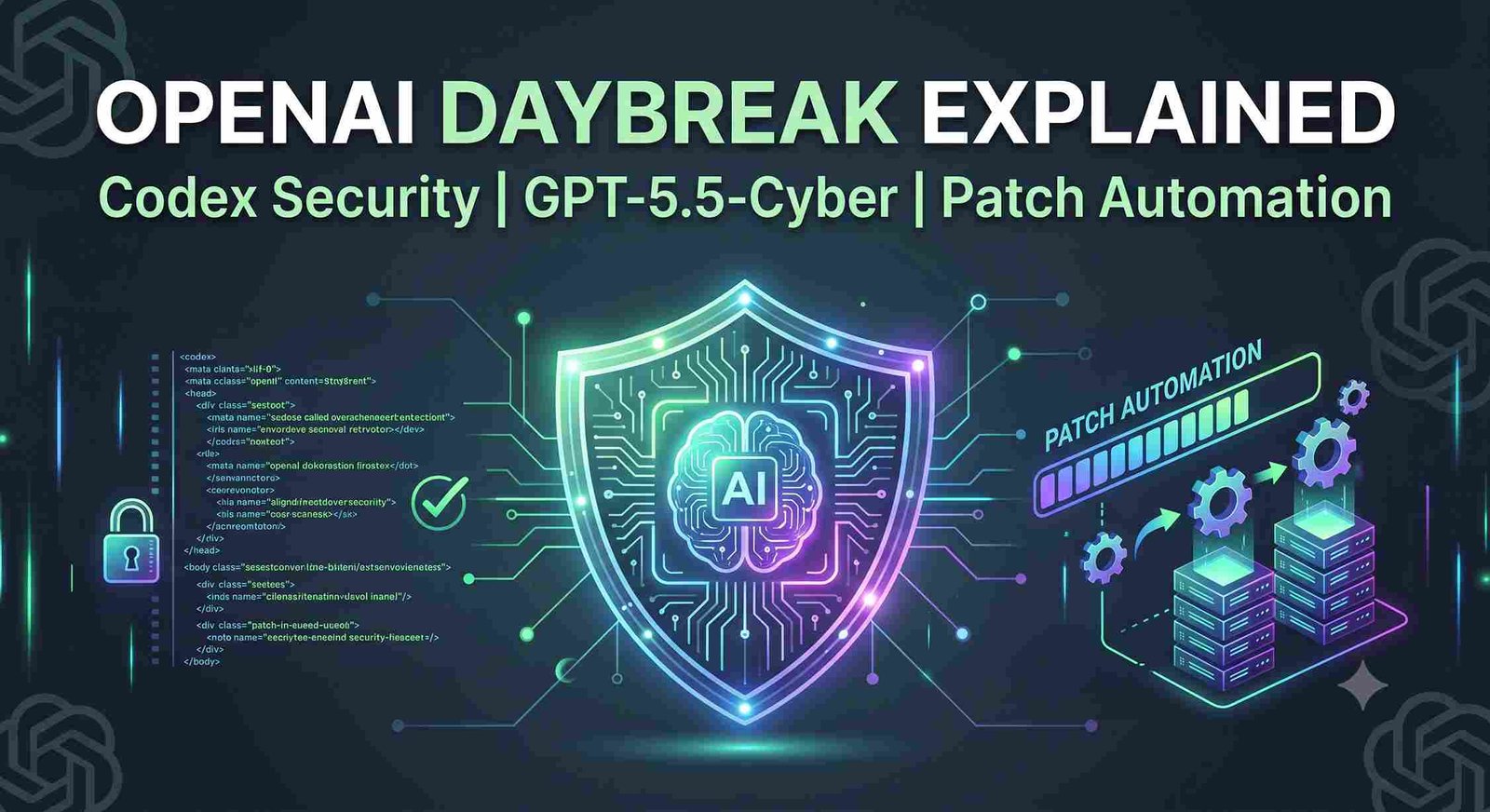
A strong featured image for this article should show a code editor, a security shield, and a patch pipeline moving from “finding” to “fix.” The visual should feel clean, technical, and trustworthy rather than dark or fear-based.
Useful visual ideas:
- A flowchart: Scan → Validate → Patch → Test → Human Review.
- A comparison graphic showing “security alerts” versus “security fixes.”
- A simple dashboard mockup with vulnerability findings being converted into pull requests.
FAQ: OpenAI Daybreak and Codex Security
What is OpenAI Daybreak?
OpenAI Daybreak is a defensive cybersecurity initiative focused on helping approved defenders find, validate, prioritize, and patch vulnerabilities with AI-assisted workflows.
What is Codex Security?
Codex Security is an OpenAI security workflow inside Codex that can scan code, review changes, generate security reports, validate findings, and help create patches for human review.
What is GPT-5.5-Cyber?
GPT-5.5-Cyber is a specialized OpenAI model for advanced, authorized defensive cybersecurity work. OpenAI says it is designed for trusted defenders and controlled workflows.
Is OpenAI Daybreak available to everyone?
No. The most advanced cyber model access is limited. Developers and maintainers can start with Codex Security and approved defensive workflows depending on availability and eligibility.
What is Patch the Planet?
Patch the Planet is an OpenAI-backed initiative, founded with Trail of Bits, that supports open-source maintainers by helping validate vulnerabilities and prepare safe patches.
Which open-source projects are involved?
OpenAI listed initial participants including cURL, Go, Python, Sigstore, and pyca/cryptography, along with more than 30 committed open-source projects.
Does Codex Security replace security engineers?
No. It is better understood as an assistant for security and development teams. Humans still need to approve scans, review findings, inspect patches, and decide what ships.
Why is patch automation important?
Because finding vulnerabilities is only half the job. Real risk goes down when teams validate issues, create safe fixes, test them, and deploy patches quickly.
Can AI security tools create false positives?
Yes. AI tools can still misunderstand code, miss context, or overstate risk. That is why evidence, tests, and human review are essential.
What should developers do now?
Developers should start treating AI security reports like code review input: useful, fast, and worth considering, but still something that needs careful technical judgement.
Final Thoughts
OpenAI Daybreak is not just another AI product announcement.
It shows where AI coding agents are going next.
The first wave helped developers write code faster.
The next wave will help teams maintain, secure, and repair code faster.
That may be less flashy than a new chatbot feature, but it is much more important for real software.
The best version of this future is not “AI finds thousands of bugs and throws them at maintainers.”
The best version is calmer and more useful: AI helps experts validate real issues, prepare better fixes, reduce noise, and keep critical software safer.
That is why Daybreak is worth watching.
If you follow AI tools, developer workflows, and software security, keep an eye on Codex Security and Patch the Planet. They may become early examples of how AI agents move from writing code to protecting it.