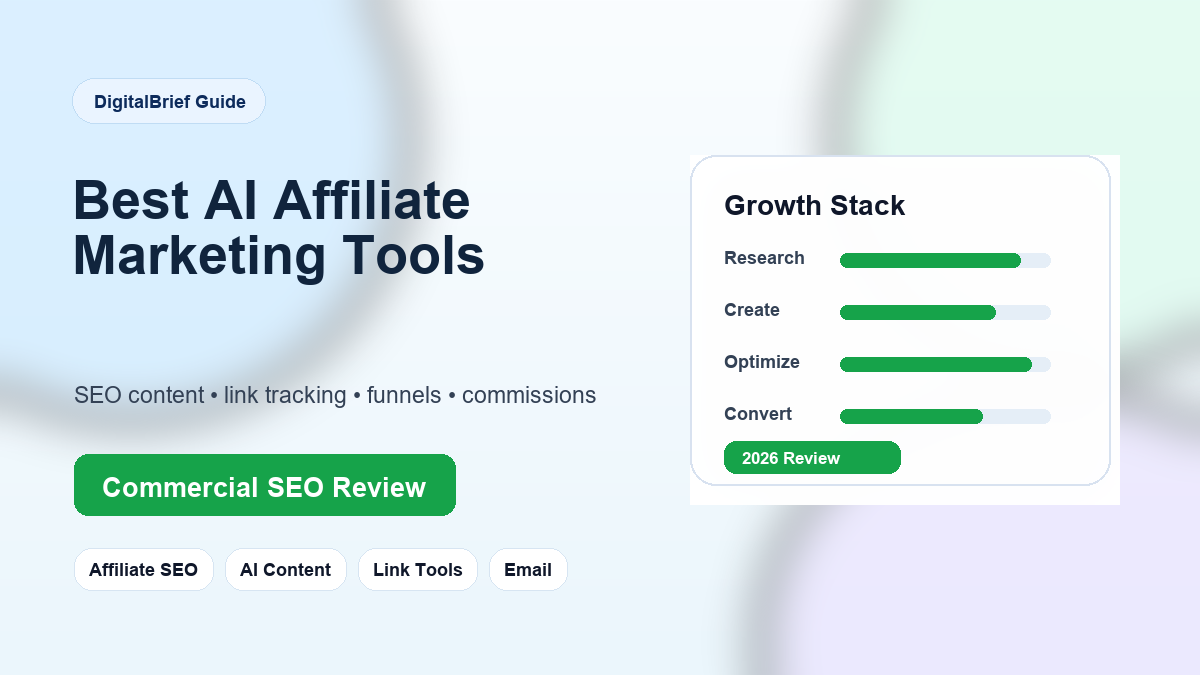
The best AI affiliate marketing tools help you research products, write better review content, create comparison pages, generate videos, manage affiliate links, build email funnels, and track what actually converts. The real win is not “AI writes everything.” The win is building a faster affiliate content system without losing trust.
Affiliate marketing has changed. Thin product roundups, copied descriptions, and generic “best tools” articles are much harder to rank and convert now. Google is looking for helpful experience, readers are tired of fake reviews, and AI search engines are pulling answers from content that looks structured, specific, and trustworthy.
That is why this DigitalBrief guide focuses on practical AI affiliate marketing tools you can use for research, SEO, writing, visuals, link tracking, and audience building.
DigitalBrief recommendation:
Do not build your affiliate business around one AI writer. Build a stack: keyword research, content optimization, product review writing, link management, email capture, and analytics.
What Are AI Affiliate Marketing Tools?
AI affiliate marketing tools are platforms that help affiliate marketers create, optimize, automate, and measure content that earns commissions. Some tools help with SEO writing. Some help with keyword research. Others help with product comparison tables, link cloaking, email automation, or content repurposing.
If you are building an affiliate site, YouTube channel, Instagram page, newsletter, or niche blog, AI tools can speed up the work. But they should not replace your judgment. The best affiliate content still needs real product understanding, honest pros and cons, clear recommendations, and useful buying guidance.
Best AI Affiliate Marketing Tools: Quick Comparison
| Tool | Best Use | Why Affiliates Use It |
|---|---|---|
| ChatGPT | Research and drafting | Fast outlines, product comparison frameworks, FAQs, email copy, and content repurposing. |
| Surfer SEO | SEO content optimization | Helps optimize affiliate reviews and listicles around SERP-driven terms and topical coverage. |
| Frase | Briefs and question research | Useful for search intent, competitor headings, and FAQ-led content planning. |
| Jasper | Brand-safe marketing copy | Good for affiliate landing pages, emails, product blurbs, and promotional campaigns. |
| NeuronWriter | Budget SEO optimization | A practical content scoring tool for niche site owners and affiliate bloggers. |
| Canva AI | Visuals and social assets | Creates pins, thumbnails, comparison graphics, and product promo images quickly. |
| Pretty Links / ThirstyAffiliates | Affiliate link management | Helps cloak, organize, track, and update links inside WordPress. |
1. ChatGPT: Best All-Purpose AI Assistant for Affiliates
ChatGPT is the most flexible tool in an affiliate marketer’s workflow. You can use it to brainstorm niche ideas, map buyer journeys, compare product categories, create content briefs, rewrite intros, build FAQ sections, and turn one review into multiple social posts.
Where ChatGPT shines is structure. Ask it to create a product comparison framework and it can give you scoring categories such as ease of use, pricing flexibility, integrations, reporting, customer support, and best-fit user. That is much better than writing a random review from memory.
Best for: outlines, review angles, email sequences, FAQ ideas, social repurposing, and content refreshes.
2. Surfer SEO: Best for Ranking Affiliate Reviews
Surfer SEO is popular with SEO writers because it helps optimize content based on what is ranking in search results. For affiliate marketers, this matters because review posts and comparison pages need more than persuasive copy. They need topical depth.
Surfer can help you see related terms, content gaps, structure opportunities, and optimization signals. It is useful for keywords like “best AI writing tools,” “best CRM for small business,” or “Jasper vs Copy.ai.”
Best for: SEO-heavy affiliate blogs, content refreshes, and commercial comparison articles.
3. Frase: Best for Search Intent and FAQ Research
Frase is useful when you want to understand what searchers expect before writing. Affiliate content often fails because it jumps straight into selling. Frase helps you slow down and answer the questions buyers actually ask.
For example, before writing a “best AI video generator” article, you can use Frase to identify recurring questions around pricing, watermarks, commercial rights, export quality, templates, and use cases.
Best for: content briefs, SERP analysis, FAQ sections, and buyer-intent content planning.
4. Jasper: Best for Polished Marketing Copy
Jasper is built for marketing teams and creators who need consistent copy. It can help with product descriptions, social posts, ad copy, email sequences, landing pages, and brand-aware content.
Affiliate marketers can use Jasper to improve the conversion layer of content: CTA sections, newsletter promos, comparison summaries, and product positioning. The key is to feed it your real notes and product experience instead of asking for generic reviews.
Best for: affiliate email campaigns, landing pages, and polished promotional copy.
5. Copy.ai: Best for Outreach and Funnel Copy
Copy.ai is useful for marketers who need content across multiple funnel stages. Affiliates can use it for short-form copy, social captions, product launch emails, lead magnets, and outreach messages.
If your affiliate model includes creator partnerships, newsletter sponsorships, or B2B affiliate offers, Copy.ai can help create messaging faster.
6. KoalaWriter: Best for Fast Affiliate Blog Drafts
KoalaWriter is popular among niche site builders because it focuses on long-form SEO articles. It can be useful for first drafts of informational and commercial content, especially if you already have a keyword plan.
Still, do not publish raw AI drafts. Add screenshots, product testing notes, pricing checks, comparison logic, and your own buying recommendation. That is what turns a draft into a useful affiliate article.
7. NeuronWriter: Best Budget-Friendly Content Optimizer
NeuronWriter is a practical option for affiliate marketers who want SEO content scoring without paying enterprise-level prices. It helps with terms, competitor structure, and content optimization.
For DigitalBrief-style niche content, tools like NeuronWriter are useful for building topical coverage across clusters: “AI SEO tools,” “AI writing tools,” “AI automation tools,” and “make money online with AI.”
8. Canva AI: Best for Affiliate Visuals
Affiliate marketers need visual trust. Canva helps create comparison graphics, Pinterest pins, YouTube thumbnails, Instagram carousels, lead magnets, and product feature visuals.
For example, a review article can become a carousel: “5 reasons I would choose Tool A over Tool B.” That visual can drive traffic back to the affiliate article.
9. CapCut: Best for Short Affiliate Videos
CapCut is useful if you promote affiliate offers through TikTok, Instagram Reels, YouTube Shorts, or Facebook Reels. Short video can work well for demos, tutorials, “before and after” workflows, and quick product comparisons.
A simple video formula: problem, tool, result, proof, CTA. Keep it honest and avoid unrealistic income claims.
10. Pictory: Best for Turning Articles Into Videos
Pictory can help turn blog content into video assets. If you already publish affiliate articles, repurposing them into YouTube or social videos can increase reach without starting from zero.
11. Semrush: Best for Affiliate Keyword Research
Semrush is not only an AI tool, but it remains useful for affiliate marketers because keyword research is the foundation of commission growth. You can find buyer keywords, competitor pages, backlink opportunities, and content gaps.
Look for keywords with commercial intent: “best,” “review,” “alternatives,” “vs,” “pricing,” “coupon,” “for small business,” and “for beginners.”
12. Ahrefs: Best for Competitor and Backlink Analysis
Ahrefs is valuable when you want to understand why affiliate competitors are ranking. You can inspect backlinks, top pages, keyword gaps, and content opportunities.
For a newer affiliate site, the smartest move is not chasing the biggest keyword. It is finding subtopics competitors missed.
13. Pretty Links: Best WordPress Link Cloaking Tool
Pretty Links helps WordPress site owners create clean, manageable affiliate links. Instead of pasting long tracking URLs everywhere, you can create branded links and track clicks.
This is important because affiliate programs change. If a link changes, you want to update it in one place, not inside 80 old blog posts.
14. ThirstyAffiliates: Best Affiliate Link Management Alternative
ThirstyAffiliates is another strong WordPress affiliate link management plugin. It helps organize links by category, cloak URLs, and manage affiliate campaigns more neatly.
15. Lasso: Best for Affiliate Product Displays
Lasso is useful for creating attractive affiliate boxes, comparison tables, and product displays. Better visual presentation can improve clicks because readers can quickly understand your recommendation.
16. Geniuslink: Best for Global Affiliate Links
Geniuslink is useful when you have traffic from multiple countries. It can route users to location-appropriate destinations, which is especially helpful for Amazon-style affiliate programs and global commerce content.
17. ConvertKit or beehiiv: Best for Affiliate Email Funnels
Affiliate SEO is powerful, but email turns one visitor into a long-term audience. ConvertKit and beehiiv are useful for newsletters, lead magnets, product recommendations, and automated email sequences.
If you are serious about affiliate marketing, build an email list early. Search traffic can fluctuate. An audience you own is more stable.
Best AI Affiliate Marketing Stack for Beginners
If you are just starting, do not buy 12 tools. Start lean:
- Research: Semrush or Ahrefs
- Writing assistant: ChatGPT
- SEO optimization: Surfer SEO, Frase, or NeuronWriter
- Visuals: Canva
- Links: Pretty Links or ThirstyAffiliates
- Email: ConvertKit or beehiiv
That stack is enough to create review articles, comparison pages, social assets, email capture, and measurable affiliate links.
Final Verdict
The best AI affiliate marketing tool depends on your bottleneck. If you need traffic, start with SEO research and content optimization. If you need conversions, improve your review structure, comparison tables, CTAs, and email follow-up. If you need scale, add bulk content workflows and link management.
My advice: use AI to speed up research and execution, but keep your recommendations human. Affiliate marketing still runs on trust.
Frequently Asked Questions
What are the best AI affiliate marketing tools?
The best AI affiliate marketing tools include ChatGPT, Surfer SEO, Frase, Jasper, Copy.ai, KoalaWriter, NeuronWriter, Canva, Semrush, Ahrefs, Pretty Links, ThirstyAffiliates, Lasso, Geniuslink, ConvertKit, and beehiiv.
Can AI help with affiliate marketing?
Yes. AI can help with keyword research, content briefs, review drafts, product comparisons, email copy, video scripts, social posts, FAQ sections, and link organization. Human editing and honest product evaluation are still essential.
What is the best AI tool for writing affiliate articles?
ChatGPT is the most flexible general assistant, while Surfer SEO, Frase, NeuronWriter, and KoalaWriter are more focused on SEO-style content creation and optimization.
Do I need link management software for affiliate marketing?
If you run a WordPress affiliate site, yes. Tools like Pretty Links and ThirstyAffiliates make it easier to manage, update, cloak, and track affiliate links across multiple posts.
Can AI affiliate content rank on Google?
AI-assisted affiliate content can rank if it is helpful, accurate, original, well-structured, and edited with real insight. Thin AI-generated product roundups with no experience or value are much harder to rank.
Which AI affiliate marketing tools are best for beginners?
Beginners can start with ChatGPT for planning, Canva for visuals, NeuronWriter or Frase for optimization, Pretty Links for link management, and ConvertKit or beehiiv for email capture.
How do affiliate marketers use AI for SEO?
Affiliate marketers use AI for keyword clustering, SERP analysis, content outlines, semantic terms, FAQ generation, meta descriptions, internal link suggestions, and content refreshes.
Is affiliate marketing still profitable in 2026?
Yes, but low-quality affiliate content is becoming less effective. The profitable approach is to build topical authority, publish honest reviews, compare products clearly, grow an email list, and track conversions carefully.