Vibe Coding in 2026: What It Means, Why It Matters, and How It’s Reshaping Software Development
Direct Answer: The Vibe Coding Revolution Vibe coding is the practice of building functional software by describing your intent in plain language and letting AI models translate that intent into working code — with the developer focusing on architecture, direction, and quality rather than syntax. In 2026, it represents the dominant paradigm of AI-first software development.
Section 1: What Is Vibe Coding? (Beyond the Buzzword)
If you’ve heard the term and assumed it was Silicon Valley slang for “winging it,” you’re not entirely wrong — but you’re missing the deeper revolution it signals.
Vibe coding, coined in early 2025 by Andrej Karpathy and rapidly adopted across the developer community, refers to a mode of software creation where you articulate what you want rather than precisely how to build it. You describe the problem in natural language — “I need a real-time inventory dashboard that flags items below reorder threshold and sends a Slack alert” — and the AI fills in the implementation details.
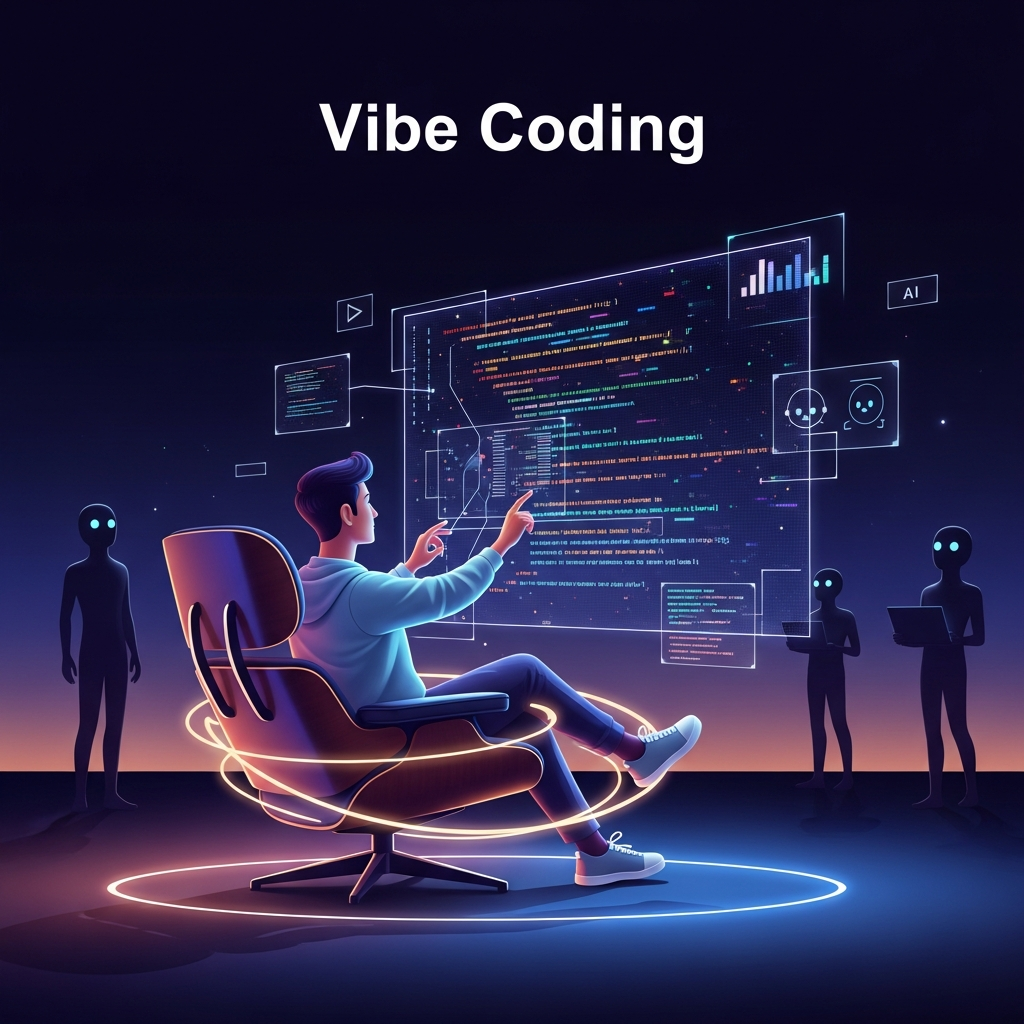
The “vibe” is your intent, your instinct, your sense of what the end result should feel like. You’re not ignoring craft — you’re operating at a higher level of abstraction. Think of it the way an architect works: they don’t swing the hammer, but every nail matters because they designed the load-bearing walls.
This isn’t autocompleted on steroids. Vibe coding in 2026 means multi-step, agentic AI systems that can scaffold an entire project, write tests, debug failures, and refactor based on your feedback — all in response to conversational prompts. The “syntax work” drops to near zero. The thinking work remains entirely yours.
The vibe coding meaning has also evolved to carry a cultural weight: it marks the boundary between developers who treat AI as a tool and those who treat it as a collaborator. The former writes a prompt and pastes the output. The latter maintains a continuous dialogue, guiding the AI through ambiguity the way a senior engineer would mentor a brilliant but inexperienced junior.
Section 2: The Agentic Shift — From Chatbots to Engineers
The year 2025 was defined by AI assistants. The year 2026 is defined by AI agents.
There is a precise distinction worth drawing here. A chatbot answers. An agent acts. When you ask ChatGPT to write a function, it writes a function. When you task an agentic coding system with “build the authentication module,” it plans the subtasks, writes the code, runs the tests, reads the error logs, fixes the failures, and reports back with a working implementation — autonomously, across multiple steps, using real tools.
This is what practitioners now call agentic engineering: the design and orchestration of AI agents that carry out complex, multi-step software engineering tasks with minimal human intervention per step. It’s not about removing humans from the loop — it’s about moving humans up the loop, from implementation to strategy.
The AI coding trends 2026 data tells the story clearly. GitHub Copilot’s agent mode, Cursor’s background agents, and emerging platforms like Devin 2.0 and Anysphere’s suite have moved the productivity curve dramatically. Developers using agentic workflows consistently report completing features in 40–70% less calendar time. Not because the AI is perfect — it isn’t — but because the iteration cycle compresses dramatically when your “compiler” can also explain the error, suggest three fixes, and implement the one you pick.
The tools enabling this shift in 2026 deserve a closer look:
Top Tools Enabling Vibe Coding in 2026
Cursor remains the flagship IDE built around AI-native workflows. Its Composer and Background Agent features allow developers to issue high-level instructions and let the tool handle multi-file edits, dependency resolution, and test runs. Cursor’s tight integration with large context window models makes it especially powerful for refactoring legacy codebases.
Anysphere (Cursor’s parent company) has pushed beyond the editor itself, developing infrastructure for persistent AI agents that can maintain context across sessions — effectively giving your AI collaborator a memory of the project’s history, decisions, and constraints.
GitHub Copilot Workspace enables full task-to-PR pipelines: describe a feature request or bug in natural language, and Copilot plans, implements, and opens a pull request. The human reviews and merges — or redirects.
Replit Agent targets non-traditional developers and rapid prototypers, compressing the journey from idea to deployed app into minutes. It’s the most aggressive expression of the “describe it and ship it” philosophy.
Windsurf by Codeium introduced “Flow” — an agentic paradigm where the AI maintains awareness of what you’re doing in real time and acts proactively, not just reactively. It anticipates your next move and prepares the scaffolding before you ask.
Section 3: The New Developer Persona — The Orchestrator
Here’s what vibe coding is not: a replacement for developers.
What it is replacing is a specific kind of developer — the one whose primary value was memorizing syntax, recalling API signatures, and grinding through boilerplate. That role is being automated. The demand for what good developers have always been — problem-solvers, system thinkers, communicators — is accelerating.
The emerging AI developer workflow looks less like “write code” and more like:
1. Define the architecture. Before any prompt is written, someone has to decide what the system should look like. Microservices or monolith? Event-driven or request-response? What are the failure modes? This is human work, and it becomes more consequential, not less, when AI is doing the implementation.
2. Prompt with precision. Effective vibe coding is not sloppy prompting. The developers who get the best results have internalized a new skill: translating ambiguous requirements into unambiguous intent. “Make it faster” is a bad prompt. “Reduce the P95 latency on the product search endpoint below 200ms by optimizing the database query and adding a Redis cache layer” is vibe coding done right.
3. Review with rigor. The AI produces code. A human reviews it — not just for correctness, but for alignment with the system’s conventions, security posture, and long-term maintainability. Code review becomes more important, not less, because AI-generated code can be confidently wrong in subtle ways.
4. Iterate through dialogue. When the output isn’t right, the orchestrator doesn’t rewrite from scratch — they redirect. “The approach is correct but this won’t scale beyond 10,000 concurrent users — revisit the locking strategy.” The dialogue IS the development process.
This persona — part architect, part editor, part product thinker — is what the industry increasingly calls the AI-native engineer. They’re not less technical. They’re technical in different ways, at different levels of the stack.
Section 4: Security in a ‘Vibe-First’ World
The enthusiasm around vibe coding has a shadow, and it deserves honest attention: AI-generated code has a reliability and security problem that scales with the autonomy you grant it.
Studies from 2025 and early 2026 consistently show that LLM-generated code contains security vulnerabilities at rates comparable to — and in some categories, higher than — code written by junior developers. SQL injection vectors, improper input validation, hardcoded credentials in test scaffolding that migrates to production, over-permissive IAM policies — these aren’t hypothetical risks. They are documented, reproducible failure patterns.
The solution is not to abandon vibe coding. The solution is to build security into the orchestration layer:
Automated static analysis (Semgrep, Snyk, CodeQL) should run on every AI-generated PR as a hard gate, not a soft warning. Treat AI-authored code as untrusted by default until it clears the same bar as human-authored code.
Dependency hygiene matters more than ever. AI models sometimes hallucinate package names. In the worst cases, attackers have pre-registered those hallucinated package names with malicious payloads — a supply chain attack vector specific to the AI coding era.
Principle of least privilege in prompts. Agentic systems that have write access to your production database, filesystem, or cloud infrastructure need the same access controls you’d apply to a new employee on day one. Scope the agent’s permissions to exactly what the task requires.
Human review is non-negotiable for security-sensitive paths. Authentication logic, payment processing, data export, and permission checks should always pass through a human expert review before deployment, regardless of how confident the AI appears in its explanation.
The security calculus of vibe coding is manageable — but only for teams who treat it as a systems problem, not an afterthought.
Section 5: The Future of SaaS and Custom Software
Zoom out far enough and vibe coding begins to look less like a developer productivity story and more like a civilizational shift in who gets to build software.
The traditional barrier to custom software has been cost and time: you needed engineers, and engineers were expensive and scarce. Vibe coding attacks both variables. A domain expert who understands their own workflow deeply — a hospital administrator, a logistics coordinator, a financial analyst — can now collaborate with an AI to build custom tooling that would have required a six-month development contract five years ago.
This has profound implications for the SaaS industry. The value proposition of many vertical SaaS products has been “we built the software so you don’t have to.” As vibe coding lowers the barrier to custom software, the products that survive will be the ones that are genuinely hard to replicate — deeply integrated with proprietary data, network effects, or regulatory moats. Generic workflow software faces an existential question.
For professional developers, the opportunity is equally large. The ability to build more — faster, at lower cost — means the viable project surface area expands enormously. Ideas that weren’t worth pursuing at $200K in development cost become worth pursuing at $20K. The market for software doesn’t shrink as AI gets better at writing it; it expands, because more software gets built.
Vibe coding is not the end of programming. It is the beginning of a phase where the definition of “programmer” expands dramatically — and the developers who thrive will be the ones who embrace that expansion rather than resist it.
Frequently Asked Questions About Vibe Coding
1. What does “vibe coding” mean?
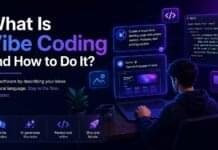
Vibe coding means building software by describing your intent in plain language and having AI translate that intent into functional code. The developer focuses on what to build and why, while the AI handles most of the how. The term was coined by Andrej Karpathy in 2025.
2. Is vibe coding the same as using GitHub Copilot?
Not exactly. GitHub Copilot is one tool that enables vibe coding, but vibe coding as a practice goes beyond single-line autocomplete. It encompasses full agentic workflows where AI plans, implements, tests, and iterates on entire features or modules based on high-level instructions.
3. Do you need to know how to code to do vibe coding?
Basic technical literacy helps significantly, but vibe coding has lowered the barrier considerably. People without formal engineering backgrounds are building functional applications. However, understanding software architecture, security principles, and debugging fundamentals remains valuable for producing reliable, production-grade results.
4. What is agentic engineering?
Agentic engineering is the practice of designing and orchestrating AI agents that perform complex, multi-step software engineering tasks autonomously — planning work, writing code, running tests, and resolving failures — with the human developer acting as director and reviewer rather than hands-on implementer.
5. What are the best vibe coding tools in 2026?
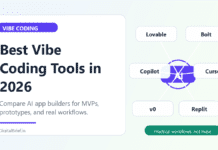
The leading vibe coding tools in 2026 include Cursor (and Anysphere’s agent infrastructure), GitHub Copilot Workspace, Replit Agent, Windsurf by Codeium, and Devin 2.0. Each targets different use cases, from enterprise codebases to rapid prototyping.
6. Is AI-generated code secure?
AI-generated code carries real security risks, including SQL injection vulnerabilities, improper input validation, and hallucinated dependency names that attackers can exploit. The mitigation is rigorous: automated static analysis, human review of security-critical paths, and strict access controls on agentic systems.
7. Will vibe coding replace software developers?
Vibe coding will not replace developers — it is already replacing specific tasks (boilerplate writing, repetitive implementation) while increasing demand for higher-order developer skills: system design, security architecture, AI orchestration, and technical judgment. Developers who adapt will be significantly more productive.
8. How does vibe coding change the software development lifecycle?
Vibe coding compresses the implementation phase dramatically, shifting developer time toward requirements definition, architecture, code review, and iteration guidance. Continuous integration and testing become more important, not less, as AI-generated code must be validated rigorously at each step.
9. What is the difference between vibe coding and prompt engineering?
Prompt engineering refers specifically to crafting effective inputs to AI models. Vibe coding is a broader development methodology that includes prompt engineering but also encompasses workflow design, AI tool selection, architectural decision-making, and quality control processes across the full software development lifecycle.
10. How do I get started with vibe coding in 2026?
Start by installing Cursor or enabling GitHub Copilot Workspace on an existing project. Begin with well-scoped tasks — “add input validation to this form,” “write unit tests for this module” — before attempting full-feature generation. Study how the AI interprets your prompts and refine your instruction style based on results. Treat your first 20 hours as deliberate practice in a new kind of thinking.