
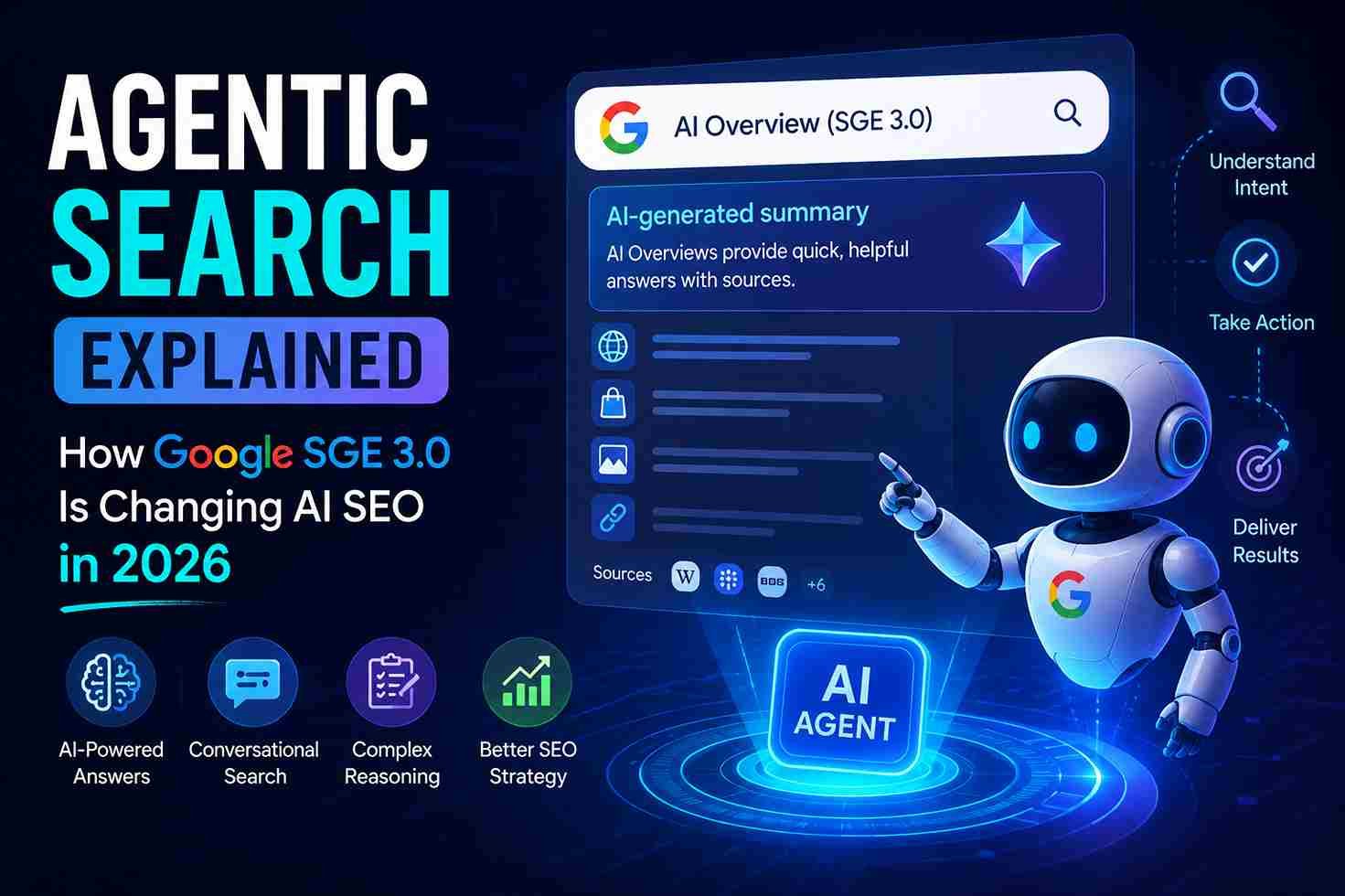
Agentic Search:As of Thursday, May 9, 2026, the digital landscape has shifted from ‘Search Engines’ to ‘Action Engines.’ With the full-scale deployment of Google SGE 3.0 (Search Generative Experience) earlier this quarter, the SEO community is grappling with a reality where AI agents, not just humans, are the primary consumers of web content. This shift toward Agentic Search—where AI autonomously navigates, synthesizes, and executes tasks across the web—has rendered traditional keyword-centric strategies obsolete. Today, we analyze the seismic shifts in ranking factors and how the latest AI SEO tools are pivoting to maintain visibility in a world of zero-click, agent-driven interactions.

Mastering Agentic Search: The Google SGE 3.0 Revolution
The Dawn of the Agentic Era (May 2026)
For over two decades, SEO was a game of visibility: getting a human to click a blue link. Today, May 9, 2026, that era is officially in the rearview mirror. With the release of Google SGE 3.0, search has become ‘Agentic.’
what is Google SGE 3.0
Google AI Overviews, previously known as SGE, is Google’s AI-powered search system that uses Gemini AI to provide instant answers, summaries, product recommendations, images, and useful links directly in search results. Instead of showing only website links, it gives users quick and conversational responses, even for complex questions. AI Overviews can understand follow-up questions, compare information, and help users make decisions faster. This shift is changing SEO in 2026 because websites now need clear, structured, and easy-to-understand content to appear in AI-generated search results.
What’s Agentic Search ?
Agentic Search refers to an environment where the search engine does not just provide a list of answers, but deploys autonomous agents to perform multi-step reasoning. If a user asks, “Plan a 3-day sustainable trip to Kyoto and book the most eco-friendly options within a $2,000 budget,” SGE 3.0 doesn’t show links; it researches, compares carbon footprints, checks real-time availability via APIs, and prepares a checkout cart.
Featured Snippet: What is the Primary Ranking Factor in 2026?
In the SGE 3.0 ecosystem, the primary ranking factor is Agentic Utility (AU). This measures how easily an AI agent can parse, verify, and execute a specific task using your content. High AU scores are granted to sites that provide clean, structured data and ‘Actionable Endpoints’ over long-form prose.
The New Ranking Factors: From Keywords to Capabilities
The May 2026 Core Update has solidified three new pillars of ranking that every AI SEO tool is now rushing to track.
1. Actionable Schema & Agent-Manifests
Gone are the days when basic Schema.org markup was enough. SGE 3.0 requires Agent-Manifests (.json-agent) files. These allow Google’s ‘Search Agents’ to understand the capabilities of a website. Can the agent check stock? Can it book a demo? Can it verify a professional credential? If the agent can’t ‘do’ anything on your site, your ranking in the generative carousel will plummet.
2. The Verifiability Index (VI)
With the explosion of synthetic content in 2025, Google has doubled down on trust. The Verifiability Index is a real-time score based on how many ‘Trusted Nodes’ (government databases, primary research papers, and verified experts) support your claims. SEO tools like Ahrefs Agent-Insight now provide a VI score alongside traditional Domain Rating.
3. Latent Reasoning Alignment (LRA) Agentic Search
SGE 3.0 uses ‘Chain-of-Thought’ processing to answer queries. Ranking now depends on how well your content aligns with the logical steps an AI takes. This is known as Latent Reasoning Alignment. Content that skips logical steps or provides ‘fluff’ fails to gain a foothold in the AI’s synthesized response.
Comparison of Ranking Paradigms: 2024 vs. 2026
| Feature | SEO 2.0 (2024) | Agentic SEO (SGE 3.0 – 2026) |
|---|---|---|
| Primary Goal | Click-Through Rate (CTR) | Agentic Utility (AU) |
| Content Focus | Readability & Keywords | API-First & Reasoning Alignment |
| Trust Signal | Backlinks (E-E-A-T) | Verifiability Index (VI) & Provenance |
| User Journey | Search -> Click -> Website | Search -> Action -> Conversion (SGE-Native) |
| Metadata | Meta Tags & Alt Text | Agent-Manifests & JSON-LD 3.0 |
How AI SEO Tools Are Pivoting
The current generation of SEO tools has undergone a total transformation. As of this week’s news, the top players have released ‘Agent-Visibility’ dashboards.
The Rise of ‘Synthetic Crawling’
Tools like Semrush AI-Gage no longer just crawl for keywords. They deploy their own ‘mini-agents’ to simulate how Google’s SGE 3.0 agent interacts with a site. They identify ‘Reasoning Gaps’ where an AI agent might get confused and provide ‘Token Optimization’ suggestions to reduce the computational cost for Google to process your page.
Top 3 AI SEO Tools in May 2026
| Tool Name | Core 2026 Feature | Primary Use Case |
|---|---|---|
| SearchGPT Insights | Cross-Platform Agent Ranking | Tracking visibility in OpenAI and Google Agents |
| Surfer Agentic v5 | Reasoning Gap Analysis | Aligning content with AI Chain-of-Thought |
| Clearscope 2026 | Verifiability Auditor | Fact-checking content against ‘Trusted Nodes’ |
The ‘Zero-Click’ Paradox and SGE-Native Conversion
A critical concern for brands in May 2026 is the SGE-Native Conversion. Google now allows users to complete purchases via ‘Action Tokens’ within the search interface. For example, if your product is featured in an SGE 3.0 recommendation, the ‘Buy Now’ button uses Google Pay to execute the transaction directly through your site’s API, bypassing the need for a user to ever visit your homepage.
This makes ‘API SEO’ the new frontier. If your checkout flow or booking system isn’t accessible to Google’s agent, you are effectively invisible to 70% of the search market.
Technical Implementation: Optimizing for the 2026 Agent
To master SGE 3.0, technical SEOs must focus on the following:
- Contextual Compression: Ensuring your most vital data is within the first 1,000 tokens of a page’s layout.
- Deterministic Responses: Avoiding ambiguous language that might lead an AI agent to ‘hallucinate’ your service offerings.
- Real-Time Data Sync: SGE 3.0 prioritizes sites with Webhook integrations that provide real-time price and availability updates over static HTML content.
Case Study:
EcoGear’s 400% Revenue Surge via Agentic OptimizationIn April 2026, outdoor retailer EcoGear faced a 40% drop in organic traffic following the SGE 3.0 beta expansion. Their traditional blog posts were being summarized, and users weren’t clicking through to the product pages.
The Strategy:
EcoGear implemented ‘Agent-Manifests’ for their entire catalog and optimized their ‘Sustainability Score’ data to be cryptographically verifiable. They transitioned from ‘Top 10 Tent’ articles to ‘Comparison Nodes’—structured data blocks that Google’s AI agent could directly ingest for its internal reasoning steps.
The Result:
While their traditional ‘clicks’ dropped by an additional 15%, their **attributed revenue** through SGE-Native conversions increased by 400%. By making it easier for the Google Agent to ‘buy’ on behalf of the user, they dominated the ‘Eco-friendly camping’ reasoning cluster, becoming the primary recommendation for over 2 million agentic queries in 30 days.
Frequently Asked Questions
Is traditional SEO dead in 2026?
Traditional SEO (optimizing for human clicks) is not dead but has become a secondary channel. The primary growth is now in AEO (Answer Engine Optimization) and Agentic Search, where you optimize for AI agents that act as intermediaries.
What is an Action Token in SGE 3.0?
An Action Token is a secure, Google-native integration that allows the AI agent to interact with your website’s backend (e.g., adding an item to a cart or booking a time slot) directly from the search results page.
How do I improve my Verifiability Index?
You can improve your VI by citing primary sources using Decentralized Identifiers (DIDs), ensuring your authors have verified ‘Knowledge Graph’ entities, and using the new ‘Provenance’ meta-tags to prove content wasn’t hallucinated.
Conclusion
Mastering search in May 2026 requires a fundamental shift in perspective. We are no longer building websites for people to browse; we are building data-rich environments for AI agents to inhabit. Google SGE 3.0 is the definitive proof that the ‘Information Age’ has given way to the ‘Action Age.’ To stay relevant, brands must move beyond surface-level content and provide the structured, verifiable, and actionable data that fuels the agentic ecosystem. Those who fail to adopt Agent-Manifests and Action Tokens by the end of 2026 will find themselves in the ‘Dark Web’ of the unsearchable.


[…] Agentic Search Explained: How Google SGE 3.0 Is Changing AI SEO in 2026 […]