
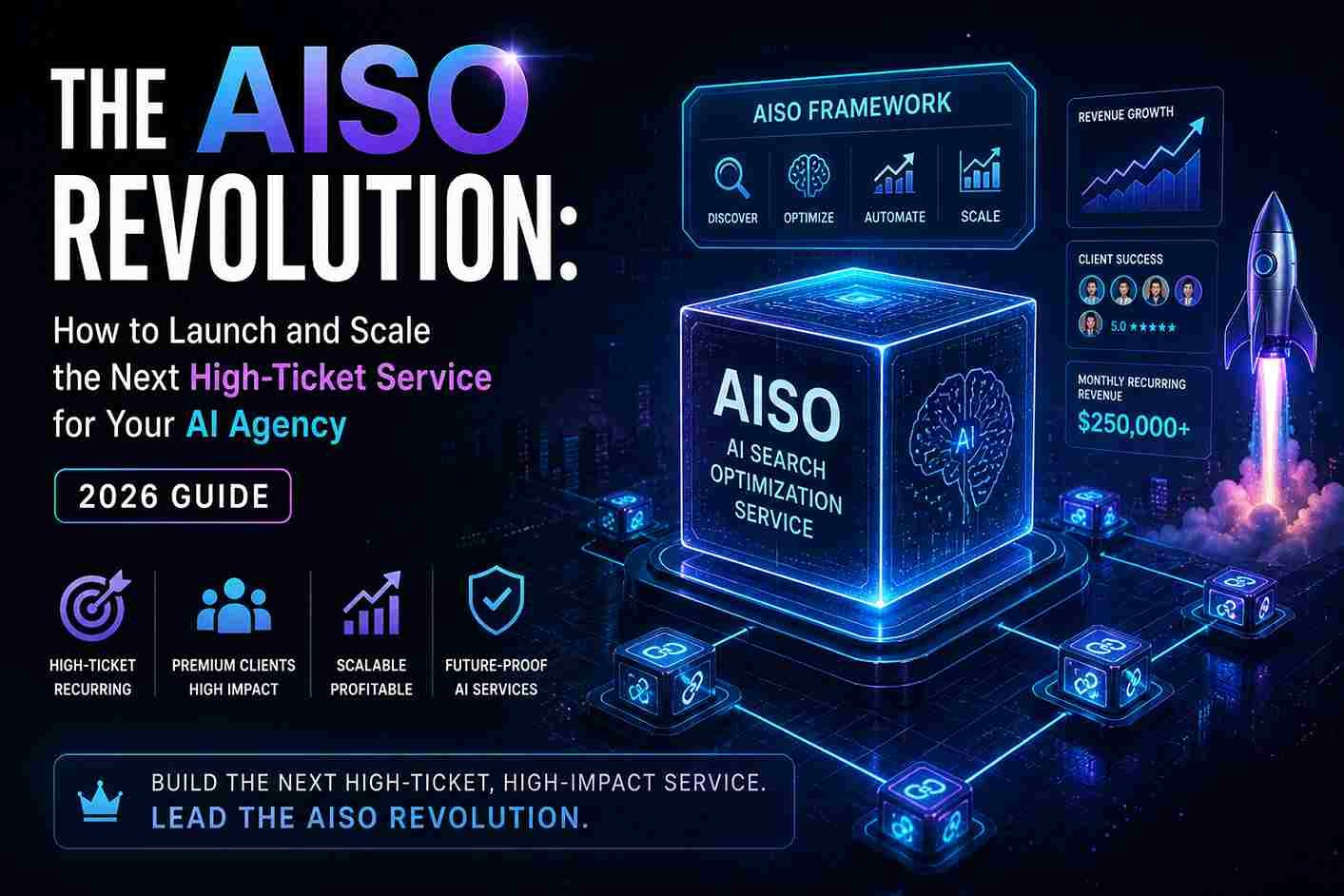
The AISO Revolution: As of Saturday, May 2, 2026, the digital landscape has shifted fundamentally from ‘searching’ to ‘answering.’ Traditional SEO, once the backbone of digital marketing, has been superseded by AISO—AI Search Optimization. With over 70% of consumer queries now being resolved directly within generative interfaces like OpenAI Search, Google Gemini, and Perplexity, the opportunity for AI agencies to provide high-ticket AISO services has never been greater. This guide explores how to capitalize on the transition from blue links to conversational citations.

The AISO Revolution: How to Launch and Scale the Next High-Ticket Service for Your AI Agency
The Dawn of the Answer Engine Era
In May 2026, the ’10 blue links’ model is a relic of the past. Users no longer browse; they consult. Whether it’s via an AR headset, a voice assistant, or a dedicated AI search portal, the goal of the user is to receive a synthesized, factual, and actionable answer. For brands, being the source of that answer is the difference between hyper-growth and obsolescence.
AISO (AI Search Optimization)—also known as Answer Engine Optimization (AEO) or Generative Engine Optimization (GEO)—is the strategic process of ensuring a brand’s data is ingested, prioritized, and cited by Large Language Models (LLMs) during the generation process. For AI agencies, this represents the most lucrative service frontier since the birth of PPC.
Featured Snippet: What is AISO?
AISO (AI Search Optimization) is the technical and creative practice of optimizing digital content so that generative AI models (like ChatGPT, Gemini, and Claude) accurately retrieve, cite, and recommend a specific brand or service in response to user queries. Unlike traditional SEO, which targets search engine algorithms, AISO targets the weights, RAG systems, and context windows of generative models.
1. Evolution & Origin: From Keywords to Contextual Intelligence
To understand the AISO revolution, we must look at the three distinct epochs of digital discovery:
The Discovery Epochs
- The Keyword Era (1998–2012): Search engines relied on exact match keywords and backlink volume. Content was written for crawlers first, humans second.
- The Semantic Era (2013–2023): Google’s Hummingbird, BERT, and MUM updates shifted focus to ‘intent.’ Knowledge Graphs began providing direct answers, but traffic still flowed to websites.
- The Generative Era (2024–Present): With the launch of SearchGPT and the integration of Gemini into the core Google ecosystem, the ‘Search Engine’ evolved into an ‘Answer Engine.’ The AI now consumes the content, synthesizes it, and provides the solution within the interface, often citing sources via footnotes.
In 2026, the ‘AISO’ term became standardized as agencies realized that simply ‘ranking’ wasn’t enough—you had to be ‘synthesized.’
Comparison: Traditional SEO vs. AISO (2026 Standards)
| Feature | Traditional SEO (Legacy) | AISO (The New Standard) |
|---|---|---|
| Primary Goal | Rank #1 on Google SERP | Be the #1 Cited Source in AI Responses |
| Success Metric | Click-Through Rate (CTR) | Brand Mention & Citation Share (MCS) |
| Content Focus | Keyword Density & LSI | Factual Accuracy & Structured Data |
| Authority Signal | Backlinks & Domain Authority | Contextual Relevance & ‘Truthfulness’ |
| Optimization Target | Web Crawlers (Googlebot) | LLM Training Sets & RAG Systems |
| User Intent | Information Retrieval | Task Completion / Synthesis |
2. The High-Ticket AISO Service Framework
Scaling an AI agency to high-ticket status requires moving beyond ‘GPT-wrapper’ services. You must offer a comprehensive AISO ecosystem. Here is how leading agencies are structuring their $10k+/mo packages in 2026:
Phase 1: The AI Visibility Audit
Using proprietary tools, agencies scan how various models (GPT-5, Claude 4, Gemini 2.0 Ultra) perceive a brand.
- Citation Analysis: How often is the brand cited for core industry queries?
- Sentiment Mapping: Is the AI describing the brand’s products accurately or hallucinating negative traits?
- Gap Analysis: Which competitors are currently ‘winning’ the AI context window?
Phase 2: RAG-Ready Content Infrastructure
Retrieval-Augmented Generation (RAG) is how AI models fetch real-time data. To scale, your agency must optimize the client’s ‘Digital Footprint’ for RAG ingestion.
- Structured Data 2.0: Implementing advanced Schema.org markups that include ‘Argumentation’ and ‘Evidence’ tags.
- Knowledge Graph Integration: Ensuring the brand is correctly indexed in Wikidata, DBpedia, and niche-specific industry ontologies.
- The ‘Source’ Strategy: Creating high-authority PDF whitepapers and technical docs that are easily parsable by AI agents.
Phase 3: Synthetic Persona Testing
This is a new service for 2026. Agencies use ‘Synthetic Personas’—automated AI agents—to simulate thousands of user queries. This tests whether the brand appears in the response across different geographic, demographic, and intent-based contexts.
3. The 2026 AISO Tool Stack for Agencies
To deliver high-ticket results, your agency needs a specialized tech stack. Gone are the days of just using Ahrefs or SEMRush.
| Tool Category | 2026 Industry Leader | Function |
|---|---|---|
| Model Visibility Tracking | CiteMonitor AI | Tracks brand mentions across all LLM outputs in real-time. |
| RAG Optimization | LlamaIndex Enterprise | Manages how brand data is structured for AI retrieval. |
| Sentiment & Bias Auditing | TruthEngine | Detects if AI models have developed a ‘bias’ against a brand. |
| Automated Knowledge Injection | VectorFlow | Synchronizes website updates directly into major vector databases. |
| Synthetic Testing | PersonaLab | Runs massive query simulations to check for AI visibility gaps. |
4. Real-World Case Study: SolarStream Tech (Q1 2026)
Client: SolarStream Tech, a mid-sized B2B solar hardware provider.
Problem: Despite ranking #3 on Google for ‘commercial solar panels,’ they were receiving 0% mentions in Perplexity and SearchGPT queries related to ‘most reliable commercial solar providers 2026.’
The AISO Strategy:
- Contextual Correction: We discovered that AI models were pulling outdated 2023 data from a defunct forum. We flooded high-authority industry wikis with updated, verified technical specs.
- Citation Engineering: We secured three ‘Deep Citation’ placements in industry-leading journals that are primary sources for the ‘SearchGPT’ index.
- Schema Overhaul: We implemented ‘Product Evidence’ schema, linking customer reviews directly to technical claims.
Results (After 4 Months):
- Citation Share: Increased from 0% to 42% for ‘Top Tier Solar’ queries.
- Inbound Lead Quality: 65% increase in ‘AI-Referral’ leads (users who arrived after asking an AI for a recommendation).
- Revenue: The client signed a $2M contract directly attributed to a ‘Gemini-suggested’ comparison table.
5. How to Price and Sell AISO Services
Selling AISO is different from selling SEO. You aren’t selling ‘traffic’; you are selling ‘Authority’ and ‘Future-Proofing.’
- The ‘Loss of Voice’ Pitch: Show the CEO a screen recording of an AI recommending their competitor. The psychological impact of being ‘invisible’ to AI is a powerful closer.
- Performance-Based Retainers: Charge a base fee ($5k) plus a bonus for ‘Citation Share’ milestones.
- The AI Data Guard: Position AISO as a defensive service—protecting the brand from hallucinations and misinformation.
6. Semantic Keywords and LSI Integration
For the AEO framework to be effective, agencies must focus on these semantic clusters:
- Entity-Based Optimization: Focus on the ‘Brand as an Entity.’
- Vector Embeddings: Understanding how content is converted into numbers for AI memory.
- Zero-Click Conversion: Optimizing for the answer, not the link.
- LLM Sensitivity: How small changes in phrasing change the AI’s recommendation engine.
Case Study: The SolarStream Tech case study demonstrates a shift from traditional SERP visibility to ‘Citation Share.’ By optimizing the brand’s ‘Digital Provenance’—the verifiable history and authority of its online data—the agency was able to move the brand from 0% AI visibility to becoming a market leader in AI-generated recommendations within 120 days. The core of the success was ‘Vector Database Injection,’ ensuring the brand’s most recent technical whitepapers were the primary sources for RAG-based search queries.
Frequently Asked Questions
Is SEO dead because of AISO?
No, but it has evolved. While traditional Google Search still exists, the high-intent traffic has moved to AI interfaces. SEO is now a subset of AISO, focusing on providing the ‘raw data’ that AI models consume.
How do you measure AISO success?
Success is measured through ‘Citation Share’ (how often you are cited compared to competitors), ‘Sentiment Accuracy’ (how correctly the AI describes you), and ‘Referral Attribution’ via AI-generated tracking links.
Which AI models should we optimize for first?
As of May 2026, the ‘Big Three’ are OpenAI Search (ChatGPT), Google Gemini (SGE), and Perplexity. However, niche models in legal, medical, and tech are becoming increasingly important for B2B AISO.
Conclusion
The AISO revolution is not a distant trend; as of May 2, 2026, it is the operational reality of the global economy. Agencies that continue to sell ‘keywords and backlinks’ will see their margins vanish. The future belongs to the ‘Architects of Context’—those who can ensure that when a human asks an AI for a solution, their client’s brand is the only logical answer. By 2027, we predict that AISO will be a $50B industry, with specialized ‘Model Relations’ departments becoming as common as PR firms. Start building your AISO infrastructure today, or risk being filtered out of the world’s collective intelligence.



[…] The AISO Revolution: How to Launch and Scale the Next High-Ticket Service for Your AI Agency (2026 G… […]