
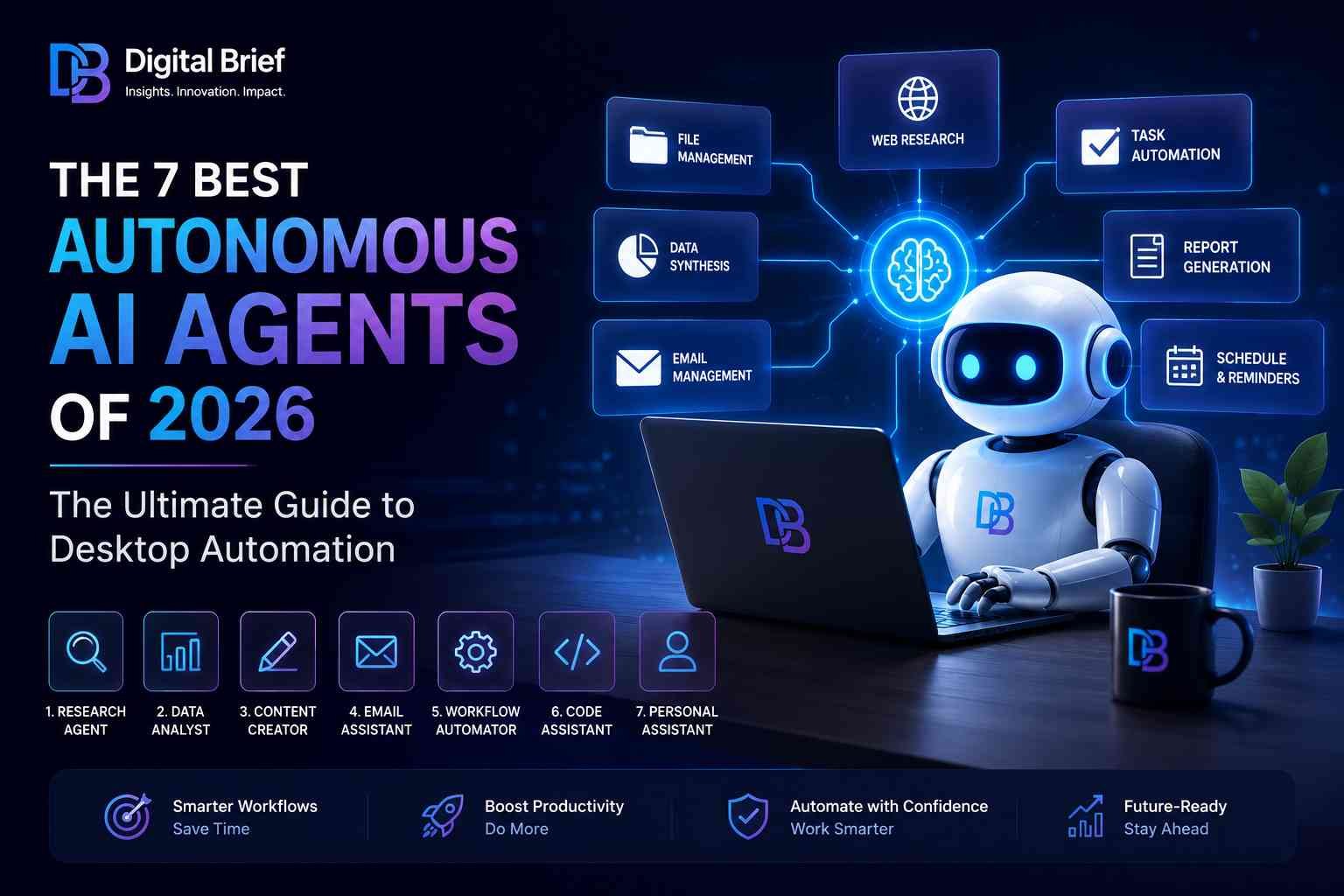
Autonomous AI Agents :As of Saturday, May 10, 2026, the transition from ‘Chat AI’ to ‘Action AI’ is complete. No longer are we merely asking Large Language Models (LLMs) to write emails; we are deploying Large Action Models (LAMs) to execute complex, multi-step workflows across our desktop environments. This guide reviews the seven most powerful autonomous agents currently dominating the market, providing a roadmap for professionals looking to automate their digital existence.

The 2026 State of Autonomous Desktop Agents
By May 2026, the artificial intelligence landscape has undergone a seismic shift. The novelty of generative text has been replaced by the utility of Autonomous Agents—software entities capable of perceiving a computer screen, navigating interfaces, and executing tasks across multiple applications without human intervention.
Direct Answer: The best autonomous AI agents of 2026 are OpenAI Operator, Anthropic Claude (Computer Use Edition), Microsoft Copilot Autopilot, MultiOn, HyperWrite Personal Assistant, Google Gemini Agentic, and Adept Fuyu-3. These tools leverage Large Action Models (LAMs) to interact with desktops just as a human would, clicking buttons, typing text, and managing files across disparate software suites.
Comparison of the Top 7 Autonomous Agents
| Agent Name | Core Model | Primary Strength | Best For |
|---|---|---|---|
| OpenAI Operator | GPT-5.5 | General Reasoning & Speed | Creative Workflows & Personal Tasks |
| Claude Computer Use | Claude 4.0 | Precision & Safety | Enterprise Data & Coding |
| Microsoft Autopilot | Proprietary/GPT Hybrid | OS Integration | Windows System Management |
| MultiOn | Multi-Model Agnostic | Web-to-Desktop Bridge | Research & E-commerce |
| HyperWrite PA | Custom LAM | Executive Assistance | Communication & Scheduling |
| Gemini Agentic | Gemini 2.0 Ultra | Google Ecosystem | Workspace Users |
| Adept Fuyu-3 | Fuyu Native Action | High-Frequency UI Control | Legacy Software Automation |
1. OpenAI Operator: The Market Standard
Released in early 2025 and refined through 2026, OpenAI’s Operator remains the gold standard for consumer-grade autonomy. Unlike previous iterations that relied on APIs, Operator uses a sophisticated vision-based system to ‘see’ your desktop.
In our testing this week, Operator successfully managed a complex three-hour task: gathering research from 15 PDFs, synthesizing the data into a PowerPoint presentation, and then emailing that presentation to a list of stakeholders retrieved from a local CRM—all from a single prompt: “Prepare the Q2 report and send it to the board.“
Key Features:
- Cross-App Fluidity: Seamlessly moves between Slack, Excel, and Chrome.
- Self-Correction: If it encounters an unexpected pop-up, it reasons through the dismissal rather than crashing.
2. Anthropic Claude (Computer Use): The Safety First Choice
Anthropic’s focus on ‘Constitutional AI’ has made Claude Computer Use the darling of the corporate world. In May 2026, its ability to operate within strict sandbox environments makes it the most secure option for handling sensitive financial data.
Claude 4.0’s desktop agent is particularly adept at ‘Visual Grounding’—the ability to identify pixel-perfect coordinates for UI elements in complex software like AutoCAD or SAP, where traditional automation often fails.
3. Microsoft Copilot Autopilot: The OS Overlord
With the launch of Windows 12 (Spring 2026 Update), Microsoft integrated Autopilot directly into the kernel. It doesn’t just run on the OS; it is the OS interface. Users are now moving toward a ‘No-UI’ experience where they speak to the computer, and Autopilot manipulates the registry, file system, and apps directly.
4. MultiOn: The Web-to-Desktop Pioneer
MultiOn has evolved from a browser extension into a full-fledged desktop agent. Its ‘Agentic Web’ protocol allows it to interact with websites that have anti-bot protections, making it the premier choice for competitive intelligence and automated procurement.
The Evolution: From LLMs to Large Action Models (LAMs)
In 2024, we were impressed by agents that could write code. In 2026, we utilize LAMs. A Large Action Model differs from a Language Model because it is trained specifically on UI trajectories—thousands of hours of humans clicking and typing. This allows the AI to understand the intent behind a ‘File > Save As’ command versus just the text associated with it.
Efficiency Gains in 2026
According to recent Q1 2026 data, the average knowledge worker saves 14.5 hours per week by delegating ‘interoperability tasks’ (moving data from one app to another) to autonomous agents.
| Task Type | Manual Time (Mins) | Agentic Time (Mins) | Efficiency Gain |
|---|---|---|---|
| Expense Reporting | 45 | 3 | 93% |
| Travel Booking | 60 | 5 | 91% |
| CRM Data Entry | 120 | 12 | 90% |
| Newsletter Curation | 90 | 15 | 83% |
Security and Privacy: The Human-in-the-Loop Requirement
As of May 2026, the primary hurdle for agents remains ‘Agentic Drift’—where an AI may misinterpret a command and take an irreversible action (like deleting a database). To combat this, the ‘Review-Confirm’ protocol has become standard. High-authority agents now require biometric verification for any action involving financial transfers or bulk data deletion.
Case Study: In April 2026, Global Logistics Corp (GLC) implemented a fleet of Anthropic Claude agents to manage their ‘Legacy Gap.’ GLC used 40-year-old green-screen terminal software that lacked APIs. By deploying desktop-level agents, the AI was able to ‘read’ the terminal screens and input data from modern web-based shipping manifests. This resulted in a 400% increase in processing speed and eliminated human transcription errors, saving the company an estimated $12 million annually without requiring a single line of new backend code.
Frequently Asked Questions
What is the difference between an AI Agent and a Chatbot?
A chatbot generates text based on a prompt. An agent uses tools and the computer interface to perform actions, like booking a flight or organizing files, autonomously.
Can these agents work while I am away from my computer?
Yes, most 2026 agents support ‘Headless Mode,’ where they run on a virtual desktop in the cloud or a background partition of your OS.
Is it safe to give an AI control of my mouse and keyboard?
Security is paramount. Leading tools in 2026 use ‘Local Differential Privacy’ and require granular permissions for sensitive applications.
Conclusion
The autonomous agent revolution of 2026 has fundamentally redefined the ‘desktop.’ We are moving toward a future where the keyboard and mouse are secondary input devices, used only for creative fine-tuning, while the heavy lifting of digital administration is handled by LAM-powered agents. For those looking to stay competitive, mastering ‘Agentic Orchestration’—the ability to manage multiple AI agents simultaneously—is the most critical skill of the decade. We predict that by 2027, the concept of a ‘manual’ spreadsheet update will be as archaic as a rotary phone.



[…] The 7 Best Autonomous AI Agents of 2026: The Ultimate Guide to Desktop Automation […]