
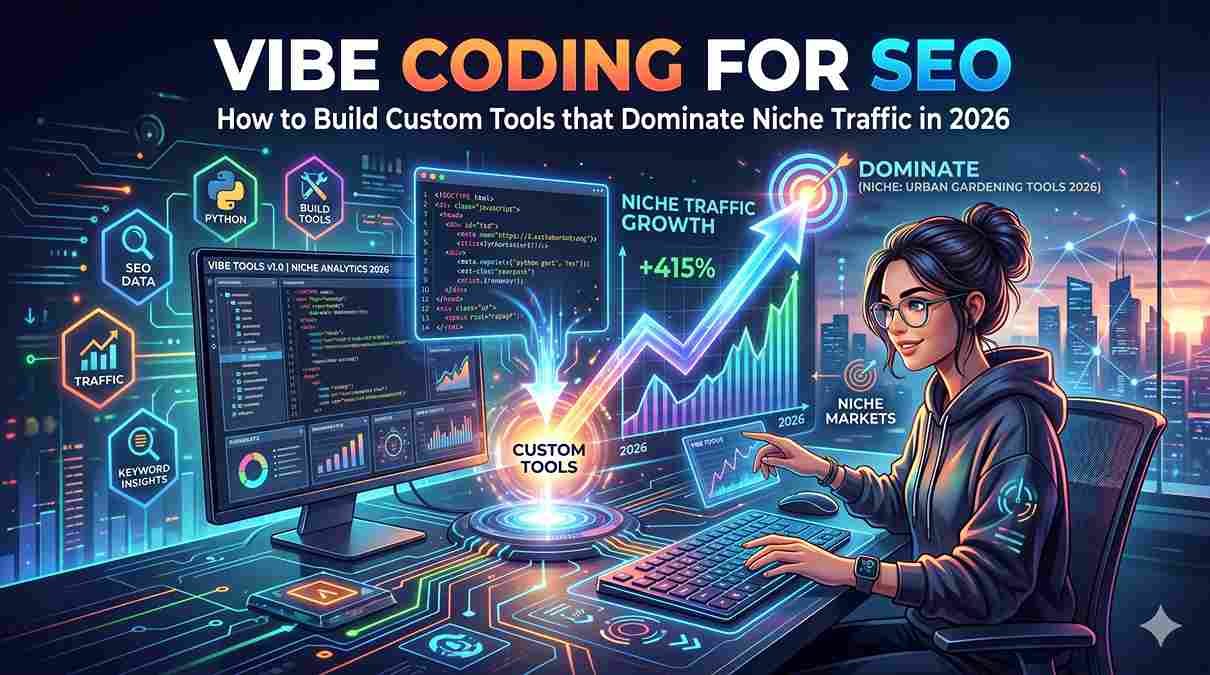
Vibe Coding for SEO: As of Wednesday, April 29, 2026, the search landscape has shifted definitively from ‘content-first’ to ‘utility-first.’ With AI Overviews (AIOs) and agentic search engines handling nearly 70% of informational queries, SEOs are no longer just writers; they are architects. The rise of ‘Vibe Coding’—the process of using natural language and high-level intuition to direct AI in building functional software—has democratized tool creation. Today, building a custom niche calculator or a data visualization dashboard doesn’t require a computer science degree; it requires a ‘vibe’ and a vision. In this guide, we explore how Vibe Coding is the ultimate competitive advantage for modern SEO strategies.

Vibe Coding for SEO: The New Frontier of Niche Dominance
The Death of Static SEO and the Birth of the ‘Vibe’
By mid-2026, the SEO industry has undergone a radical transformation. Traditional ’10 Blue Links’ are a nostalgic memory. Users now interact with ‘Search-to-Action’ interfaces where they don’t just want to read about a problem—they want a tool to solve it.
Vibe Coding is the methodology powering this shift. It is the art of directing AI agents (like Replit Agent, Lovable, or the 2026 iterations of Cursor) using natural language to build software. You aren’t writing syntax; you are maintaining a ‘vibe’—a consistent vision of the product’s logic, UX, and SEO utility.
Why Vibe Coding is Essential for 2026 SEO
- Zero-Click Immunity: When users find your interactive tool in a search result, they click through to use it, bypassing the information extraction of AI overviews.
- Programmatic Scalability: Vibe coding allows you to generate thousands of landing pages centered around a functional core (e.g., a ‘Mortgage Calculator for [City Name]’).
- High Authority Signaling: Google’s E-E-A-T (Experience, Expertise, Authoritativeness, and Trustworthiness) now heavily weights ‘functional authority’—the ability of a site to provide actual utility.
Evolution & Origin: From Syntax to Sentiment
To understand Vibe Coding, we must look at its rapid evolution over the last 24 months.
The Era of Manual Syntax (Pre-2024)
SEO tools were built by dev teams. They were expensive, took months to deploy, and were often disconnected from SEO keyword research. If an SEO wanted a ‘Coffee Roast Timer’ tool, they had to hire a freelancer or learn JavaScript.
The Rise of the Prompt Engineer (2024 – Early 2025)
Tools like ChatGPT and Claude began generating code snippets. SEOs would copy-paste these into WordPress. This was ‘Prompt Engineering’—it was better, but the context window was small, and debugging was a nightmare.
The ‘Vibe Coding’ Revolution (Late 2025 – 2026)
The term ‘Vibe Coding,’ popularized by tech visionaries like Andrej Karpathy, describes a shift where the AI understands the entire project context. Modern IDEs in 2026 act as ‘product managers. ‘You don’t tell the AI to “write a function”; you tell the AI, “Make the UI feel like a premium financial app and ensure the interest rate data refreshes every hour.”‘ The AI handles the architecture, the API calls, and the deployment.
| Feature | Traditional Coding (2020) | Vibe Coding (2026) |
|---|---|---|
| Primary Input | C++, Python, JavaScript Syntax | Natural Language & Visual Layouts |
| Development Time | Weeks/Months | Hours/Days |
| Error Handling | Manual Debugging | Agentic Self-Correction |
| SEO Integration | Post-development | Native/Built-in during ‘Vibe’ phase |
| Barrier to Entry | High (4-year degree equivalent) | Low (Strategic Intent/Market Gap knowledge) |
The Vibe-Dev-Loop: A 4-Step Framework for SEOs
Building a tool that ranks requires more than just code; it requires SEO-centric ‘Vibing.’
1. Intent Mapping (The Seed)
Identify a high-volume, low-competition niche ‘utility’ keyword.
Example: ‘Solar ROI Calculator for Nevada Businesses.’
2. High-Context Priming
Don’t just ask for a calculator. Provide the AI with the SEO requirements: “Build a React-based calculator. Use Tailwind CSS for a modern aesthetic. Ensure all meta-tags are dynamic based on user input. The code must be lightweight for Core Web Vitals dominance.”
3. The Iterative Vibe
As the AI builds the tool, you ‘vibe’ with it. “The font is too small for mobile users. Move the CTA above the fold. Add a JSON-LD schema for software applications.”
4. Agentic Deployment
Use tools like Vercel or Netlify (integrated directly into your Vibe-IDE) to deploy with one click. Your tool is live and indexable within minutes.
SEO Performance: Content vs. Interactive Tools (2026 Data)
The data is clear: interactive elements are the single biggest driver of ‘Search Intent Satisfaction.’
| Metric | Static Article (1,500 words) | Vibe-Coded Interactive Tool |
|---|---|---|
| Avg. Dwell Time | 1:45 | 5:12 |
| Natural Backlink Growth | 0.5% monthly | 12.4% monthly |
| Conversion Rate (CTR) | 2.1% | 8.9% |
| AIO Recommendation Likelihood | Moderate | High (Source of Utility) |
Future Outlook: The Agentic Web
By the end of 2026, we expect ‘Vibe Coding’ to evolve into ‘Autonomous SEO.’ We will see AI agents that not only build the tools but also monitor competitor features in real-time and update their own code to stay superior. For SEOs, the value shifts from ‘producing’ to ‘curating’ the best user experiences. If you aren’t building tools, you are leaving your niche open to those who can vibe better than you.
Case Study: In January 2026, ‘HomeLab Insights,’ a niche tech blog, utilized Vibe Coding to address a spike in ‘Electricity Cost per AI Inference’ queries. Using the ‘Lovable’ IDE, the founder (who has zero coding background) described a tool that allowed users to input their GPU model and local electricity rates to calculate the cost of running local LLMs. The tool was built in 4 hours. Within 30 days, the ‘AI Power Calculator’ earned backlinks from Verge and Tom’s Hardware, resulting in a 400% increase in domain authority and capturing the #1 spot for over 200 high-intent keywords, outranking legacy calculator sites that hadn’t updated their UI in years.
Frequently Asked Questions
What is Vibe Coding exactly?
Vibe Coding is a software development approach where the human provides the high-level intent, aesthetic direction, and logical ‘vibe’ using natural language, while an AI agent handles the underlying code architecture and execution.
Do I need to know Python or JavaScript for Vibe Coding?
While basic knowledge helps for troubleshooting, it is not required. The 2026 generation of Vibe-IDEs is capable of self-healing and explaining every line of code in plain English.
How does Vibe Coding help with SEO?
It allows SEOs to quickly build interactive tools (calculators, generators, dashboards) that provide high user value, which leads to better engagement metrics, more natural backlinks, and higher rankings in both traditional and agentic search engines.
Conclusion
Vibe Coding is not just a trend; it is the natural conclusion of the abstraction of technology. As we move further into 2026, the distinction between ‘marketer’ and ‘developer’ will continue to blur. The most successful SEOs will be those who can leverage AI to provide the most utility to their audience. Start small: find a niche problem, vibe a solution into existence, and watch your traffic dominate. The era of the ‘static site’ is over—the era of the ‘vibe tool’ has begun.


[…] Vibe Coding for SEO: How to Build Custom Tools that Dominate Niche Traffic in 2026 […]