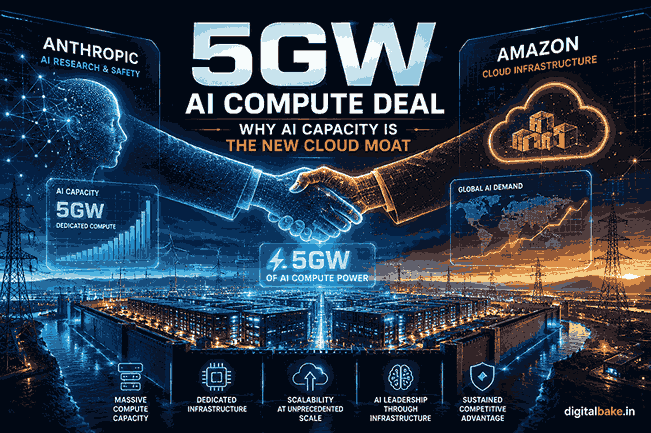
Let’s dive into Anthropic And Amazon’s 5GW Compute Deal
Anthropic and Amazon’s expanded compute partnership is one of the biggest AI infrastructure stories of 2026. The agreement gives Anthropic access to up to 5 gigawatts of new capacity for training and deploying Claude, while deepening its reliance on AWS technologies and Amazon custom silicon roadmap.
This is not just a supplier agreement. It is a sign that AI capacity has become a product feature. A model is only useful if it is available, fast, reliable, regionally accessible, and economically sustainable.
Why This Topic (Let’s dive into Anthropic And Amazon’s 5GW Compute Deal )Is Trending
The compute race is becoming the AI race. Model quality still matters, but capacity increasingly determines who can serve enterprise demand without slowdowns, throttling, or unpredictable costs.
Search intent is news-driven and strategic. Readers want to understand what the Anthropic-Amazon deal means, why gigawatt-scale compute matters, and how it affects Claude, AWS, and enterprise AI buyers.
What Readers Need To Know
The deal connects three competitive layers: frontier models, cloud infrastructure, and custom AI chips. That combination is becoming a moat.
| Signal | What It Means | SEO Angle |
|---|---|---|
| Up to 5GW of compute | AI scale is now discussed in power-infrastructure terms | Breaking tech news and AI infrastructure keywords |
| Long-term AWS commitment | Model companies need durable cloud capacity | Cloud AI and enterprise procurement intent |
| Trainium roadmap | Custom silicon is central to AI economics | AI chip and compute race cluster |
Key Features And Business Implications
The deal includes expanded capacity for Claude training and inference, deeper AWS alignment, Trainium-related infrastructure, and improved access through Amazon Bedrock for enterprise customers.
For enterprises, the implication is direct: AI vendor selection should include infrastructure reliability, not just benchmark comparisons.
Best Use Cases
This deal matters most for high-scale AI workloads where reliability and latency affect daily operations.
| Use Case | Best Fit | Expected Outcome |
|---|---|---|
| Claude on AWS | AWS-standardized enterprises | Easier procurement and governance |
| High-volume inference | Customer support and internal copilots | Better capacity planning |
| Frontier model training | Anthropic research and product teams | More room for model improvement |
Benefits
Anthropic gets scale and cloud integration. Amazon gets a major AI partner and demand for its custom silicon. Customers may benefit from more reliable Claude capacity and simpler AWS-based adoption.
Pros And Cons
| Pros | Cons |
|---|---|
| Strengthens Claude capacity | Deepens cloud dependency |
| Supports AWS AI strategy | Large infrastructure projects can face delays |
| Improves enterprise distribution | Cloud-model coupling may increase lock-in |
Comparison: Old Approach Vs 2026 AI Approach
| Old Approach | 2026 AI Approach | Why It Matters |
|---|---|---|
| AI vendors compete mostly on benchmarks | Vendors compete on capacity and reliability | Production customers need uptime |
| Cloud treated as backend plumbing | Cloud becomes AI distribution channel | Procurement and governance matter |
| Chip supply hidden from buyers | Custom silicon becomes strategic | Affects cost and availability |
Industry Impact
The deal raises pressure on every major AI platform company. It shows that frontier AI will be shaped by infrastructure alliances as much as research talent.
Cloud marketplaces will become more important because enterprises want model access through existing identity, billing, security, and compliance systems.
Strategic Analysis For 2026
The reason this topic deserves close attention is that it sits at the intersection of product adoption, platform competition, and operational change. A surface-level reading would treat it as another AI announcement. A stronger reading sees it as evidence of a larger market shift: AI is moving from isolated experimentation into the systems where business work is planned, measured, reviewed, and governed.
For readers, the practical takeaway is to evaluate Anthropic Amazon 5GW compute deal through a workflow lens. The question is not only whether the technology is impressive. The better question is whether it removes friction from a recurring business process, whether it can be adopted safely by real teams, and whether the output quality can be measured over time.
That is where many companies still struggle. They buy AI access before defining the work. They encourage usage before defining approved data. They celebrate early demos before building review loops. The result is often fragmented adoption: a few power users get value, but the organization does not build a repeatable capability.
A better approach is to separate three layers: experimentation, workflow design, and operational governance. Experimentation helps teams discover what is possible. Workflow design turns that possibility into a repeated process. Governance makes the process trustworthy enough to scale. All three layers matter, and skipping any one of them weakens the outcome.
From an SEO perspective, this is also why the topic has strong long-term potential. Readers will search not only for the headline news, but also for tutorials, comparisons, best practices, risks, pricing implications, alternatives, and implementation steps. That creates a full content cluster rather than a single news post.
Implementation Framework
Teams that want to act on this trend should begin with a simple operating framework. First, define the target workflow in plain language. Second, identify the data sources involved. Third, decide who reviews outputs. Fourth, set a measurable baseline. Fifth, run a controlled pilot. Sixth, expand only after the workflow shows consistent quality and business value.
This framework is intentionally practical because AI adoption fails when teams treat it as magic. Even the strongest model or platform needs context, constraints, and feedback. The companies that perform best in 2026 will be the ones that turn AI usage into a managed system.
One useful metric is time-to-decision. Many AI workflows do not directly replace a job or eliminate a tool. Instead, they reduce the time needed to gather context, prepare a draft, find exceptions, or compare options. Those savings compound across teams, especially in functions with repeated reporting, review, support, sales, or analysis cycles.
Another useful metric is review quality. AI can produce faster drafts, but speed is only valuable if the review process catches mistakes and improves consistency. Strong teams create checklists, examples, evaluation sets, and escalation rules. They do not rely on a single impressive output as proof that the workflow is ready.
Common Mistakes To Avoid
The first mistake is adopting AI tools without an owner. Every workflow needs someone responsible for quality, permissions, measurement, and iteration. Without ownership, AI usage becomes scattered and hard to improve.
The second mistake is ignoring change management. Employees need to know when to use AI, when not to use it, how to validate outputs, and where to report issues. A short enablement plan often produces more value than another tool license.
The third mistake is measuring the wrong thing. Usage alone is not ROI. A team can generate many prompts without improving business outcomes. Better metrics include cycle time, rework reduction, customer response quality, forecast accuracy, support resolution speed, and employee hours saved on recurring work.
The fourth mistake is assuming one vendor or model will fit every workflow. Some tasks require premium reasoning. Others need speed, low cost, privacy, or integration depth. The best architecture leaves room to route work based on task requirements.
What This Means For Indian And Global Businesses
For Indian startups, SaaS companies, agencies, and enterprise teams, this trend is especially relevant. Many organizations are under pressure to do more with leaner teams while serving global customers. AI can help, but only when it is tied to specific workflows such as lead research, customer support, content operations, code review, financial analysis, and internal knowledge management.
For global enterprises, the challenge is scale. They need regional availability, compliance alignment, data residency options, vendor review, and integration with existing systems. This is why enterprise AI decisions increasingly involve security, legal, procurement, finance, and business leadership together.
The most durable advantage will come from combining fast experimentation with disciplined governance. Companies that only experiment may move quickly but create risk. Companies that only govern may move too slowly. The balance is to create approved paths where teams can test, learn, and scale responsibly.
Editorial Notes For Decision Makers
Decision makers should read this trend through three lenses: productivity, control, and compounding advantage. Productivity is the visible layer because AI can reduce time spent on drafting, searching, summarizing, reviewing, and preparing work. Control is the enterprise layer because companies need permissions, auditability, policy alignment, and human accountability. Compounding advantage is the strategic layer because small workflow improvements can accumulate across departments over months.
The mistake is to chase every new AI announcement with the same level of urgency. Some updates are interesting but not operationally meaningful. Others change where work happens or how teams coordinate. Anthropic Amazon 5GW compute deal belongs in the second group because it connects directly to repeated business behavior rather than a one-time novelty.
For content teams and publishers, this also creates a strong topical authority opportunity. A single article can cover the news, but a cluster can cover setup guides, use cases, comparisons, pricing questions, implementation risks, security concerns, alternatives, and future predictions. That is how a site can move beyond news chasing and start owning the search journey around an emerging category.
For buyers, the best question is not “should we use this?†The better question is “where would this improve a measurable workflow in the next quarter?†That forces the conversation away from hype and toward business value. It also makes vendor comparison easier because teams can test tools against the same workflow, data, and success metric.
For teams already experimenting with AI, the next maturity step is documentation. Document the prompt patterns that work, the review rules that prevent mistakes, the data sources that are approved, and the cases where AI should not be used. This turns individual experimentation into shared organizational learning.
Finally, leaders should remember that AI adoption is not a one-time migration. It is a continuous capability. Models will change, vendors will change, prices will change, and employee habits will change. The organizations that build flexible workflows and clear governance will be better prepared for that moving landscape.
The most useful internal discussion is therefore a quarterly review. Teams should ask what changed in vendor capability, what workflows improved, what risks appeared, what users ignored, and which processes deserve deeper automation. This habit keeps the AI program connected to business reality rather than frozen around last quarter’s assumptions.
That review should include both quantitative and qualitative evidence. Usage dashboards show adoption, but interviews reveal friction. Cost reports show spend, but workflow owners explain whether the spend produced better decisions. Combining both views gives leaders a more honest picture of whether the AI initiative is becoming durable capability.
In practice, that discipline is what separates a temporary AI trial from a lasting operating advantage.
Expert Insight
Enterprise buyers should ask infrastructure questions during AI procurement: where inference runs, how capacity is guaranteed, what regions are supported, how usage spikes are handled, and whether the model is available through existing cloud contracts.
Future Predictions
More AI companies will announce multi-year compute commitments measured in gigawatts. The market will also see more regional inference capacity and more custom chip competition.
AI infrastructure will increasingly look like a strategic utility: expensive, scarce, regulated, and central to economic competitiveness.
Practical Checklist
- Ask vendors about capacity and rate limits
- Evaluate cloud marketplace availability
- Compare latency and regional deployment options
- Model total cost at production usage levels
- Avoid architecture that makes provider switching impossible
FAQ
What is the Anthropic and Amazon 5GW deal?
It is an expanded partnership that gives Anthropic access to up to 5 gigawatts of AWS-linked compute capacity for Claude training and deployment.
Why is compute important for AI?
Compute determines how quickly, reliably, and affordably AI models can be trained and served.
What is AWS Trainium?
Trainium is Amazon’s custom AI chip family for machine learning workloads.
How does this affect Claude users?
More capacity can improve reliability, availability, and performance as Claude usage grows.
Does this make Anthropic dependent on Amazon?
It deepens the AWS relationship, though Anthropic also works with other major cloud providers.
Why should enterprise buyers care?
Because production AI reliability depends on infrastructure, not only model quality.
Is AI capacity now a competitive moat?
Yes. Access to chips, power, cloud infrastructure, and inference capacity can determine market position.
Will more deals like this happen?
Very likely. Frontier AI demand requires long-term compute planning.
Conclusion
The Anthropic-Amazon deal shows that AI competition has entered an infrastructure era. Compute capacity, custom chips, cloud distribution, and enterprise controls are now part of the product.
Follow DigitalBrief.in for more breaking AI infrastructure news, cloud AI analysis, and enterprise technology coverage.