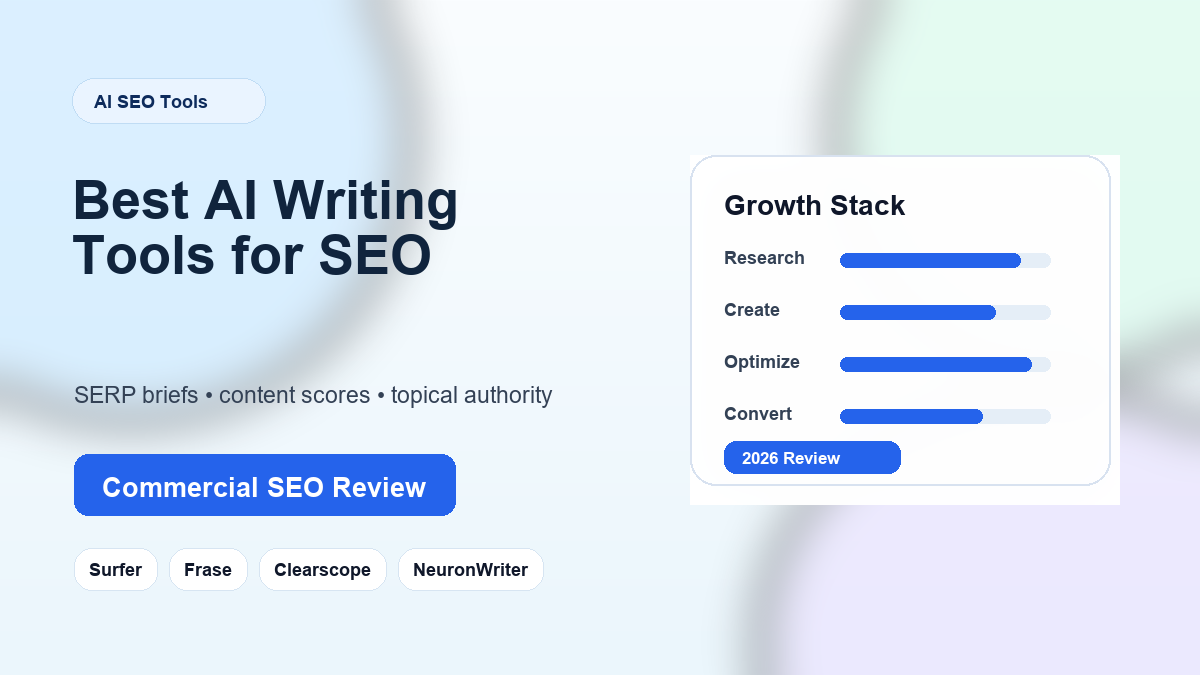
The best AI writing tools for SEO are not just “AI blog generators.” The strongest tools help with search intent, SERP analysis, content briefs, semantic terms, topical coverage, internal structure, readability, and content optimization. For most SEO writers, the best stack is one AI writing assistant plus one SEO optimization tool.
AI writing has become normal. The problem is that normal is not enough. If everyone can generate a 1,500-word article in minutes, the winning content is the one that understands the reader better, answers the question faster, and gives search engines a clearer topical signal.
In this DigitalBrief review, we compare the best AI writing tools for SEO in 2026 based on practical use cases: blog posts, affiliate reviews, SaaS landing pages, topical authority, content refreshes, and AI search optimization.
What Makes a Good AI Writing Tool for SEO?
A good SEO writing tool should help you create content that deserves to rank. That means it should support:
- Search intent analysis
- Competitor and SERP research
- Keyword and entity coverage
- Content briefs and outlines
- Natural AI-assisted drafting
- Readability improvement
- FAQ and AEO-friendly answers
- Content scoring or optimization guidance
- Content refresh workflows
The best tools do not remove the writer. They make the writer faster and more strategic.
Best AI Writing Tools for SEO: Comparison Table
| Tool | Best For | SEO Strength | Ideal User |
|---|---|---|---|
| Surfer SEO | Optimization-led writing | Content score, semantic terms, SERP-driven guidance | SEO teams and bloggers |
| Frase | Briefs and question research | Search intent, headings, FAQs, competitor analysis | Content strategists |
| Clearscope | Premium content optimization | Content grading and editorial optimization | Serious content teams |
| NeuronWriter | Budget optimization | NLP terms, competitor outlines, content score | Niche site builders |
| Jasper | Brand-safe writing | Marketing copy and long-form drafts | Brands and agencies |
| KoalaWriter | Fast SEO drafts | Long-form draft generation | Affiliate bloggers |
1. Surfer SEO: Best Overall AI Writing Tool for SEO Optimization
Surfer SEO remains one of the most popular tools for optimization-led SEO writing. It helps writers understand the terms, topics, headings, and structure commonly found in ranking content.
Surfer is useful when you already know your keyword and want to create a piece that covers the topic deeply. It is especially strong for affiliate reviews, SaaS comparisons, service pages, and blog posts where search intent is clear.
Best for: SEO writers, bloggers, affiliate site owners, agencies, and content teams that want a content score and SERP-based optimization workflow.
DigitalBrief take: Surfer is best when you use it as a guide, not a dictator. Do not stuff every suggested term. Use the recommendations to find content gaps and then write naturally.
2. Frase: Best for Content Briefs and FAQ-Led SEO
Frase is one of the best tools for researching what searchers want before you write. It helps you analyze competitor pages, build briefs, collect common questions, and organize an article around search intent.
This makes Frase excellent for AEO and FAQ sections. If you want your content to appear in featured snippets, AI answers, and conversational search results, answering the right questions clearly is important.
Best for: content strategists, SEO freelancers, editors, and agencies that create briefs before assigning content.
3. Clearscope: Best Premium SEO Content Optimizer
Clearscope is known for high-quality content grading and editorial optimization. It is not usually the cheapest option, but many serious content teams like it because the recommendations are clean and easy for writers to follow.
If your team already has writers and you want stronger optimization, Clearscope can be a good fit. It is less about pushing out AI drafts and more about improving content quality and relevance.
Best for: established brands, SaaS companies, editorial teams, and SEO agencies with budget for premium optimization.
4. MarketMuse: Best for Topical Authority Planning
MarketMuse is useful for teams that think beyond one article. It helps with topical coverage, content gaps, and authority building. This is important because ranking is increasingly about topical depth, not just one optimized page.
If you are building a content hub around “AI SEO tools,” MarketMuse-style planning can help you identify supporting pages such as AI keyword research tools, AI content briefs, AI search optimization, AI writing tools, and content refresh workflows.
5. NeuronWriter: Best Budget-Friendly SEO Writing Tool
NeuronWriter is a practical option for creators, bloggers, and small affiliate sites that want content optimization without a huge software budget. It provides competitor analysis, content scoring, and semantic term suggestions.
It is not as polished as some premium tools, but it can be very useful for building consistent SEO content around long-tail keywords.
6. Semrush ContentShake AI: Best for Semrush Users
Semrush ContentShake AI is useful if your workflow already lives inside Semrush. It can help with content ideas, article creation, and SEO-based writing workflows.
The advantage is that Semrush connects content creation with a broader SEO platform. Keyword research, competitor analysis, and content planning can live closer together.
7. SE Ranking Content Editor: Best for Practical SEO Teams
SE Ranking’s content tools are useful for creating briefs, optimizing drafts, and managing SEO content workflows. It is a good option for teams that want an SEO platform plus writing guidance without buying separate tools for everything.
8. Jasper: Best AI Writing Tool for Brand Voice
Jasper is strong for marketing content and brand consistency. It can help create blog drafts, landing page copy, emails, ads, and product descriptions while keeping a more polished marketing tone.
For SEO, Jasper works best when paired with a tool like Surfer, Frase, Clearscope, or NeuronWriter. Jasper can write; the optimizer can guide what the page needs to cover.
9. Copy.ai: Best for Short-Form SEO and Funnel Copy
Copy.ai is useful for snippets, meta descriptions, product descriptions, social posts, email copy, and campaign assets. It is not always the first tool I would choose for deep SEO content, but it is helpful around the edges of a content system.
10. KoalaWriter: Best for Fast Affiliate SEO Drafts
KoalaWriter is popular with niche site owners and affiliate bloggers because it can produce long-form drafts quickly. It is especially useful for informational articles, product roundups, and listicles.
The warning is simple: never publish raw AI output. Add real product insight, screenshots, examples, original comparisons, and editorial judgment.
11. Byword: Best for Programmatic SEO Content
Byword is often used for scaling SEO content production. It can be useful when you have a large keyword set, strong templates, and a clear content strategy.
Programmatic content can work, but only if the pages are genuinely useful. If every page feels like a spun version of the previous one, it will not build trust.
12. Writesonic: Best for Mixed Marketing and SEO Content
Writesonic offers AI writing features for blogs, ads, landing pages, and marketing content. It can fit creators who need one tool for several content types instead of only SEO articles.
13. Scalenut: Best for Content Planning and Optimization
Scalenut combines SEO research, topic planning, and AI writing workflows. It is useful for teams that want a guided process from keyword to outline to draft.
14. Outranking: Best for SERP-Driven Article Planning
Outranking focuses on SEO content strategy, outlines, and optimization. It can help writers build articles around search intent and competitor analysis instead of writing blindly.
15. ChatGPT: Best Flexible Writing Assistant
ChatGPT is still one of the most useful AI writing tools because it is flexible. You can use it for outlines, intros, FAQs, content refreshes, schema ideas, summary boxes, comparison frameworks, and rewrites.
But ChatGPT alone is not an SEO platform. It does not replace keyword research, SERP analysis, or real editorial review. Use it with SEO data, not instead of SEO data.
Best AI Writing Tool Stack for SEO
If I were building a lean SEO writing stack, I would choose:
- Research: Semrush, Ahrefs, or SE Ranking
- Briefing: Frase or MarketMuse
- Writing: ChatGPT, Jasper, KoalaWriter, or Writesonic
- Optimization: Surfer SEO, Clearscope, or NeuronWriter
- Publishing: WordPress with strong internal linking and FAQ formatting
That is usually better than relying on one tool to do everything.
How to Choose the Right AI Writing Tool for SEO
Choose based on your bottleneck:
- If you struggle with outlines, use Frase.
- If you struggle with optimization, use Surfer SEO or Clearscope.
- If you need budget SEO scoring, use NeuronWriter.
- If you need brand-safe marketing copy, use Jasper.
- If you need fast first drafts, use KoalaWriter.
- If you need topical authority planning, use MarketMuse.
Final Verdict
The best AI writing tool for SEO depends on whether you need strategy, drafting, or optimization. For most creators, Surfer SEO or Frase plus ChatGPT is a strong starting point. For larger teams, Clearscope, MarketMuse, Jasper, or Semrush can make sense.
My honest view: AI can help you write faster, but ranking still comes from usefulness. The winning content in 2026 will be specific, well-structured, updated, easy to read, and backed by real editorial judgment.
Frequently Asked Questions
What are the best AI writing tools for SEO?
The best AI writing tools for SEO include Surfer SEO, Frase, Clearscope, MarketMuse, NeuronWriter, Semrush ContentShake AI, SE Ranking Content Editor, Jasper, Copy.ai, KoalaWriter, Byword, Writesonic, Scalenut, Outranking, and ChatGPT.
Can AI-written content rank on Google?
AI-assisted content can rank if it is helpful, accurate, original, well-edited, and aligned with search intent. Low-quality AI content that adds no new value is unlikely to perform well over time.
Which AI writing tool is best for SEO beginners?
For beginners, Frase or NeuronWriter can be easier entry points for SEO guidance, while ChatGPT can help with outlines and drafts. Surfer SEO is strong if you want more optimization structure.
Is Surfer SEO better than Frase?
Surfer SEO is often stronger for content scoring and optimization. Frase is very useful for briefs, questions, and search intent research. Many writers can use either, depending on workflow.
Is ChatGPT enough for SEO writing?
ChatGPT is useful, but it is not enough by itself for serious SEO. You still need keyword research, SERP analysis, internal linking, topical planning, fact-checking, and human editing.
What is the best AI tool for affiliate SEO content?
For affiliate SEO, a strong stack is ChatGPT or KoalaWriter for drafting, Surfer SEO or NeuronWriter for optimization, and Semrush or Ahrefs for keyword and competitor research.
Do AI SEO writing tools replace writers?
No. They reduce repetitive work, speed up research, and improve structure, but human writers are still needed for judgment, examples, trust, brand voice, fact-checking, and conversion strategy.
How should I optimize AI content for AEO and GEO?
Use clear answers, FAQ sections, comparison tables, original summaries, semantic subtopics, concise definitions, and structured headings. AI search engines prefer content that is easy to understand, cite, and summarize.