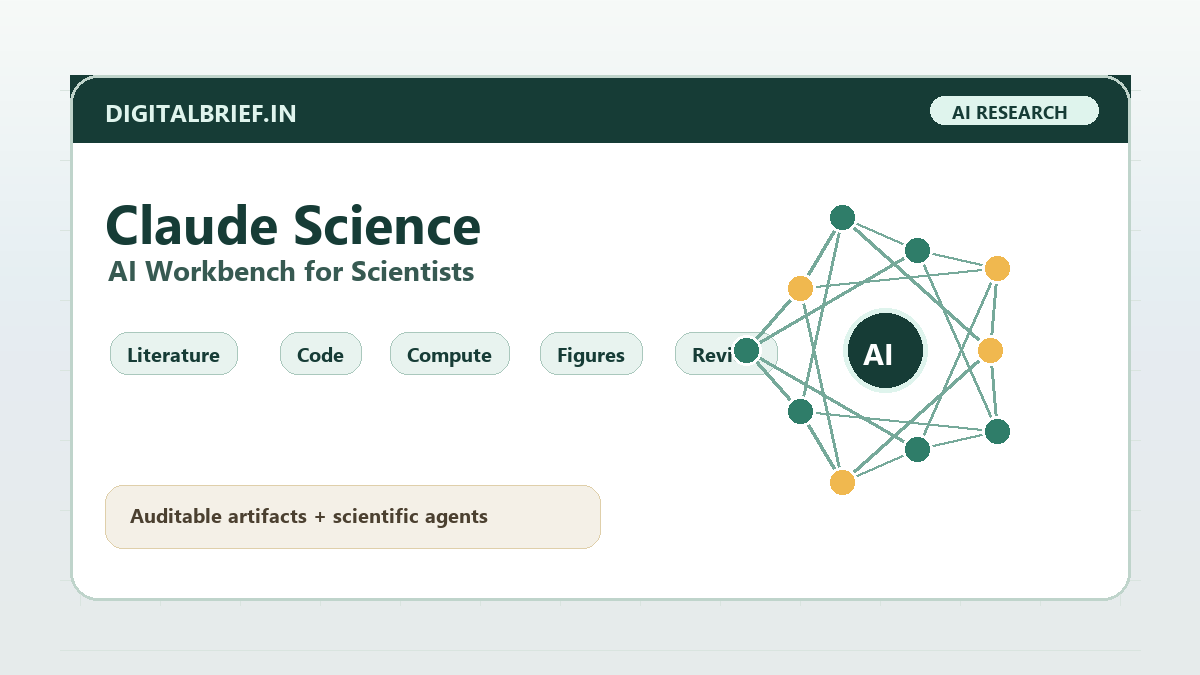
Claude Science is Anthropic’s new AI workbench for scientists, and it is one of the more interesting AI product launches of 2026 so far.
Not because it is another chatbot.
Honestly, we already have enough of those.
What makes Claude Science worth watching is that Anthropic is trying to move AI into the actual messy workflow of research: literature review, data analysis, code execution, scientific figures, citations, compute jobs, and manuscript drafting.
That is a much bigger idea than “ask an AI a question.”
According to Anthropic’s official announcement, Claude Science launched on June 30, 2026 as a beta app for Claude Pro, Max, Team, and Enterprise users. It runs on macOS and Linux, can connect to local or remote compute, and is designed around auditable scientific artifacts.
In simple words: it wants to become a single AI-powered research desk for scientists.
And if Anthropic executes well, this could become one of those launches we look back on as an early sign of where professional AI tools are heading.
What Is Claude Science?
Claude Science is an AI workbench built around Claude for scientific research workflows.
It brings together tools that researchers usually keep scattered across different apps and environments. Think PubMed, Jupyter, R, cluster terminals, scientific databases, protein viewers, manuscript drafts, analysis scripts, and research notes.
Instead of asking scientists to jump between all of these tools manually, Claude Science gives them a coordinating AI agent that can help plan work, run analysis, generate figures, inspect citations, and keep a reproducible history of the steps taken.
This is where things get interesting.
Most AI tools are useful only at the surface level. They summarize papers. They write Python snippets. They explain biology terms. That is helpful, but it still leaves the researcher doing the heavy workflow stitching.
Claude Science is aimed at the stitching itself.
Anthropic says the app includes more than 60 curated skills and connectors for areas like genomics, single-cell analysis, proteomics, structural biology, and cheminformatics. It can also work on a researcher’s own infrastructure, including a laptop, Linux machine, SSH server, or HPC login node.
That matters because serious science is rarely done in a clean demo environment. Data is large. Pipelines are fragile. Lab workflows are custom. Privacy and reproducibility matter.
Why This Launch Is Trending Now
The timing is important.
AI has already changed how developers write code. In 2025 and 2026, coding agents moved from autocomplete into planning, editing, testing, and workflow automation.
Science may be entering a similar phase.
OpenAI launched Prism earlier in 2026 as a free AI-native workspace for scientific writing and collaboration. Prism focuses strongly on LaTeX writing, paper drafting, equations, citations, and team collaboration.
Claude Science appears to go deeper into computational research.
That difference creates a clear search opportunity: people will want to know whether Claude Science is a Prism competitor, a lab automation tool, a scientific coding agent, or something closer to a research operating system.
The short answer is: it is a mix of all four, but still early.
For DigitalBrief readers, the broader trend is more important than the product name. AI companies are no longer only shipping general chat models. They are packaging AI into professional workbenches for specific industries.
That is the real story.
Claude Science Key Features
Here are the most important Claude Science features based on Anthropic’s announcement and early coverage.
| Feature | What It Means | Why It Matters |
|---|---|---|
| Unified research workspace | Researchers can work across literature, code, data, figures, and manuscripts in one environment. | Less context switching and fewer broken handoffs between tools. |
| Scientific agents | A coordinating agent can use specialist skills and connect to scientific databases. | Useful for multi-step research work, not just simple answers. |
| Auditable artifacts | Outputs include code, environment details, plain-language explanations, and message history. | Researchers can validate and reproduce results later. |
| Compute integration | The app can work with local machines, remote servers, HPC systems, and on-demand compute. | Important for large datasets and expensive analysis jobs. |
| Reviewer agent | A second agent checks citations, calculations, and whether figures match code. | This directly targets one of the biggest AI risks: confident but wrong output. |
How Claude Science Actually Works
The best way to understand Claude Science is to imagine a researcher working on a complex biology question.
Normally, that researcher might read papers in one place, pull data from several databases, write analysis code in Jupyter, run heavier jobs on a cluster, create figures in Python or R, check citations manually, and then write the results into a manuscript.
Each step creates friction.
Claude Science tries to sit across that whole chain.
The researcher can ask a question in plain English. Claude can plan the work, call relevant tools, inspect data, generate code, run analysis where allowed, produce figures, and keep the steps connected to the final output.
Anthropic says Claude Science can display scientific artifacts such as protein structures, genome browser tracks, chemical structures, and figures. It can also modify figures through natural language, such as changing an axis scale or removing gridlines.
In my experience with technical workflows, this kind of “small edit” layer is often where AI becomes genuinely useful. Not because changing a chart axis is hard. It is useful because researchers make dozens of tiny changes during analysis, and each one breaks focus.
If Claude Science can make those changes while preserving code and reproducibility, that is a real productivity win.
Claude Science vs OpenAI Prism
Claude Science and OpenAI Prism are easy to compare because both target scientific work. But they are not identical products.
Prism is more focused on writing, collaboration, LaTeX, equations, and paper preparation. OpenAI describes it as a free AI-native workspace for scientists to write and collaborate on research, powered by GPT-5.2.
Claude Science is more focused on computational research, scientific databases, code execution, reproducible artifacts, and lab workflows.
| Comparison Point | Claude Science | OpenAI Prism |
|---|---|---|
| Main focus | Scientific analysis and research workflow automation | Scientific writing and collaboration |
| Best fit | Labs doing computational biology, data analysis, and scientific pipelines | Researchers writing papers, managing LaTeX, and collaborating with co-authors |
| Access | Beta for Claude Pro, Max, Team, and Enterprise users | Free for users with a ChatGPT personal account |
| Compute | Can connect to local, SSH, HPC, and on-demand compute environments | Cloud-based writing workspace with AI assistance |
| Big promise | Make scientific analysis more reproducible and agent-driven | Make scientific writing and collaboration faster |
If I had to simplify it, I would put it this way:
Prism helps scientists write the paper. Claude Science wants to help scientists do more of the work behind the paper.
That is not a perfect distinction, but it is a useful starting point.
Why Auditable AI Matters in Science
AI tools can be impressive, but science has a higher bar than most content or productivity use cases.
A wrong paragraph in a blog draft is annoying.
A wrong citation, wrong calculation, or unreproducible figure in a scientific workflow can create serious problems.
That is why Anthropic keeps emphasizing auditable artifacts. Claude Science is designed to show how something was made: the code, the environment, the inputs, the explanation, and the conversation history.
This is not just a nice feature. It is the difference between AI as a brainstorming assistant and AI as a serious research tool.
Most people miss this part of the AI science conversation. The main question is not “Can AI generate a plausible answer?” The better question is “Can a domain expert inspect the chain of work and verify it?”
Claude Science seems built around that second question.
Real-World Use Cases
Anthropic highlighted early use cases across life sciences, including single-cell RNA sequencing analysis, CRISPR screen design, protein structure prediction, and cheminformatics.
Those are not casual tasks. They require domain knowledge, data handling, statistical care, and tool fluency.
Here are practical examples of where a workbench like Claude Science could help.
- Literature review: Search across papers, extract claims, summarize findings, and organize evidence for a review article.
- Genomics analysis: Build and run a pipeline, inspect outputs, generate figures, and document every step.
- Protein research: Visualize structures, compare models, and connect analysis to existing biological databases.
- Manuscript preparation: Draft methods sections from actual analysis steps instead of reconstructing them from memory.
- Research reproducibility: Preserve code, environment details, and data lineage so results can be checked later.
- Lab onboarding: Turn repeated workflows into reusable skills for new team members.
Benefits for Researchers and Labs
The biggest benefit is not speed alone.
Speed matters, of course. Anthropic says one UCSF researcher reported that Claude Science helped accelerate comprehensive germline analysis to roughly one-tenth of the previous time, with independent validation of the results.
But the deeper benefit is workflow continuity.
Researchers lose time because scientific work is fragmented. A question starts in a paper, moves into a dataset, becomes a script, turns into a compute job, produces a figure, then needs to be explained in a manuscript.
Every transition is a chance to lose context.
Claude Science tries to keep that context alive.
| Benefit | Practical Impact |
|---|---|
| Less tool switching | Researchers spend more time thinking and less time moving between apps. |
| Better documentation | Analysis steps are captured while the work happens. |
| Reusable workflows | Labs can turn trusted pipelines into repeatable skills. |
| Faster iteration | Figures, analysis, and drafts can be refined through conversation. |
| Stronger validation | Reviewer agents can flag citation and calculation issues before humans review final outputs. |
Pros and Cons
Claude Science is promising, but it should not be treated like magic.
| Pros | Cons |
|---|---|
| Built around real scientific workflows instead of generic chat. | Still in beta, so reliability and coverage will vary by domain. |
| Strong focus on auditability and reproducibility. | Currently limited to macOS and Linux users on eligible Claude plans. |
| Can connect to existing compute and lab infrastructure. | Labs will still need governance, validation, and human review. |
| Useful for complex multi-step research tasks. | May require setup effort before it becomes genuinely productive. |
| Reviewer agent directly addresses citation and calculation risk. | AI review is helpful, but it is not a replacement for expert review. |
Who Should Try Claude Science?
Claude Science is not for everyone.
If you are a casual ChatGPT or Claude user who only wants paper summaries, this may be more tool than you need.
But it is worth watching if you are in one of these groups:
- Computational biology researchers
- Bioinformatics teams
- Pharma and biotech R&D teams
- Academic labs with repeated analysis pipelines
- Researchers using HPC or remote compute
- Scientific teams struggling with reproducibility and documentation
- AI builders interested in domain-specific agents
For general AI users, the product is still important because it shows where the market is going.
The future of AI tools is not one chatbot for everything. It is specialized workbenches for serious jobs.
SEO and Market Opportunity
From a search perspective, Claude Science has a strong content opportunity because it sits at the intersection of several rising topics:
- AI for science
- AI research tools
- Claude Science vs OpenAI Prism
- AI agents for scientific research
- AI in drug discovery
- AI workbench tools
- Scientific workflow automation
The keyword difficulty may rise quickly if major publishers keep covering the launch. But right now, there is still room for practical explainers that answer basic user questions clearly.
That is why the best content angle is not “Anthropic launches new product.” Many sites can write that.
The better angle is: What does Claude Science actually do, who is it for, and how is it different from Prism?
Future Predictions
I expect three things to happen next.
First, AI science tools will become more workflow-specific. Instead of broad assistants, we will see tools for biology, materials science, climate modeling, chemistry, medical research, and engineering.
Second, reproducibility will become a core product feature. The winners in this category will not be the tools that produce the prettiest answer. They will be the tools that preserve the evidence trail.
Third, AI workbenches will become a new enterprise battleground. OpenAI has Prism. Anthropic has Claude Science. Google DeepMind already has deep credibility in scientific AI through work like AlphaFold. Microsoft and cloud providers will want the infrastructure layer.
This is not just a science story. It is a platform story.
Featured Image and Visual Ideas
A strong featured image for this article should show a futuristic research desk with a laptop, molecular visualization, data charts, and an AI assistant interface. Keep it clean, premium, and editorial rather than cartoonish.
Useful supporting visuals would include:
- A Claude Science vs OpenAI Prism comparison chart
- A workflow diagram showing literature review to data analysis to manuscript
- A table of best AI tools for scientific research in 2026
- An infographic explaining auditable AI artifacts
FAQs About Claude Science
What is Claude Science?
Claude Science is Anthropic’s AI workbench for scientists. It helps researchers work across literature, data, code, compute, figures, and manuscripts in one AI-assisted environment.
When did Claude Science launch?
Claude Science launched in beta on June 30, 2026.
Who can use Claude Science?
Claude Science is available in beta for Claude Pro, Max, Team, and Enterprise users. Team and Enterprise users may need an admin to enable it.
Is Claude Science free?
Claude Science is tied to eligible Claude plans. Anthropic is also supporting up to 50 AI for Science projects with up to $30,000 in credits, with applications open through July 15, 2026.
How is Claude Science different from OpenAI Prism?
OpenAI Prism focuses mainly on scientific writing, LaTeX, collaboration, and paper preparation. Claude Science focuses more on computational research workflows, data analysis, scientific tools, and reproducible artifacts.
Does Claude Science replace scientists?
No. Claude Science is better understood as a research assistant and workflow tool. Human experts still need to validate outputs, interpret findings, and make scientific decisions.
Can Claude Science run code?
Yes, Claude Science is designed to work with code and compute environments, including local machines, remote systems, SSH, HPC login nodes, and on-demand compute where configured.
Why is auditability important in Claude Science?
Auditability helps researchers verify how an output was created. Claude Science can preserve code, environment details, inputs, explanations, and history so results are easier to reproduce and check.
What fields is Claude Science best for?
Claude Science currently appears strongest for life sciences and scientific computing, including genomics, proteomics, structural biology, cheminformatics, and biomedical research.
Is Claude Science useful for non-scientists?
Most non-scientists probably do not need Claude Science directly. But AI builders, product teams, and automation consultants should study it because it shows how domain-specific AI agents may evolve.
Can Claude Science help with drug discovery?
It may help with parts of the drug discovery workflow, especially literature analysis, data analysis, protein or molecular workflows, and pipeline automation. But AI-generated insights still need experimental validation.
Is Claude Science better than a normal chatbot?
For scientific workflows, yes. A normal chatbot can answer questions, but Claude Science is designed to work with tools, code, compute, artifacts, and reproducible research history.
Final Thoughts
Claude Science is not just another AI announcement.
It is part of a larger shift from chatbots to AI workbenches.
That shift matters because the next wave of AI productivity will not come only from better answers. It will come from AI systems that understand the tools, files, data, rules, and review loops of a real profession.
For scientists, Claude Science could reduce friction in research workflows. For AI companies, it is a signal that domain-specific agents are becoming the product. For the rest of us, it is another reminder that AI is moving deeper into high-value knowledge work.
My practical take: Claude Science is worth watching closely, especially if Anthropic can prove reliability, reproducibility, and enterprise-grade governance in real labs.
If you follow AI tools, scientific AI, or the future of professional work, this is one of the launches to keep on your radar.
CTA: Follow DigitalBrief.in for practical breakdowns of the latest AI tools, automation trends, and technology launches that actually matter.