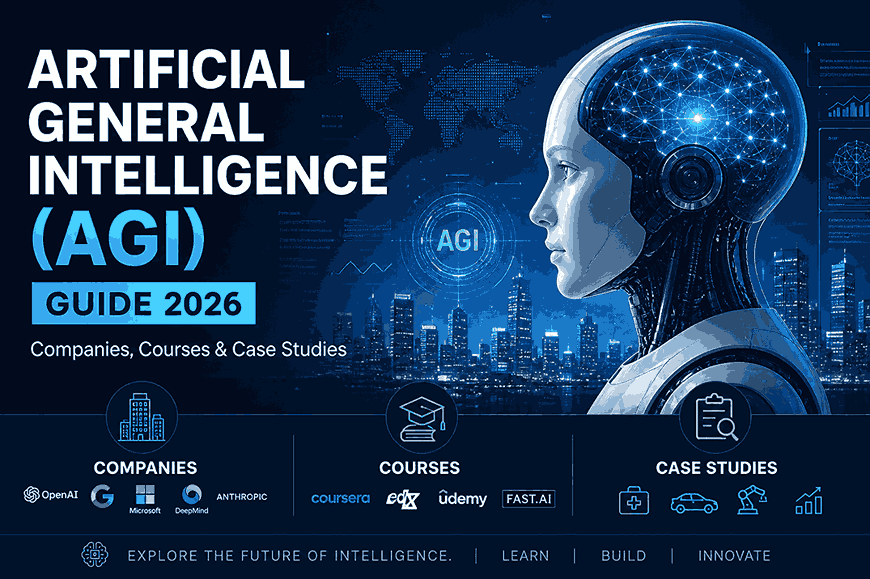
Artificial General Intelligence (AGI) Guide: Welcome to digital.in, your premier destination for the latest AI news, tech blog updates, and the ultimate online income guide.
The tech world is changing faster than ever. We are moving from simple artificial intelligence to something much bigger: Artificial General Intelligence (AGI). This shift is the most important tech event of the 21st century.
By 2026, the debate over “AGI vs AI” is no longer just philosophy. It is real computer science. It is changing how businesses work, how we make money online, and how we interact with the digital world.
In this comprehensive guide brought to you by digital.in, we will break down everything you need to know. We will explain the real difference between AI and AGI. We will look at the top companies building AGI, the best courses to learn about it, and real-world case studies. Plus, we will answer the most searched FAQs on the internet.
The Big Question: AGI vs AI
People use the terms AI and AGI a lot. But they mean very different things. The difference is not just about having a faster computer. It is about how the system actually thinks and learns.
What is Artificial Narrow Intelligence (AI)?
Right now, almost all the AI we use is “Narrow AI.” This means it is built to do one specific job really well.
For example, a self-driving car is great at predicting traffic. A medical AI can spot diseases in an X-ray. A chatbot like the early versions of ChatGPT is amazing at writing text.
But these systems have a limit. They only know their specific job. A medical AI cannot suddenly play chess. A self-driving car cannot translate French. To do a new task, narrow AI has to be completely rebuilt and retrained.
What is Artificial General Intelligence (AGI)?
AGI is the next level. It refers to a machine that is as smart, or smarter, than a human across almost every task.
An AGI system can learn a skill in one area and apply it somewhere completely different. This is called “transfer learning.”
A true AGI can also think about its own thoughts. It knows when it is confused and knows how to ask for help. It learns continuously from its environment, just like a human does.
Imagine you need a project manager. A narrow AI could help you schedule meetings. But an AGI could be told, “Launch my new online income project by next month.” The AGI would autonomously research the market, build the website, write the code, and run the marketing campaign without you needing to hold its hand.
The 5 Levels of AGI
To help us understand our progress, Google DeepMind created a simple 5-level system. This system measures how general an AI is, and how well it performs compared to humans.
| AGI Level | Designation | Performance Criteria | General AI Status |
| Level 0 | No AI | Simple calculators | N/A |
| Level 1 | Emerging | Equal to an unskilled human | Achieved (ChatGPT, Gemini) |
| Level 2 | Competent | Better than 50% of skilled adults | Not yet achieved publicly |
| Level 3 | Expert | Better than 90% of skilled adults | Not yet achieved publicly |
| Level 4 | Exceptional | Better than 99% of skilled adults | Not yet achieved publicly |
| Level 5 | Superhuman | Outperforms 100% of humans | Not yet achieved |
When Will AGI Arrive?
People have dreamed of thinking machines for thousands of years. But modern AI really started in the 1950s when Alan Turing proposed the Turing Test.
For a long time, progress was slow. But in the 2010s, powerful computers and massive amounts of data changed everything. This led to the incredible AI tools we have today.
So, when will true AGI finally arrive? Experts are changing their predictions fast. Just a few years ago, scientists thought AGI was 50 years away. Now, they think it is right around the corner.
Timeline Forecasts for AGI (Metaculus & Expert Consensus)
Median Predicted Years to AGI Arrival
Forecast Year | Years Remaining to AGI
2020 | ██████████████████████████████████████████████████ 50 Years (2070)
2021 | ███████████████████████████████████ 35 Years (2056)
2022 | ████████████████████ 20 Years (2042)
2023 | ████████ 8 Years (2031)
2024 | █████ 5 Years (2029)
2025 | ███ 3 Years (2028)
2026 | ██ 1.5 Years (2027.5)
Many leaders at top AI companies now believe we will see AGI between 2027 and 2030.
Top AGI Companies to Watch in 2026
In 2026, building AGI takes billions of dollars and massive data centers. Only a few massive tech giants and specialized startups are leading the race.
1. OpenAI
OpenAI is famous for ChatGPT. Their goal is to build AGI that benefits everyone. In 2026, they released GPT-5.5. This model is incredible at acting like an autonomous agent. It can take over your computer mouse and keyboard to complete complex coding and business tasks on its own.
2. Google DeepMind
Google has a huge advantage because its AI, Gemini, is built right into Google Search, Android, and Google Workspace. Their newest model, Gemini 3.1 Pro, is a powerhouse for logic and coding. They are also leading the way in biology with AlphaFold 3, mapping the building blocks of life.
3. Anthropic
Anthropic is the safety-first AI company. They built the Claude series of models. In 2026, they developed a model so powerful (Claude Mythos) that they decided not to release it to the public. They were worried hackers could use it, so they kept it hidden to protect global cybersecurity.
4. Safe Superintelligence Inc. (SSI)
Started by AI legend Ilya Sutskever, SSI has one simple goal: build a safe superintelligence. They do not sell chatbots or apps. They just focus 100% on making AGI safe and smart. Because of this laser focus, they are valued at over $32 billion.
5. ByteDance
ByteDance, the company behind TikTok, is leading the AI race in Asia. Their AI assistant, Doubao, has over 155 million weekly users. They are spending billions on new AI computer chips to stay ahead.
Table: Top AGI Companies (2026)
| Company | Lead Model | Main Focus |
| OpenAI | GPT-5.5 | Agentic execution, broad business use |
| Google DeepMind | Gemini 3.1 Pro | Search integration, science |
| Anthropic | Claude 4.7 / Mythos | Enterprise safety and defense |
| SSI | Undisclosed | Pure safe AGI research |
| ByteDance | Doubao | Consumer apps in Asia |
| xAI | Grok 5 | Scientific discovery |
The AGI Economy and Online Income
Building AGI is expensive. The market for AGI research and tools is expected to grow by 45% every year, reaching $150 billion by 2033.
For readers of our online income guide at digital.in, this is a massive opportunity. The broader AI market will hit almost $3.5 trillion by 2033.
Money is flooding into data centers, computer chips, and even nuclear power plants to provide electricity for AI. If you want to build wealth online, learning how to use and deploy these AI tools is the best place to start.
Best AGI Courses and Certifications for 2026
Because AI is taking over, companies are desperate for workers who understand it. Learning AI is a guaranteed way to boost your career. Here are the best certifications depending on your current skill level:
For Beginners and Business Leaders
You do not need to know how to code to work in AI. Business leaders need to understand how to use AI to make money and save time.
- AI for Everyone (DeepLearning.AI): A great beginner course that explains AI strategy without complicated math.
- CertNexus AI Biz (AIS-210): Perfect for managers who want to deploy AI safely in their business.
For Tech Workers and Cloud Engineers
If you are already in IT, you should learn how to run AI models on the cloud.
- Microsoft Certified Azure AI Engineer: Teaches you how to build AI apps using Microsoft’s tools.
- Google Professional Machine Learning Engineer: Focuses on building massive data pipelines on Google Cloud.
For Elite Researchers
If you want to invent the next version of AGI, you need elite training.
- OpenAI Residency: A six-month, paid program where you work directly with OpenAI scientists to build frontier models.
- Stanford University CS224N: A very difficult, graduate-level college course on deep learning and AI language models.
Real-World Case Studies
How is this tech actually changing the world today? Let’s look at three examples.
Case Study 1: AI Search and SEO
At digital.in, we follow tech blog trends closely. The biggest trend in 2026 is how AI is killing traditional Google Search.
Millions of people now use AI Overviews to get answers instantly. They do not click on website links anymore. For marketers, this means traditional SEO is dead. You now have to optimize your content so that AI chatbots cite you as a source. You need clear facts, numbers, and highly structured FAQs.
Case Study 2: Curing Diseases with AlphaFold 3
Google’s AlphaFold 3 is a great example of AGI precursor technology applied to science. This AI can predict how the tiny molecules inside our bodies interact.
Google is using this to help pharmaceutical companies invent new medicines in a fraction of the time. Their ultimate goal is to build a “virtual cell”—a digital simulation of human biology that could cure diseases without endless lab testing.
Case Study 3: AI Agents doing Real Work
The holy grail of AGI is an “agent” that can do your job for you. We saw hints of this with DeepMind’s Gato, which could play games and stack blocks.
Today, models like OpenAI’s GPT-5.5 act like digital employees. You can tell GPT-5.5 to build a software program, and it will autonomously open your code editor, write the code, test it, fix its own bugs, and deliver the final product hours later.
Highly Searched FAQs on AGI and AI
As your go-to tech blog, digital.in is here to clear up the confusion. Here are the most common questions people ask about AGI.
How is AGI different from AI?
AI (Artificial Intelligence) is a broad term. Right now, it means “Narrow AI.” Narrow AI is basically a specialized tool that does one thing really well, like generating a picture or translating a language.
AGI (Artificial General Intelligence) is an autonomous, adaptable worker. It can learn any intellectual task a human can do. It can teach itself new skills without needing a programmer to write new code.
Does any AGI exist yet?
No. As of 2026, scientists agree that full AGI does not exist yet.
We are currently at “Level 1” (Emerging AGI) according to Google’s framework. Our AI is very smart, but it still makes silly mistakes and cannot reliably do complex human jobs perfectly every time. However, experts think we might hit full AGI in the next few years.
Is ChatGPT AGI?
No, ChatGPT is not AGI. It is an amazing AI tool, but it is not a true general intelligence.
The newest versions, powered by the o-series and GPT-5.5, are getting closer. They can “think” before they speak and fix their own logic errors. But they still struggle with tasks that require a true understanding of the physical world. Therefore, ChatGPT is still just a very advanced Level 1 AI.
Is AGI the same as W-2?
This is a very common point of confusion! The answer is no. They are two completely different things that happen to share an acronym.
In technology, AGI stands for Artificial General Intelligence.
In personal finance and taxes, AGI stands for Adjusted Gross Income.
Your tax AGI is a number the IRS uses to figure out how much you owe in taxes. You calculate it by taking your total income (which includes the wages listed on your W-2 form) and subtracting certain deductions. Your W-2 is just a piece of paper from your boss showing your salary. Your AGI is the final math calculation on your tax return. They have nothing to do with robots or computer science!
Conclusion
The leap from standard AI to AGI is happening incredibly fast. We are moving away from simple chatbots toward autonomous digital agents that can think, code, and do business on their own.
For the readers of digital.in, this is the perfect time to get involved. Whether you are reading our tech blog to stay updated, taking an AI course to boost your career, or using our online income guide to launch an AI business, understanding AGI is your key to the future. Stay curious, keep learning, and prepare for the next big shift in the digital world.