
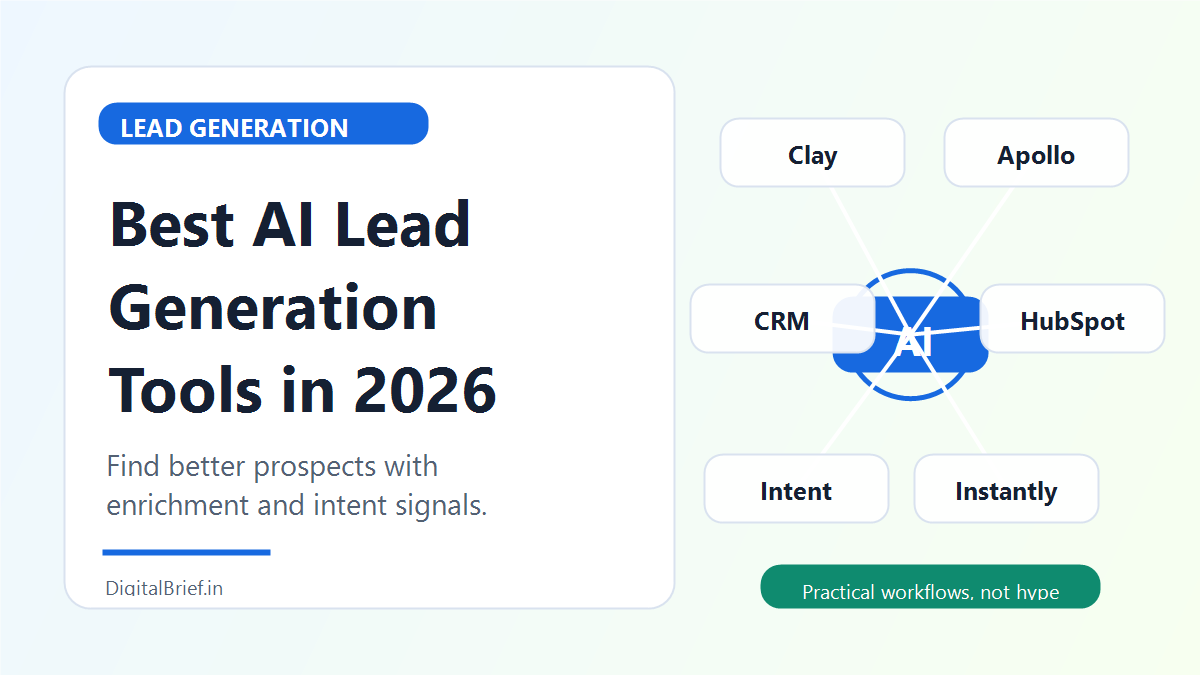
AI lead generation tools are no longer just contact databases with a chatbot bolted on. The best tools in 2026 can research accounts, enrich contacts, detect buying signals, score leads, write personalized outreach, sync with your CRM, and help sales teams spend less time hunting for data.
That matters because lead generation has become messy. A simple list of emails is not enough anymore. Buyers are harder to reach, inboxes are crowded, and generic outreach gets ignored quickly.
The real value of AI lead generation is not “more leads.” It is better timing, better context, and cleaner handoffs to sales.
This guide compares the best AI lead generation tools for B2B teams, agencies, founders, consultants, and small businesses.
What Makes a Good AI Lead Generation Tool?
A good AI lead generation platform should help with at least three of these jobs:
- Finding companies that match your ideal customer profile
- Finding decision-makers inside those companies
- Verifying or enriching emails and phone numbers
- Detecting buying signals such as hiring, funding, technology use, or website activity
- Writing personalized outreach based on real context
- Scoring and prioritizing leads
- Syncing clean data into a CRM
- Automating follow-up without losing personalization
If a tool only gives you a list of names, it is not really an AI lead generation tool. It is a database.
1. Clay: Best for Advanced Lead Enrichment Workflows
Clay is one of the strongest AI lead generation tools for teams that want to build custom prospecting workflows. It lets you combine data providers, enrichment steps, AI research, scraping, scoring, and CRM syncs inside flexible tables.
Clay’s official pricing page currently lists a free plan and paid plans such as Launch for small teams. The page also explains that Clay uses Actions and Data Credits. Actions measure orchestration work inside Clay, while Data Credits are used when purchasing data from Clay’s marketplace.
Best for:
- Growth teams
- GTM engineers
- Agencies
- B2B SaaS teams
- Custom enrichment workflows
Clay is not the easiest tool for a beginner, but it is powerful. You can build workflows like: find companies hiring for a role, enrich their tech stack, identify the VP of Sales, check recent funding, use AI to write a custom opening line, then push qualified leads into HubSpot or Salesforce.
2. Apollo.io: Best All-in-One B2B Prospecting Platform
Apollo is popular because it combines lead database, email sequencing, enrichment, calling, CRM integrations, and sales intelligence in one platform.
Apollo’s public materials describe it as a sales intelligence and engagement platform, and its help center explains that credits are used for activities such as requesting verified emails or phone numbers, enrichment, and AI research. Apollo also integrates with tools like Salesforce, HubSpot, Outreach, Salesloft, Marketo, LinkedIn, and email providers.
Best for:
- SDR teams
- Startups
- B2B prospecting
- Email sequences
- Lead database search
Apollo is a practical choice if you want one platform to find leads and run outbound. It may not be as customizable as Clay, but it is easier to operate as a core prospecting system.
3. HubSpot Breeze Prospecting Agent: Best CRM-Native AI Prospecting
HubSpot’s Breeze Prospecting Agent is interesting because it works inside the HubSpot customer platform. Instead of acting like a separate prospecting tool, it uses CRM context to research, detect signals, and personalize outreach.
HubSpot says the Prospecting Agent can monitor buying signals, research accounts, personalize messaging, and scale engagement from within HubSpot. In April 2026, HubSpot announced outcome-based pricing for Breeze Prospecting Agent at $1 per lead recommended for outreach, available to Pro and Enterprise customers.
Best for:
- HubSpot users
- SMB sales teams
- CRM-native prospecting
- Teams that want less tool switching
HubSpot also reports on its Breeze page that Sandler drove 25% more engagement and 4x sales leads by creating personalized experiences with Breeze. That is a useful real-world signal, though results will depend heavily on setup, data quality, and offer-market fit.
4. Instantly: Best for Cold Email Lead Generation and Outreach
Instantly started as a cold email platform, but its current product set includes lead finding, enrichment, AI email writing, AI reply agents, and AI sales agent features through Instantly Credits.
Instantly’s pricing page currently lists outreach plans such as Growth, Hypergrowth, and Light Speed, while its help center explains Instantly Credits for SuperSearch, lead enrichment, lead verification, Copilot, AI reply agent, and AI sales agent.
Best for:
- Cold email outreach
- Agencies
- Founders testing outbound
- High-volume prospecting
- Deliverability-focused campaigns
Instantly is strongest when your lead generation strategy includes cold email. But remember: sending volume is not the same as building pipeline. Your list quality, deliverability, offer, and personalization still matter.
5. ZoomInfo: Best Enterprise Sales Intelligence
ZoomInfo is a major sales intelligence platform for enterprise and mid-market teams. It is known for contact data, company intelligence, buyer intent, org charts, and enrichment.
Best for:
- Enterprise sales teams
- Account-based marketing
- Intent data
- Large revenue organizations
- Complex buying committees
ZoomInfo is usually not the first tool I would recommend to a solo founder or small blogger because enterprise sales intelligence can get expensive. But for larger sales teams, it can be a serious pipeline engine.
6. Cognism: Best for Compliant B2B Contact Data
Cognism focuses heavily on B2B contact data, mobile numbers, intent data, and compliance. It is often considered by teams that care about European markets and data quality.
Best for:
- B2B sales teams
- European prospecting
- Mobile number discovery
- Compliance-conscious teams
Choose Cognism if your lead generation depends on reliable contact data and compliant outreach workflows.
7. Seamless.AI: Best for Sales Contact Discovery
Seamless.AI is a contact discovery and sales prospecting tool that helps teams find leads, emails, phone numbers, and company data.
Best for:
- Sales reps
- SDRs
- Recruiting-style prospecting
- Contact discovery
It works best when paired with a strong CRM and outreach process.
8. Clearbit: Best for Website Visitor and Company Enrichment
Clearbit, now part of HubSpot, is useful for company enrichment, firmographic data, and turning anonymous or partial data into more complete records.
Best for:
- Website visitor enrichment
- Form enrichment
- Account scoring
- Marketing operations
Use Clearbit-style enrichment when your lead problem is not finding people from scratch, but understanding who is already visiting or entering your funnel.
9. Leadfeeder / Dealfront: Best for Identifying Website Visitors
Leadfeeder, now part of Dealfront, helps identify companies visiting your website. This can reveal warm accounts already showing interest.
Best for:
- B2B websites
- Demand generation
- Sales follow-up
- Account-based marketing
This is especially useful if your website already gets traffic but your sales team does not know which companies are researching you.
10. Lusha: Best for Simple Contact Data
Lusha helps sales teams find contact details and enrich leads. It is a simpler choice for users who want quick access to B2B contact information without building complex workflows.
Best for:
- Small sales teams
- Recruiting
- Basic prospecting
- Contact enrichment
Lusha is easy to understand, which can be a benefit if your team does not need a heavy GTM operations setup.
11. Snov.io: Best Budget Prospecting and Email Outreach
Snov.io offers email finding, verification, outreach campaigns, and sales automation features. It is often attractive to smaller teams because it combines prospecting and outreach at a lower price point than enterprise platforms.
Best for:
- Startups
- Agencies
- Budget-conscious prospecting
- Email verification
If you are experimenting with outbound and do not need a huge enterprise database, Snov.io can be worth testing.
12. Hunter: Best for Email Finding and Verification
Hunter is useful for finding professional email addresses by domain and verifying email deliverability.
Best for:
- Manual prospecting
- Small campaigns
- PR outreach
- Founder-led sales
Hunter is not a full AI lead generation suite, but it is reliable for one specific job: finding and verifying email addresses.
13. LinkedIn Sales Navigator: Best for Relationship-Based Prospecting
LinkedIn Sales Navigator remains important because B2B selling often starts with account research and relationship context.
Best for:
- B2B sales reps
- Social selling
- Account research
- Decision-maker discovery
Pair Sales Navigator with AI tools for research summaries and outreach drafting, but do not automate LinkedIn in ways that violate platform rules.
14. Kaspr: Best for LinkedIn-Based Prospecting
Kaspr helps users find contact data from LinkedIn and build prospecting lists.
Best for:
- LinkedIn prospecting
- European sales teams
- SDR workflows
- Contact exports
It is best used with a clean ICP and a structured outreach sequence.
15. Customers.ai: Best for Website Visitor and Retargeting-Oriented Leads
Customers.ai focuses on identifying and engaging website visitors and turning traffic into contactable leads.
Best for:
- Ecommerce
- Website visitor identification
- Retargeting
- SMB lead generation
It can be useful when your site has traffic but you are not capturing enough leads through forms.
Real Case Study: HubSpot Breeze Shows the Direction of AI Prospecting
HubSpot’s Breeze Prospecting Agent is a good example of where AI lead generation is going. HubSpot says the agent can monitor prospects, research accounts, detect signals, and personalize outreach. In April 2026, HubSpot moved the Prospecting Agent toward outcome-based pricing at $1 per lead recommended for outreach.
That is important because it shifts pricing away from vague AI usage and closer to business outcomes. HubSpot also reports customer examples on its Breeze page, including Sandler driving 25% more engagement and 4x sales leads through personalized experiences with Breeze.
The takeaway: AI lead generation is becoming less about buying lists and more about turning CRM context, buyer signals, and automation into better-timed outreach.
How to Choose the Right AI Lead Generation Tool
Choose Clay if you need custom enrichment and AI research workflows.
Choose Apollo if you want an all-in-one prospecting and outreach platform.
Choose HubSpot Breeze if your sales process already lives in HubSpot.
Choose Instantly if cold email volume and deliverability are central to your strategy.
Choose ZoomInfo or Cognism if you need enterprise-grade sales intelligence.
Choose Leadfeeder or Customers.ai if your website traffic is your best lead source.
FAQs About AI Lead Generation Tools
What is the best AI lead generation tool?
Clay is best for advanced enrichment workflows, Apollo is best for all-in-one prospecting, HubSpot Breeze is best for HubSpot users, and Instantly is best for cold email-driven lead generation.
Are AI lead generation tools worth it?
They are worth it if they improve lead quality, reduce manual research time, and help your sales team prioritize the right accounts. They are not worth it if you only use them to send generic outreach at scale.
What is AI prospecting?
AI prospecting uses artificial intelligence to find, research, enrich, score, and engage potential customers based on company fit, buyer signals, and prospect context.
Which AI lead generation tool is best for small businesses?
Apollo, Instantly, Snov.io, Hunter, and HubSpot Starter or Professional setups are practical for small businesses depending on budget and workflow.
Can AI generate leads automatically?
AI can automate parts of lead generation, including list building, enrichment, scoring, research, and outreach drafting. But strategy, offer, compliance, and human review still matter.
What is the highest ROI AI lead generation strategy?
The highest ROI strategy is usually targeted prospecting around a clear ICP, enriched with buying signals, then followed by personalized outreach that connects to a real business pain.
Final Thoughts
The best AI lead generation tools do not just give you more names. They help you find better-fit accounts, understand why now is a good time to reach out, and make the first message more relevant.
Start with your workflow, not the tool. If your CRM is messy, fix that first. If your ICP is vague, define it. If your offer is weak, improve it.
AI can accelerate a good lead generation system. It cannot rescue a bad one.
Sources
- HubSpot: Breeze Prospecting Agent
- HubSpot: Outcome-based pricing for Breeze agents
- Clay: Official pricing
- Instantly: Official pricing
- Instantly: Plans overview
- Apollo: Credits help article
- McKinsey: Unlocking profitable B2B growth through gen AI



[…] Best AI Lead Generation Tools in 2026: 15 Platforms to Find Better Prospects […]