Agent Runtime Wars 2026: OpenAI Agents SDK vs Google Genkit Middleware vs Microsoft Copilot Studio
Most people think the AI race is about models.
In 2026, that’s only half the story.
The real fight is moving one layer lower: the agent runtime layer.
That means the infrastructure that decides how an agent executes tasks, handles files, recovers from failures, follows policy, and integrates with business tools.
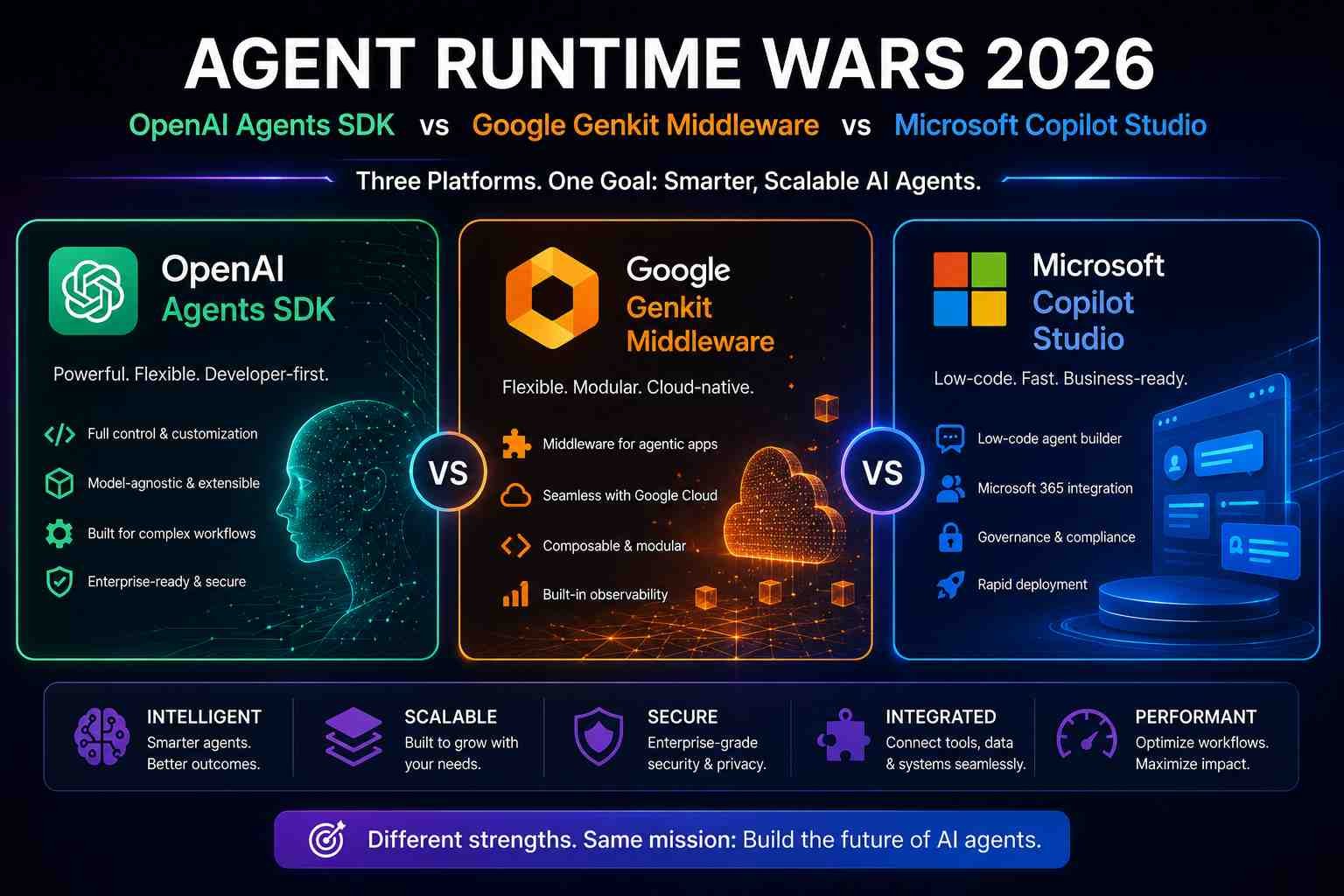
Over the last few weeks, three major moves made this shift obvious:
- OpenAI expanded the Agents SDK with native sandbox execution and checkpoint recovery.
- Google launched Genkit Middleware for production-grade guardrails and workflow interception.
- Microsoft pushed Copilot Studio toward stronger governance and richer in-chat app actions.
If you run a startup, product team, automation agency, or enterprise AI program, this matters immediately.
Your model can be excellent and your product can still fail if your runtime layer is weak.
The Quick Take
Here’s the short version before we go deeper.
| Platform | Core Strength | Best Fit | Main Risk |
|---|---|---|---|
| OpenAI Agents SDK | Model-native runtime + sandbox + recovery | Teams building custom agents with deep workflow control | Needs careful architecture and policy setup |
| Google Genkit Middleware | Interception layer for policy, routing, observability | Teams building agentic apps needing middleware governance | Still requires strong implementation discipline |
| Microsoft Copilot Studio | Enterprise governance + business workflow integration | Microsoft ecosystem-heavy organizations | Can feel constrained for fully custom runtime designs |
What stood out to me is that all three players are trying to become your default control plane for AI work, not just your default model endpoint.
Why This Topic Is Trending in May 2026
This trend has both news momentum and search intent momentum.
Official product announcements arrived close together in April and May 2026.
Developers and teams are now searching for practical comparisons, not theory.
Search demand is clustering around questions like:
- How do I build reliable agents that survive runtime failures?
- Where should policy enforcement happen in an agent stack?
- How do I add governance without killing velocity?
- Which platform is better for enterprise rollout?
That combination creates strong SEO potential because these are high-intent, decision-stage queries.
Keyword Strategy
Primary keyword: Agent Runtime Wars 2026
Secondary keywords: OpenAI Agents SDK, Genkit Middleware, Copilot Studio agent governance, enterprise agent framework
LSI keywords: agent orchestration, sandbox execution, middleware guardrails, runtime reliability, AI workflow governance
Long-tail keywords: OpenAI Agents SDK vs Genkit, best enterprise agent platform 2026, how to secure AI agent workflows, Copilot Studio vs custom agent runtime
What OpenAI Changed: Agents SDK Moves Closer to a Runtime Platform
OpenAI’s April 15, 2026 update to the Agents SDK was a meaningful architecture shift.
Instead of only helping with orchestration logic, it introduced runtime-focused capabilities that solve real production pain.
Key capabilities that matter
- Model-native harness: tighter alignment between model behavior and runtime workflow.
- Sandbox execution: safer file/tool work in isolated environments.
- Snapshotting and rehydration: restore task state if a container fails or expires.
In plain English: your agent can do meaningful work across files and tools, and if the environment dies, it can continue without starting over.
That sounds simple, but it fixes one of the biggest hidden problems in long-running agent jobs: fragile execution continuity.
Where OpenAI’s approach shines
- Code-heavy internal automations
- Document processing pipelines
- Agent workflows that need file-system interactions
- Task chains where restart costs are high
Where teams still need caution
- Policy boundaries must be explicit, not assumed.
- Sandbox permissions need careful design per task class.
- Recovery workflows should be tested under failure simulation.
Most people miss this: features like snapshotting are only valuable if your task design is deterministic enough to resume safely.
What Google Changed: Genkit Middleware Brings Agent Control to the Interception Layer
Google’s Genkit Middleware announcement (May 14, 2026) is less flashy but strategically important.
It gives teams a reusable interception layer where they can inject policy, transform requests, filter outputs, and harden agent behavior.
If OpenAI’s update focused on execution resilience, Google’s update focused on execution governance inside app logic.
Why middleware matters in agentic apps
Without middleware, many teams bake controls directly into prompts or ad hoc code.
That usually becomes brittle and hard to audit.
Middleware creates one policy layer that can be shared across routes, tools, and agents.
Practical middleware use cases
- Block disallowed topics before model invocation.
- Redact sensitive output patterns after generation.
- Route tasks to different models by risk tier.
- Log policy events for audit and debugging.
- Add deterministic approval checks before tool execution.
From a production standpoint, this is one of the cleanest ways to scale “trust by design” instead of bolt-on compliance later.
What Microsoft Changed: Copilot Studio Pushes Enterprise Agent Operations
Microsoft’s April 2026 Copilot Studio updates emphasized governance and business process integration.
The direction is clear: help organizations build agents that can operate inside existing enterprise controls and app ecosystems.
According to Microsoft’s updates, teams get stronger operational controls plus richer app experiences directly in Copilot Chat flows.
That means users can review and act in-place rather than jumping between disconnected systems.
Where Copilot Studio is strongest
- Microsoft 365-centric organizations
- Workflow automation around internal processes
- Teams that need governance defaults out of the box
- Cross-functional rollouts involving non-engineering stakeholders
Tradeoff to understand
If your team needs deep runtime customization at infrastructure level, a managed enterprise platform can feel less flexible than a code-first stack.
That doesn’t make it worse. It just means your decision should reflect your operating model.
OpenAI vs Google vs Microsoft: Architecture-Level Comparison
| Dimension | OpenAI Agents SDK | Google Genkit Middleware | Microsoft Copilot Studio |
|---|---|---|---|
| Primary abstraction | Agent runtime + sandboxed execution | Middleware control plane for agentic apps | Managed enterprise agent platform |
| Reliability posture | Checkpoint restore and state continuity | Policy interception and flow hardening | Operational controls within Microsoft ecosystem |
| Customization depth | High for code-first teams | High for framework-level policy design | Moderate to high within product boundaries |
| Best user persona | Developer-first builders | Full-stack teams with governance needs | Enterprise ops and business automation teams |
| Time-to-value | Medium (architecture work needed) | Medium (middleware design needed) | Fast for Microsoft-native organizations |
Decision Framework: Which Stack Should You Choose?
Use this quick framework before committing engineering time.
| If your priority is… | Prefer… | Why |
|---|---|---|
| Custom agent behavior + file/tool workflows | OpenAI Agents SDK | Strong runtime primitives and resilience patterns |
| Policy interception across multi-agent app routes | Google Genkit Middleware | Middleware architecture suits shared guardrail logic |
| Enterprise rollout speed and governance defaults | Microsoft Copilot Studio | Managed integration with business environments |
In my experience, many teams should not choose one forever.
A hybrid approach often wins: one platform for enterprise workflow operations, another for advanced custom agent pipelines.
Benefits for Different Team Types
For startups
- Faster path from prototype to reliable automation.
- Better chance to avoid brittle “demo-only” agents.
- Clearer competitive edge through workflow quality.
For enterprise teams
- More governance controls for risk-sensitive operations.
- Easier alignment with security and compliance functions.
- Reduced vendor-sprawl if stack choice is intentional.
For agencies and consultants
- Opportunity to productize reusable agent implementation playbooks.
- High demand for architecture migration and policy hardening work.
- Recurring revenue from managed agent operations.
Common Mistakes Teams Are Making Right Now
After reviewing many early deployments, these patterns show up repeatedly.
- Choosing a platform based on demo quality, not runtime reliability.
- Treating guardrails as prompt text instead of enforceable architecture.
- Skipping failure recovery tests for long-running jobs.
- Underestimating permission scoping for file and tool actions.
- Ignoring observability until incidents happen in production.
Honestly, most agent failures are not “model intelligence failures.”
They are workflow design and runtime governance failures.
Implementation Blueprint (30-60-90 Days)
First 30 days: foundation
- Pick one high-value workflow with clear ROI.
- Define policy boundaries and success metrics.
- Implement baseline logging and traceability.
Days 31-60: hardening
- Run adversarial testing for prompt injection and policy bypass.
- Add deterministic fallback paths for failed actions.
- Introduce human approval gates for irreversible operations.
Days 61-90: scale
- Expand to adjacent workflows only after stability benchmarks pass.
- Create reusable templates for policy and runtime configuration.
- Publish internal runbooks for incident response and change management.
This is where teams either build durable advantage or create hidden technical debt.
Future Predictions: What Happens Next
Here are the trends likely to define the next 12 months:
- Runtime reliability features will become a major buying criterion.
- Middleware-based governance will become standard in regulated workflows.
- Enterprise buyers will demand explainable action logs from agents.
- Hybrid stacks will increase as teams separate consumer UX and backend execution.
- Vendors will compete on ecosystem lock-in at the runtime layer, not just model quality.
If you publish in AI and tech, this is a strong authority topic because it combines product news, architecture choices, and business impact in one narrative.
FAQ: Agent Runtime Wars 2026
1) What is an agent runtime?
An agent runtime is the execution layer that manages tasks, tools, files, permissions, retries, and state continuity for AI agents.
2) Why is runtime more important now?
OpenAI added model-native harness improvements, sandbox execution, and snapshot/rehydration capabilities to the Agents SDK.
3) What did OpenAI change in April 2026?
As agents take real actions, reliability and governance matter more than raw model output quality.
4) What does Genkit Middleware solve?
It gives teams a structured interception layer to enforce policy, route logic, and audit behavior consistently across agent flows.
5) Is Copilot Studio only for non-technical users?
No. It supports technical and operational teams, especially in Microsoft-centric organizations with enterprise governance requirements.
6) Which option is best for startups?
It depends on stack and speed needs, but code-first teams often benefit from OpenAI or Genkit flexibility in early-stage product iteration.
7) Can these platforms be used together?
Yes. Many teams use hybrid architectures, combining managed enterprise tools with custom runtime pipelines.
8) What’s the biggest deployment risk?
Weak policy enforcement and missing failure recovery paths are two of the most common causes of production issues.
9) How should teams evaluate success?
Track task completion quality, manual rework rate, incident frequency, and time-to-resolution for failed actions.
10) Will this impact SEO and content strategy?
Yes. Decision-stage readers are actively searching for platform comparisons and implementation guidance, creating high-value content opportunities.
Final Thoughts
2026 is the year AI teams realize a hard truth.
Great model output is not enough.
Execution quality is the moat.
And execution quality comes from runtime architecture, policy design, and operational discipline.
If you pick the right stack now and build deliberately, you can create an advantage that is hard for competitors to copy.
Want the next article in this series?
We can publish a practical “Agent Runtime Checklist” with architecture templates, policy blocks, and deployment QA gates you can copy into your team workflow.
Follow DigitalBrief.in for weekly AI implementation breakdowns that go beyond headlines.