The Rise of Agentic AI: How Autonomous Workflows Are Replacing Chatbots in 2026
Published: May 2026 | Category: Artificial Intelligence, Business Technology, Marketing Strategy
Summary: The Quick Answer
Agentic AI refers to autonomous artificial intelligence systems capable of planning, decision-making, and executing multi-step tasks without continuous human input. In 2026, the industry has decisively shifted from reactive chatbots to proactive AI agents — powered by OpenAI, Google Gemini, and Meta’s restructured AI divisions. For businesses, this means rethinking workflows, marketing strategies, and digital visibility through frameworks like AEO (Answer Engine Optimization) and GEO (Generative Engine Optimization).
The Agentic Revolution: Why Chatbots Are Yesterday’s News
Not long ago, a chatbot that could answer a customer’s shipping question felt cutting-edge. By May 2026, that same chatbot looks as antiquated as a fax machine. The AI industry has entered what analysts are calling the Agentic Era — a fundamental transformation in how artificial intelligence operates within organizations.
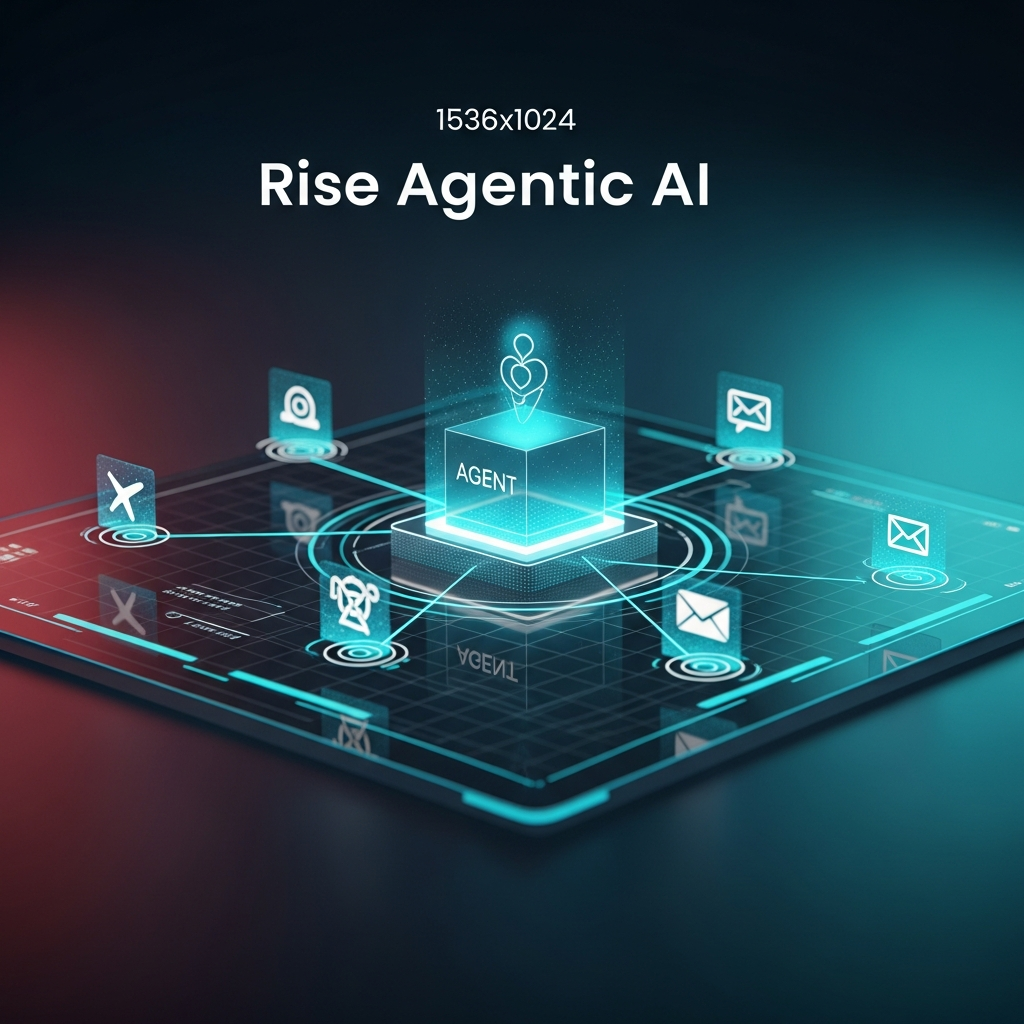
Unlike traditional large language model (LLM) chatbots, which respond to individual prompts, agentic AI systems operate with persistent memory, tool-use capabilities, and the ability to decompose complex goals into executable sub-tasks. An agentic AI doesn’t just answer “What’s the best marketing strategy?” — it researches the competitive landscape, drafts a campaign brief, schedules a team meeting, and books the ad placements, all autonomously.
This shift is being driven by three converging forces: dramatically improved reasoning in frontier models, the widespread availability of tool-calling APIs, and enterprise demand for measurable automation ROI. According to industry observers, over 60% of Fortune 500 companies are now piloting or deploying agentic AI systems in at least one core business function — a figure that stood near zero just 24 months ago.
The implications are profound. Roles in data entry, first-level customer support, market research, and routine code review are being augmented — and in some cases, replaced — by autonomous agent pipelines. The question for business leaders is no longer whether to adopt agentic AI, but how fast and at what risk tolerance.
OpenAI, Google, and Meta: The Institutional Shift to Agents
OpenAI’s Rumored ‘DeployCo’ Enterprise Consulting Arm
OpenAI has long positioned itself as a research-first organization, but 2026 signals a pivotal strategic pivot. Industry insiders and enterprise technology reporters have surfaced persistent rumors of an internal initiative codenamed “DeployCo” — a dedicated enterprise consulting arm designed to help large organizations architect, deploy, and manage production-grade AI agent systems.
If confirmed, DeployCo would represent OpenAI’s most direct move into professional services, competing directly with Accenture, Deloitte, and McKinsey’s AI practices. The reported focus is on agentic workflow design: helping enterprises map their existing processes, identify automation candidates, and integrate OpenAI’s models — including GPT-5 and the o-series reasoning models — into live operational pipelines. For the business world, this would mean OpenAI is no longer just a model provider but a full-stack implementation partner.
Google Gemini: Agentic Features Embedded in Android
Google has moved with notable urgency to embed agentic capabilities directly into consumer and enterprise surfaces. The latest Android releases now feature Gemini-powered agentic functions that can execute multi-step tasks on behalf of users — booking restaurants while checking calendar availability, filing travel expenses by reading emails and receipts, and autonomously managing app interactions without manual navigation.
These features mark a decisive move beyond the assistant paradigm. Gemini on Android no longer waits for explicit commands; it anticipates, plans, and acts. Google’s enterprise suite — Workspace — mirrors this trajectory, with Gemini agents now capable of drafting reports, summarizing threads, scheduling across time zones, and triggering workflows in connected SaaS tools, all within a single natural language instruction.
Meta’s Internal Reorganization for AI Groups
Meta has responded to the agentic moment with a sweeping internal reorganization. The company has consolidated its AI research, product, and infrastructure teams under a unified Agentic AI Division, dissolving previous siloes between FAIR (Fundamental AI Research) and the product-facing AI teams. This structural shift signals Meta’s intent to accelerate the pipeline from foundational research to real-world agent deployment at scale.
Meta’s focus areas include social commerce agents — AI that can autonomously manage product listings, respond to buyer inquiries, and optimize ad targeting on Facebook and Instagram — as well as internal productivity agents for Meta’s own engineering and operations workforce. The reorganization is widely interpreted as Meta’s acknowledgment that the competitive battleground has permanently shifted from model benchmarks to real-world agent deployment.
The New Marketing Frontier: AEO and AI Citation Visibility
What Is AEO and Why It Matters in 2026
Answer Engine Optimization (AEO) is the practice of structuring digital content so that AI-powered answer engines — including ChatGPT, Perplexity, Google’s AI Overviews, and voice assistants — surface your content as a direct, cited response. As agentic AI systems increasingly serve as the primary interface between users and information, traditional SEO rankings matter less than whether your brand appears in AI-generated answers.
Complementing AEO is GEO (Generative Engine Optimization), which focuses on making content legible and trustworthy to generative models — ensuring your data, claims, and expertise are encoded in a format that LLMs recognize as authoritative. Together, AEO and GEO represent the new frontier of digital visibility.
HubSpot’s AEO Sensor and Microsoft’s AI Citation Tracking
The marketing technology ecosystem has rapidly developed tooling to help brands navigate this new landscape. HubSpot has introduced its AEO Sensor — a feature set within its Marketing Hub that tracks how often and in what context a brand’s content is cited by major AI answer engines. The tool provides share-of-voice metrics across platforms like ChatGPT, Perplexity, and Google’s AI Overviews, giving marketers a new KPI dashboard built entirely around AI citation performance.
Simultaneously, Microsoft has embedded AI citation tracking directly into its Clarity and Advertising analytics platforms, allowing brands to measure referral traffic and impression share originating from Copilot-powered responses across Bing, Edge, and Microsoft 365. These tools represent an industry acknowledgment that AI engines are now a primary traffic source — and that visibility within them requires dedicated optimization strategies distinct from traditional search.
How Businesses Can Prepare for Autonomous AI
1. Audit Your Workflow for Automation Candidates
Begin by mapping all recurring, rule-based, or data-intensive workflows within your organization. Accounts payable processing, lead qualification, content publishing pipelines, and IT ticket triage are high-value candidates for early agentic deployment. Prioritize processes where speed and consistency matter more than nuanced human judgment.
2. Invest in Structured Data and Clean Knowledge Bases
Agentic AI is only as good as the data it can access. Organizations that maintain structured, well-documented internal knowledge bases — product information, policies, FAQs, process documentation — will see dramatically better agent performance. This is also the foundation of GEO: structured, authoritative content that AI can cite confidently.
3. Build an AEO Content Strategy
Work with your content and SEO teams to audit existing assets for AEO readiness. Ensure key product pages, service descriptions, and thought-leadership articles use structured headers, concise direct-answer paragraphs, and FAQ sections formatted for schema markup. Monitor AI citation share using tools like HubSpot’s AEO Sensor and Microsoft’s citation analytics.
4. Establish AI Governance Frameworks
Autonomous agents that can take real-world actions — sending emails, making purchases, modifying files — require robust governance. Define clear permission boundaries, audit trails, and human-in-the-loop checkpoints for high-stakes decisions. The organizations that deploy agents safely and responsibly will build the trust needed to scale them further.
5. Retrain and Reposition Your Workforce
The most effective organizations are investing in “AI orchestration” skills — teaching employees to design, monitor, and improve agent pipelines rather than perform the underlying tasks manually. This shift positions workers as strategic overseers rather than operational executors, a transition that requires deliberate training investment today.
Frequently Asked Questions About Agentic AI
What is agentic AI?
Agentic AI refers to artificial intelligence systems that can autonomously plan, make decisions, and execute multi-step tasks to achieve a goal — without requiring constant human input at each step. Unlike basic chatbots, agentic AI uses tools, memory, and reasoning to complete complex workflows independently.
How is agentic AI different from a chatbot?
A chatbot responds reactively to individual prompts, one at a time. An agentic AI system operates proactively — it can break a large goal into sub-tasks, use external tools (like web search, code execution, or API calls), remember context across sessions, and complete entire workflows without human intervention at every step.
What is AEO (Answer Engine Optimization)?
AEO, or Answer Engine Optimization, is the process of optimizing content so that AI-powered answer engines — like ChatGPT, Perplexity, and Google’s AI Overviews — surface your brand’s content as a direct, cited answer. It involves using structured data, concise direct-answer formatting, and authoritative content signals.
What is GEO (Generative Engine Optimization)?
GEO, or Generative Engine Optimization, focuses on making content easily understandable and citable by large language models. It emphasizes structured formatting, factual accuracy, clear attribution, and content depth — ensuring that generative AI tools recognize your content as a trustworthy source to include in their responses.
What is OpenAI’s DeployCo?
DeployCo is a rumored enterprise consulting initiative from OpenAI, reportedly focused on helping large organizations design and deploy production-grade agentic AI systems. If confirmed, it would position OpenAI as a professional services provider alongside its existing role as an AI model developer.
How is Google using Gemini for agentic tasks?
Google has integrated Gemini-powered agentic features into Android and Google Workspace. These features allow Gemini to execute multi-step tasks autonomously — such as booking appointments, summarizing emails and drafting replies, managing calendar conflicts, and triggering workflows in connected apps — based on a single natural language instruction.
What did Meta do with its AI organization in 2026?
Meta restructured its internal AI teams in 2026, merging its fundamental AI research division (FAIR) with its product-facing AI groups into a unified Agentic AI Division. The reorganization was designed to accelerate the path from research breakthroughs to real-world agent deployment across Meta’s platforms including Facebook, Instagram, and WhatsApp.
How can my business start using agentic AI?
Start by identifying high-volume, repetitive workflows in your business — such as lead qualification, customer support triage, or invoice processing. Evaluate platforms like OpenAI’s API (with function calling), Google’s Vertex AI Agent Builder, or Microsoft Copilot Studio. Ensure your internal data is structured and accessible, establish governance policies, and pilot with a low-risk workflow before scaling.
What tools exist for tracking AI citation visibility?
HubSpot’s AEO Sensor tracks how often your brand is cited by major AI answer engines and provides share-of-voice metrics. Microsoft’s Clarity and Advertising platforms offer AI citation tracking for Copilot-powered responses across Bing and Edge. Specialized tools like Profound, Otterly.AI, and Share of Voice dashboards on Perplexity also help marketers monitor AI citation performance.
Is agentic AI safe to use in enterprise environments?
Agentic AI can be deployed safely in enterprises when proper governance frameworks are in place. This includes defining clear permission scopes for each agent, maintaining audit logs of all actions taken, implementing human-in-the-loop review for high-stakes decisions, and conducting regular security reviews of agent pipelines. Safety and reliability improve significantly when agents operate within clearly bounded, well-tested domains.