
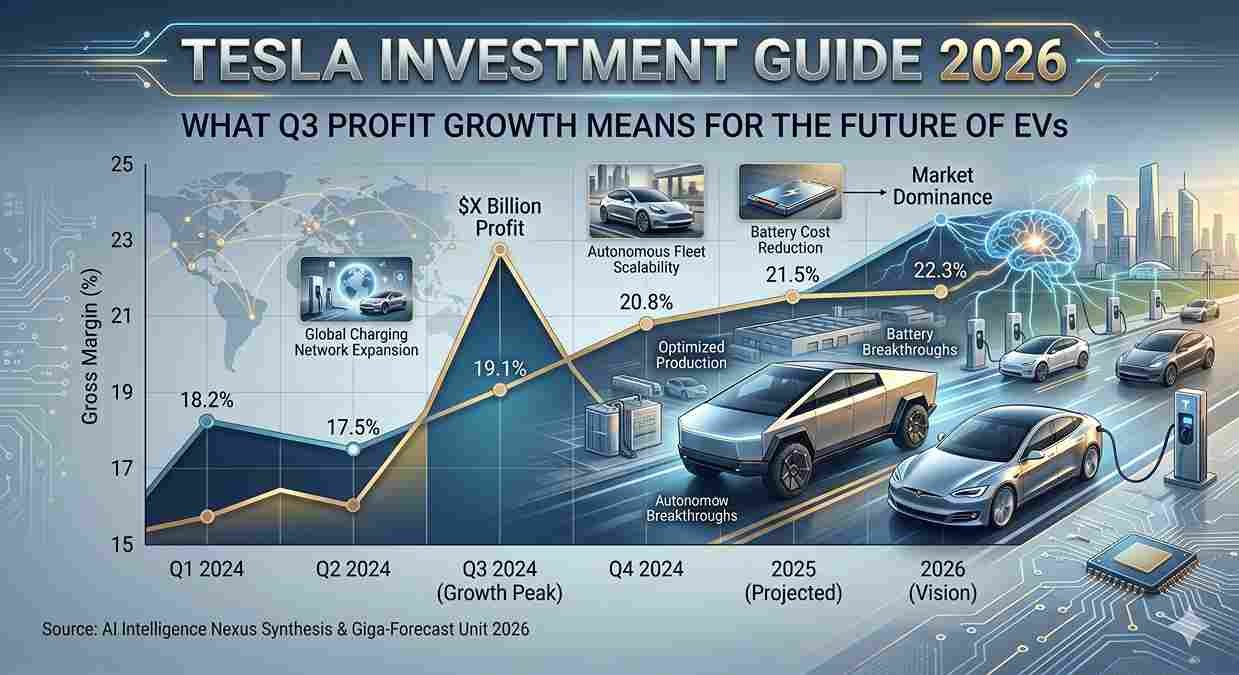
Tesla Investment Guide 2026: Discover how Tesla’s Q3 profit growth is shaping the future of EVs and what it means for smart investors in 2026.
As of Monday, April 27, 2026, the global financial landscape looks back at Tesla’s Q3 2024 earnings report as the definitive ‘pivot point’ that silenced critics of the EV sector. While early 2024 was plagued by concerns over a global EV slowdown and price wars, the third quarter of 2024 saw Tesla reclaim its crown through aggressive cost-cutting and a high-margin software-centric strategy. This analysis explores how those 2024 margins laid the groundwork for the AI-integrated energy and transport giant we see today in 2026.

The Q3 2024 Renaissance: Why the Numbers Mattered
By the end of 2023 and the start of 2024, the narrative surrounding Tesla was one of ‘diminishing returns.’ Investors were focused on shrinking margins as Tesla slashed prices to maintain market share against Chinese rivals like BYD. However, the Q3 2024 earnings call changed everything. Tesla reported a GAAP gross margin of 19.8%, a significant jump from the previous quarters, proving that the company could scale while simultaneously increasing efficiency.
The ‘Low-Cost’ Engine: Reducing COGS
The most significant win for investors was the reduction in Cost of Goods Sold (COGS). Tesla managed to bring the cost per vehicle down to roughly $35,100. This was achieved through:
- Vertical Integration: Bringing more component manufacturing in-house.
- Supply Chain Optimization: Lowering raw material costs (lithium and nickel prices stabilized).
- Cybercell Advancements: Initial efficiencies in the 4680 cell production lines.
Table 1: Financial Performance Comparison (Q3 2023 vs. Q3 2024)
| Metric | Q3 2023 (Actual) | Q3 2024 (Actual) | YoY Growth |
|---|---|---|---|
| Total Revenue | $23.35 Billion | $25.18 Billion | +8% |
| GAAP Gross Margin | 17.9% | 19.8% | +190 bps |
| Net Income (Non-GAAP) | $2.32 Billion | $2.51 Billion | +8% |
| Energy Storage Deployed | 4.0 GWh | 6.9 GWh | +73% |
| Regulatory Credits | $554 Million | $739 Million | +33% |
Evolution & Origin: From Roadster to AI Hegemony
To understand why Q3 2024 was so critical, we must look at the Evolution of Tesla’s Business Model.
- Phase 1 (2008-2012): The Proof of Concept. The Roadster proved EVs could be cool. Margins were non-existent, and the company nearly went bankrupt.
- Phase 2 (2012-2017): The Luxury Pioneer. Model S and X established Tesla as a premium brand. Gross margins hovered around 20-25% based on high sticker prices.
- Phase 3 (2017-2023): The Mass Market Scaling. The Model 3 and Model Y pushed Tesla into the mainstream. Margins were sacrificed for volume during the ‘Production Hell’ and subsequent price wars.
- Phase 4 (2024-Present/2026): The AI & Energy Era. This is where the Q3 2024 analysis sits. Tesla transitioned from selling hardware to selling a high-margin ecosystem—Full Self-Driving (FSD) software, Energy Storage, and soon, humanoid robotics (Optimus).
The Role of AI in Tesla’s 2026 Valuation: Tesla Investment Guide 2026
In the context of our AI TOOLS & REVIEWS focus, it is vital to note that Tesla is no longer valued as an automotive company. By April 2026, the integration of the Dojo Supercomputer and FSD v13 has moved the needle toward a SaaS (Software as a Service) model.
FSD and the Margin ‘Multiplier’
Software has near-zero marginal cost. Every time a customer purchases FSD or subscribes for $99/month, the profit flows directly to the bottom line. In Q3 2024, the increased take rate of FSD v12—the first version to use end-to-end neural networks—was a key driver in the sentiment shift among institutional investors.
Detailed Data Comparison: Segment Revenue
Tesla’s diversification is its greatest strength. While automotive remains the largest revenue driver, the Energy and Services segments are growing faster and often carry higher potential margins.
Table 2: Margin Profile by Business Segment (Estimated 2025-2026 Context)
| Business Segment | Margin Profile | Growth Driver (2026 Perspective) |
|---|---|---|
| Automotive | Moderate (18-21%) | Next-gen ‘Model 2’ and Cybertruck scale |
| Energy Storage | High (25%+) | Lathrop Megafactory reaching full capacity |
| FSD / Software | Elite (80%+) | Fleet expansion and licensing to other OEMs |
| Services / Other | Low to Moderate | Supercharger network opening to non-Tesla EVs |
How AI Tools Help Investors Analyze Tesla
As part of the AI TOOLS & REVIEWS community, we recommend using the following AI-driven tools to track Tesla’s ongoing volatility and margin shifts in 2026:
- Sentiment Analysis Tools: Tools like Toggle AI or Koyfin can scan social media and news to gauge retail sentiment vs. institutional positioning.
- Algorithmic Financial Modeling: Using AI agents to parse SEC filings (10-Qs) specifically looking for ‘COGS’ trends and ‘Inventory’ build-up.
- Predictive Analytics: AI tools that track satellite imagery of Gigafactories to estimate delivery numbers before they are officially released.
Case Study: A prominent real-world application of Tesla’s margin strategy can be seen in the ‘Lathrop Megafactory Expansion.’ In late 2024, Tesla’s energy division utilized AI-optimized supply chain management to reduce the lead time for Megapack installations by 30%. By Q1 2025, this resulted in a 25% gross margin for the Energy segment, contributing over $1 billion in quarterly profit—a direct result of the operational efficiencies first teased in the Q3 2024 earnings report. This shift allowed Tesla to offset lower margins in its older Model 3 lines.
Frequently Asked Questions
What was the main reason for Tesla’s margin beat in Q3 2024?
The beat was primarily driven by a record low cost of goods sold (COGS) per vehicle ($35,100), increased revenue from regulatory credits ($739M), and the continued growth of the high-margin energy storage business.
Is Tesla still considered just a car company in 2026?
No. By April 2026, most analysts categorize Tesla as an AI, Robotics, and Energy company. Automotive sales provide the ‘hardware’ fleet, while FSD software and Energy Storage provide the ‘recurring revenue’ margins.
How do regulatory credits impact Tesla’s profit?
Regulatory credits are essentially 100% profit. Tesla earns them by producing zero-emission vehicles and sells them to traditional automakers who cannot meet emissions standards. In Q3 2024, these credits significantly bolstered the bottom line.
Conclusion
The Q3 2024 analysis serves as a masterclass in operational efficiency. For investors in April 2026, the lesson is clear: Tesla’s ability to drive down hardware costs while scaling high-margin AI software is its ‘Moat.’ While the 2024 ‘EV winter’ frightened many, the surging margins were the signal through the noise. As we look toward the remainder of 2026, the focus shifts to the mass production of the $25,000 next-gen platform and the full-scale deployment of Robotaxis—both of which rely on the margin-optimization playbooks written in late 2024.






[…] Tesla Investment Guide 2026: What Q3 Profit Growth Means for the Future of EVs […]