Claude Identity Verification: What AI Users Must Know
Introduction
Something changed in June 2026 that many Claude users almost missed. Buried inside a “Privacy Policy Update Notice” email that landed in millions of inboxes was a sentence with far-reaching implications: “In certain circumstances, we may ask you to verify your age or identity.”
For an AI chatbot that millions of people use daily for writing, coding, research, and increasingly complex autonomous tasks, that sentence is anything but routine. It signals a fundamental shift in the relationship between AI users and AI providers — one that trades a degree of anonymity for accountability in a world where AI is becoming genuinely powerful.
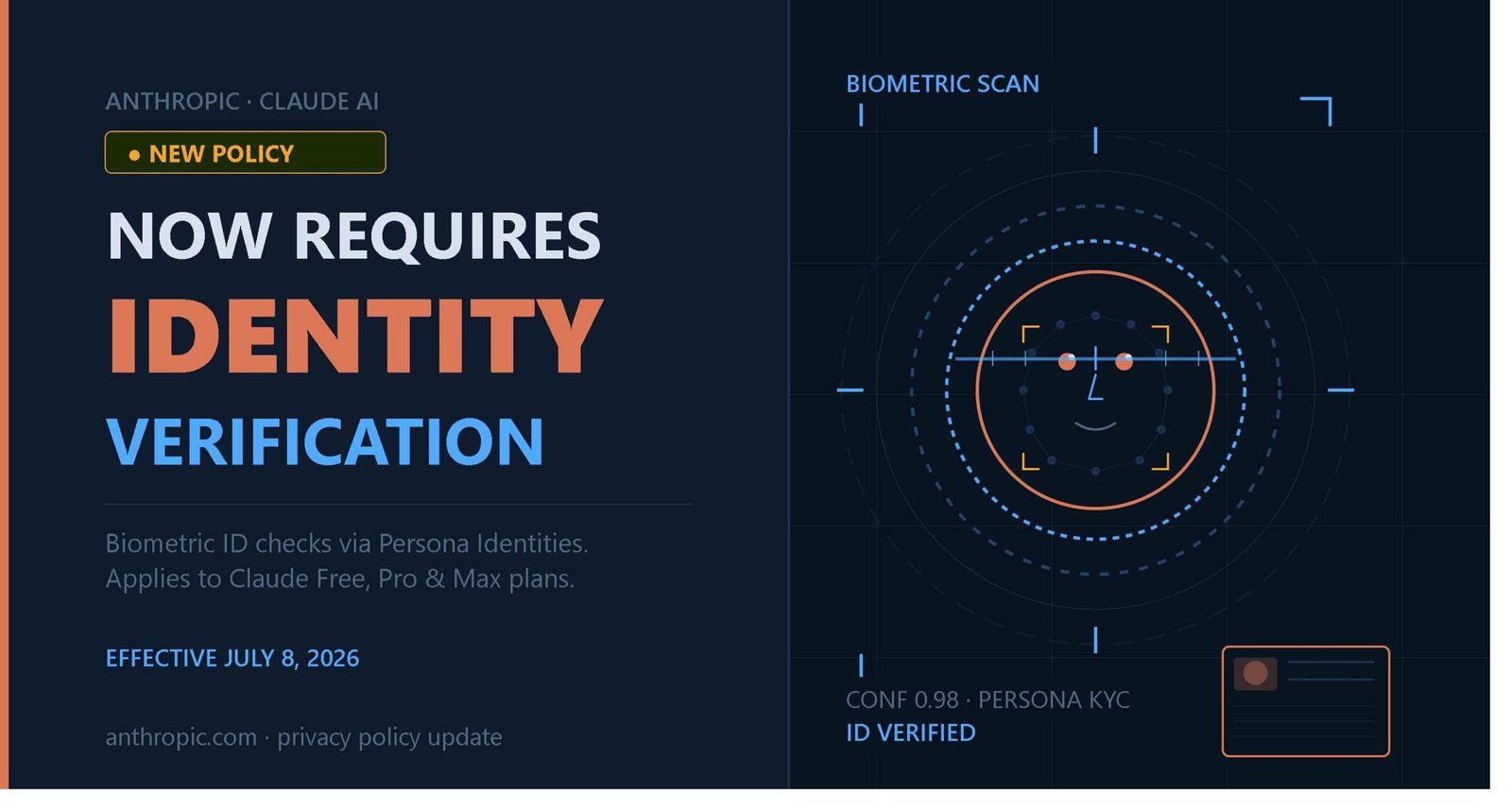
The policy, which Anthropic published around June 8, 2026 and which takes full effect on July 8, 2026, places Claude in new territory. As of the date of this article’s publication, neither OpenAI’s ChatGPT nor Google’s Gemini requires identity verification for standard consumer access. Claude is now the first major frontier AI model to formally codify biometric identity collection — government ID documents, live selfies, and “facial geometry templates” — as part of its consumer data infrastructure.
This article explains exactly what is changing, who is affected, what data is at stake, and what it all means for the future of AI access.
Key Takeaways
- Anthropic published an updated privacy policy on June 8, 2026, effective July 8, 2026, formally authorizing identity and age verification for Claude users.
- Limited biometric ID verification had already been active since April 14, 2026 through third-party vendor Persona Identities.
- Verification may require a physical government-issued photo ID, a live selfie, and may capture facial geometry templates (biometric data).
- The policy applies only to consumer plans — Claude Free, Pro, and Max — not to Team, Enterprise, or API customers.
- Verification data is processed by Persona, not stored on Anthropic’s servers, and will not be used to train AI models.
- The exact triggers for a verification check are not publicly disclosed by Anthropic.
- Neither ChatGPT nor Gemini requires comparable identity verification as of June 2026.
- The move is linked in part to the US Commerce Department’s June 12, 2026 export control directive restricting foreign access to Anthropic’s most powerful models.
What Is the Identity Verification Requirement?
Anthropic’s identity verification system requires certain Claude users to confirm who they are by submitting a government-issued ID and, in some cases, completing a live biometric check before gaining or maintaining access to the platform.
According to Anthropic’s official Help Center, the company explains: “We are rolling out identity verification for a few use cases, and you might see a verification prompt when accessing certain capabilities, as part of our routine platform integrity checks, or other safety and compliance measures.”
The verification framework introduces a new data category into Anthropic’s privacy policy — “Verification Data” — which formally names the types of information that may be collected during the process.
What the New “Verification Data” Category Covers
The updated policy explicitly states that verification data may include:
- An image of a government-issued identity document and all personal information on it (name, date of birth, ID number)
- A photo or video of the user’s face
- Facial geometry templates, which Anthropic itself acknowledges “may be considered biometric data in some jurisdictions”
- The result of the verification (e.g., whether the user’s age meets a specific threshold)
For age-only checks — where the only question is whether a user is 18 or older — Anthropic uses a separate vendor called Yoti, which returns only a pass/fail result without passing underlying ID images or biometric data to Anthropic.
Timeline: When Did This Start?
Understanding the timeline is essential for cutting through the confusion that has spread online.
| Date | Event |
|---|---|
| April 14, 2026 | Anthropic quietly enables limited ID verification via Persona Identities for “a few use cases” |
| April 15, 2026 | Official Help Center page for identity verification goes live |
| April 16, 2026 | User backlash begins; verification confirmed by multiple tech publications |
| June 8, 2026 | Anthropic publishes updated privacy policy formally codifying verification practices |
| June 10–12, 2026 | Users begin receiving “Notice of Privacy Policy Update” emails |
| June 12, 2026 | US Commerce Dept. issues export control directive on Fable 5 and Mythos 5 |
| July 8, 2026 | Full policy takes effect for consumer-tier Claude users |
A key misconception circulating online is that July 8 represents an entirely new policy. In reality, as confirmed by multiple sources, the identity verification mechanism was already active on Claude’s platform since April 14, 2026. The July 8 date marks the formal codification of that practice in Anthropic’s consumer privacy documentation.
Who Is Affected?
The policy divides Claude’s user base into two clear camps.
Plans Subject to Identity Verification
- Claude Free (no subscription)
- Claude Pro
- Claude Max
Plans Exempt from Identity Verification
- Claude Team
- Claude Enterprise
- Claude API / Platform users operating under Commercial Terms
This division is significant. Individual consumers — often the most privacy-sensitive users — bear the full weight of the new requirements. Enterprise and business customers, who operate under separate commercial terms and are more directly accountable to corporate compliance frameworks, are not subject to the same biometric checks.
How the Verification Process Works
According to Anthropic’s official documentation, verification is designed to take under five minutes. Here is what users need to have ready:
- A valid government-issued photo ID — the physical document, in hand (not a photocopy, scan, or digital version)
- A phone or computer with a working camera — a live selfie may be required
- A few minutes — the process typically completes in under five minutes
Accepted Forms of ID
| Accepted Document Types | Not Accepted |
|---|---|
| Passport | Photocopies or scanned images |
| Driver’s license or state/provincial ID card | Digital or mobile driver’s licenses |
| National identity card | Student IDs or employee badges |
| Government-issued photo ID (most countries) | Temporary paper IDs |
| Bank cards, library cards |
The ID must be issued by a government, clearly legible, undamaged, and include a photo of the holder.
What Happens After Submission
Once submitted, all verification data is passed to Persona Identities. Anthropic has access to verification records through Persona’s platform when needed — for example, to review an appeal — but does not copy or store ID images on its own systems.
The Persona Partnership: Who Is Actually Processing Your Data?
The company entrusted with processing Claude users’ government IDs, selfies, and facial geometry data is Persona Identities, a San Francisco-based Know Your Customer (KYC) platform. In this arrangement:
- Anthropic is the data controller — it sets the rules for how the data is used and retained.
- Persona is the data processor — it executes the verification under Anthropic’s instructions.
Why Persona Has Drawn Scrutiny
Persona’s selection has raised legitimate concerns on two fronts.
First, an investor overlap: Founders Fund — the venture firm co-founded by Peter Thiel — has invested in both Persona Identities and Anthropic. Critics argue this creates a conflict of interest when selecting a vendor to handle users’ most sensitive biometric data.
Second, a February 2026 security incident: Security researchers found Persona’s government dashboard codebase sitting on a publicly accessible FedRAMP-authorized endpoint, exposing 2,456 files totaling 53 megabytes without requiring any exploit. The exposed code also revealed that Persona is capable of running 269 distinct verification checks — far beyond simple age or identity confirmation — including screening users against terrorism and espionage watchlists, monitoring adverse media across 14 categories, and filing Suspicious Activity Reports directly.
Anthropic has stated it selected Persona “based on the strength of their technology, privacy controls, and security safeguards,” but has not publicly addressed the investor overlap or the February security incident directly.
Persona’s Contractual Limitations (Per Anthropic)
According to Anthropic’s Help Center, Persona is contractually restricted to:
- Using verification data only to provide and support verification services
- Improving their ability to prevent fraud
- Deleting data in line with retention limits Anthropic has set and applicable law
- Encrypting all data in transit and at rest
Why Anthropic Is Implementing Identity Verification
Anthropic has offered a brief, official explanation: to “keep our services safe and secure.” Analysts and reporting from multiple outlets point to several underlying drivers.
1. Abuse Prevention and Policy Enforcement
As AI models gain agentic capabilities — booking flights, executing code, managing documents, and taking multi-step real-world actions — the question of who is authorizing those actions becomes a safety issue. Knowing user identities helps Anthropic enforce its usage policies and prevent account-sharing, multi-account abuse, and fraudulent access.
2. Export Control Compliance
On June 12, 2026, the US Commerce Department issued a directive under the Export Control Reform Act of 2018, ordering Anthropic to suspend access to its most advanced models (Fable 5 and Mythos 5) for foreign nationals. Since Anthropic lacked infrastructure to verify user nationality at that point, it had no choice but to remove the models from rotation entirely. Identity verification creates the foundation for restoring access to verified US persons without waiting for a formal government agreement.
3. Regulatory Pressure
Over two dozen US states have passed digital safety laws requiring age verification for minors’ access to online platforms, and several specifically address AI assistants and chatbots. Internationally, GDPR frameworks and emerging biometric privacy laws further pressure AI companies to know who their users are. Anthropic frames the current policy as proactive compliance rather than a direct response to any specific law.
4. Distillation Concerns
Techzine Global reports that Anthropic has long been concerned about “distillation” — the copying and replication of its models by foreign competitors, particularly from China. Verified user identity is one layer of defense against systematic model extraction at scale.
Competitive Landscape: How Claude Now Compares
Claude’s identity verification requirement sets it apart from every other major AI chatbot platform as of June 2026.
| Feature | Claude (Anthropic) | ChatGPT (OpenAI) | Gemini (Google) |
|---|---|---|---|
| Government ID required | Yes (certain conditions) | No | No |
| Live selfie / facial biometric | Yes (certain conditions) | No | No |
| Age verification | Yes (via Yoti) | No (standard consumer) | No |
| Third-party KYC processor | Persona Identities | N/A | N/A |
| Biometric data collected | Facial geometry templates | None | None |
| Policy effective date | July 8, 2026 | — | — |
| Business/Enterprise exempt | Yes | N/A | N/A |
| Data used for model training | No | No | No |
Note: OpenAI introduced mandatory ID verification for API access in October 2025, suggesting the industry is moving in this direction — but ChatGPT’s consumer product does not currently require it.
User Concerns and Backlash
The reaction from Claude’s user base has been sharply negative in many quarters. On X (formerly Twitter), the announcement generated heated discussion. One user wrote: “No AI without gov-issued ID. All AI use tracked to individual — no private AI.” Another characterized the verification requirement as handing “a competitive advantage to ChatGPT and Gemini by adding friction that rivals do not require.”
False-Positive Suspensions
Starting in April 2026, multiple Claude Pro subscribers reported that Anthropic’s automated classifiers incorrectly flagged their accounts as belonging to minors and suspended access — disrupting active projects and erasing conversation histories. Some accounts were reinstated after submitting ID. Others received refunds but had their accounts permanently closed. Anthropic has not disclosed the false-positive rate for its age-detection classifiers.
Uncertainty About Triggers
A central complaint is that Anthropic has not disclosed what specifically triggers a verification request. The company’s official language — “certain circumstances,” “specific scenarios,” “routine platform integrity checks” — leaves users uncertain about when and why they might be prompted. This opacity makes planning and compliance difficult, particularly for professionals and developers running complex automated workflows.
Accessibility Gaps: Who Could Be Left Out?
The verification requirements create access barriers for specific user segments.
Chinese Users Without Passports
Anthropic accepts national ID cards from most countries, but Chinese national ID cards are not on the accepted list. For Chinese users, the only accepted Chinese government document is a passport. Given that passport ownership is not universal in China, this potentially excludes a significant population of legitimate users.
Users in Countries with Limited Document Recognition
Although Anthropic states it accepts government-issued IDs from “most countries,” the exact list of accepted documents by country has not been published in full. Users in countries where common national ID formats are not recognized could face permanent exclusion.
Users Without Camera-Enabled Devices
The live selfie requirement presupposes access to a camera-equipped device. Users without this hardware — including some older device users and certain accessibility cases — may face barriers to completing verification.
Anthropic’s Privacy Commitments: What the Company Says It Will Not Do
Despite the new data collection requirements, Anthropic has reaffirmed several privacy boundaries in its updated policy:
| Privacy Commitment | Anthropic’s Position |
|---|---|
| Use verification data for model training | ❌ Will NOT do this |
| Sell user data | ❌ Will NOT do this |
| Serve ads in Claude | ❌ Claude remains ad-free |
| Share ID data with third parties for marketing | ❌ Will NOT do this |
| Store ID images on Anthropic’s own servers | ❌ Stored with Persona only |
| Require more data than necessary | ❌ “Collect minimum information required” |
Users also retain the existing opt-out mechanism for having conversations used to improve Claude’s models — a separate, pre-existing control unaffected by the new verification policy.
Real-World Case Study: The Adult User False-Positive Problem
Company/Organization: Verified adult Claude Pro subscribers (multiple users, reported April–June 2026)
Challenge: Following the April 2026 rollout of automated age-detection classifiers, Anthropic’s system began flagging adult accounts as potentially belonging to minors. Affected users were suspended without warning, losing access to ongoing projects and their full conversation histories. No prior notification was sent before suspension.
Strategy Implemented: Users who received suspension notices were directed to submit government-issued ID through Persona to reinstate their accounts. Some appealed through Anthropic’s Safeguards team via the appeal form at claude.ai.
Results Achieved: Some accounts were successfully reinstated after ID verification confirmed the users were adults. Other users received refunds for unused subscription periods but did not have their accounts or conversation histories restored.
Key Lessons Learned:
- Automated classifiers are not infallible — false positives at scale create real harm for legitimate users.
- The absence of a disclosed false-positive rate makes it impossible for users to assess their risk of wrongful suspension.
- The loss of conversation history is an unaddressed consequence of account suspension — Anthropic’s current process does not appear to restore project data even when appeals succeed.
- The incident foreshadows what may happen more broadly after July 8, 2026, if verification prompts are poorly calibrated.
Pros and Cons of Claude’s Identity Verification Policy
| Category | Pro | Con |
|---|---|---|
| Safety | Reduces abuse, multi-account fraud, and unauthorized access | Potential for false positives to harm legitimate users |
| Compliance | Positions Anthropic to satisfy export control requirements | Compliance burden falls disproportionately on individual consumers |
| Security | Verification data encrypted in transit and at rest | Persona had a significant security incident in February 2026 |
| Transparency | Help Center explains process and accepted documents | Triggers for verification checks are not disclosed |
| Data Use | ID data not used for model training | No published data retention period for Persona’s copy of the data |
| Accessibility | Supports most countries’ government IDs | Chinese national IDs not accepted; excludes users without cameras |
| Competition | Builds AI accountability infrastructure | Gives ChatGPT and Gemini a friction-free competitive advantage |
| User Control | Appeals process available for wrongful suspensions | Non-compliance consequences are not clearly stated |
Industry Statistics: The Regulatory Context
| Metric | Detail |
|---|---|
| US states with minor online safety laws (requiring age verification) | 20+ as of June 2026 |
| Date OpenAI introduced API-level ID verification | October 2025 |
| Date Anthropic began limited verification | April 14, 2026 |
| Files exposed in Persona’s February 2026 security incident | 2,456 files / 53 MB |
| Number of distinct checks Persona can perform | 269 |
| Percentage of AI chatbot users affected by biometric ID requirements globally (major platforms) | First instance at consumer tier: Claude (June 2026) |
| Days between Fable 5 launch (June 9) and US export control directive (June 12) | 3 days |
Future Trends and Predictions
The Claude identity verification policy is not an isolated event. It is an early signal of where the AI industry is heading.
1. Agentic AI Demands Accountable Users As AI models evolve from conversational tools to autonomous agents capable of executing real-world tasks — placing orders, filing documents, managing accounts — the legal and safety question of who authorized this action becomes urgent. Identity infrastructure is a prerequisite for accountable agentic AI. Expect every major frontier AI lab to implement some form of verified identity layer by 2027.
2. Regulatory Mandates Will Accelerate Rollout The US states that have passed digital safety laws are writing the playbook that federal legislation will eventually follow. As regulations extend from social media platforms to AI assistants, identity verification will shift from a voluntary measure to a legal requirement. Anthropic’s early build-out could become a competitive advantage rather than a liability.
3. Biometric Standards Will Be Scrutinized The questions raised about Persona’s February 2026 incident will spur demand for higher biometric data security standards. AI companies will face pressure to publish data retention schedules, disclose vendor security audits publicly, and offer alternative verification paths that don’t require facial biometrics.
4. The Competitive Gap Will Narrow If regulatory pressure drives ChatGPT and Gemini toward their own verification requirements, the friction argument against Claude weakens substantially. OpenAI’s 2025 move to API-level verification suggests the direction is set — only the timeline varies.
5. Access Equity Will Become a Policy Debate The accessibility gaps highlighted by Claude’s current implementation — particularly for users whose government IDs are not recognized — will fuel policy discussions about equitable AI access. Expect advocacy organizations and international regulators to push for universal document acceptance standards.
Actionable Recommendations for Claude Users
For Individual Users (Free, Pro, Max)
- Prepare your documents now. If you rely on Claude for professional work, ensure you have a valid, undamaged, camera-photographable physical government ID ready before July 8, 2026.
- Check your subscription plan. Confirm whether you are on a consumer plan (affected) or a business plan (exempt). If your organization uses Claude heavily, consider whether upgrading to Team or Enterprise makes business sense.
- Download or export important conversations. Given the false-positive suspension risk, consider backing up project-critical conversations before the policy takes full effect.
- Review Persona’s privacy documentation. Since your biometric data will be handled by Persona, read their published data retention and security policies independently of Anthropic’s statements.
- Know the appeal path. If your account is suspended, go to claude.ai, log in with the suspended account, and use the appeal form at the linked form. The Safeguards team reviews wrongful suspension claims.
For Enterprise and API Developers
- Communicate the change to end users building applications on Claude-powered interfaces, so they understand the platform context.
- Monitor Anthropic’s policy communications — the scope of verification could expand over time, and staying ahead of policy changes protects your roadmap.
For Privacy-Conscious Users
- Consult the Electronic Frontier Foundation’s guidance on biometric data collection before submitting any verification. The EFF has published resources on rights around biometric data.
- Understand the consequences of non-compliance. Anthropic has not publicly specified what happens if a user declines to verify — this ambiguity is itself worth raising in feedback to Anthropic.
FAQ Section
Q1: Does every Claude user have to submit a government ID? No. The verification requirement is not universal. Anthropic states it applies in “certain circumstances,” including when accessing specific capabilities, during routine platform integrity checks, and for safety and compliance purposes. The exact triggers have not been publicly disclosed.
Q2: Is Claude the first AI chatbot to require this? Yes, at the consumer tier. As of June 2026, neither ChatGPT nor Gemini requires government ID or facial verification for standard consumer access. OpenAI introduced API-level ID verification in October 2025, but not for its consumer product.
Q3: Will my verification data be used to train Claude? No. Anthropic explicitly states that verification data is not used to train AI models. It is used solely to confirm identity and meet legal and safety obligations.
Q4: Who actually holds my ID data after I submit it? Persona Identities holds the ID images and selfie data on its servers. Anthropic does not store copies on its own systems but retains access through Persona’s platform for review purposes such as appeal investigations.
Q5: What happens if I refuse to verify? Anthropic’s policy does not explicitly state the consequences of refusal. The company notes that consequences “may vary by jurisdiction” and could range from additional security filters to access restrictions. This ambiguity is one of the most common user complaints about the current policy.
Q6: Are Team and Enterprise customers affected? No. The verification policy applies exclusively to Claude Free, Pro, and Max subscriber plans. Team, Enterprise, and API/Platform users operating under Commercial Terms are exempt.
Q7: My account was suspended and I’m an adult. What should I do? Log in to claude.ai using the suspended account and navigate to the appeal form (claude.ai/restricted). Anthropic’s Safeguards team reviews wrongful suspension cases. You may be asked to submit a government ID to confirm your age as part of the reinstatement process.
Q8: What is Persona Identities and is it trustworthy? Persona Identities is a San Francisco-based KYC (Know Your Customer) platform used across financial services. It is SOC 2 compliant and states that biometric data is deleted after verification. However, in February 2026, security researchers discovered that Persona’s government dashboard codebase was accessible on a public FedRAMP endpoint, exposing 53 MB of files. Anthropic has cited Persona’s “strength of technology, privacy controls, and security safeguards” as the basis for selection, but has not publicly addressed the February incident.
Q9: I’m a Chinese user without a passport. Can I still use Claude? This is a genuine access concern. Anthropic’s accepted ID list does not include Chinese national ID cards — only Chinese passports are accepted from China. Users in this situation who do not hold a passport may face exclusion if a verification check is triggered on their account.
Q10: Will ChatGPT and Gemini implement similar requirements soon? There is no confirmed announcement from OpenAI or Google to require consumer-level biometric verification as of June 2026. However, regulatory trends and the precedent set by Claude suggest the industry is moving in this direction. OpenAI’s October 2025 API-level ID requirement signals that frontier AI labs are increasingly willing to implement identity controls.
Conclusion
Claude’s identity verification requirement is one of the most consequential policy changes in consumer AI since the technology became mainstream. It marks a clear inflection point: AI platforms, as they grow in capability and consequence, are beginning to formalize who their users are and what accountability looks like.
The practical implications are real and uneven. For most Claude users, verification will likely be an occasional inconvenience — a five-minute step when a specific capability triggers a check. For others — including adult users wrongly flagged as minors, users in countries with limited ID acceptance, and professionals whose workflows depend on uninterrupted AI access — the stakes are meaningfully higher.
Anthropic’s stated commitments — no training use of verification data, no data selling, no advertising — offer some reassurance. But the unresolved questions around data retention timelines, non-compliance consequences, the Persona vendor choice, and the opacity of trigger conditions leave legitimate concerns unanswered.
What is undeniable is the direction of travel. As AI moves from conversation to action, identity infrastructure follows. Claude is simply the first major platform to codify that shift at the consumer tier. It is unlikely to be the last.
Article Summary
Claude, Anthropic’s AI assistant, has formally authorized identity verification for consumer users under its revised privacy policy effective July 8, 2026. Limited verification via third-party KYC vendor Persona Identities began April 14, 2026. Users on Free, Pro, and Max plans may be required to submit a physical government-issued photo ID and complete a live selfie check, with facial geometry templates potentially collected as biometric data. Business customers on Team, Enterprise, and API plans are exempt. Verification data is processed by Persona, not Anthropic, and will not be used for model training. Claude is the first major consumer AI chatbot to codify biometric identity collection at this tier, while ChatGPT and Gemini currently require no comparable verification. User backlash has focused on privacy risks, competitive disadvantage, false-positive suspensions, and unanswered questions about data retention and trigger conditions. The policy is connected in part to US export control directives issued in June 2026 that restricted access to Anthropic’s most advanced models for foreign users.