The Ultimate Guide to Autonomous AI Agents: Architecture, Frameworks, and the Future of Work (2026)
Just a few years ago, the world was mesmerized by large language models (LLMs) that could write essays, generate code, and answer complex questions. But as we navigate through 2026, the paradigm has shifted dramatically. Conversational AI is no longer the cutting edge. Today, the spotlight belongs to Autonomous AI Agents.
Unlike standard chatbots that wait for user prompts to generate text, autonomous agents are designed to act, reason, plan, and execute multi-step workflows with minimal human intervention. They don\’t just answer questions; they complete complex, open-ended objectives like conducting comprehensive market research, managing dynamic software development lifecycles, and managing multi-channel supply chains. Let\’s dive deep into the architecture, tools, and real-world applications of autonomous AI agents in 2026.
What is an Autonomous AI Agent?
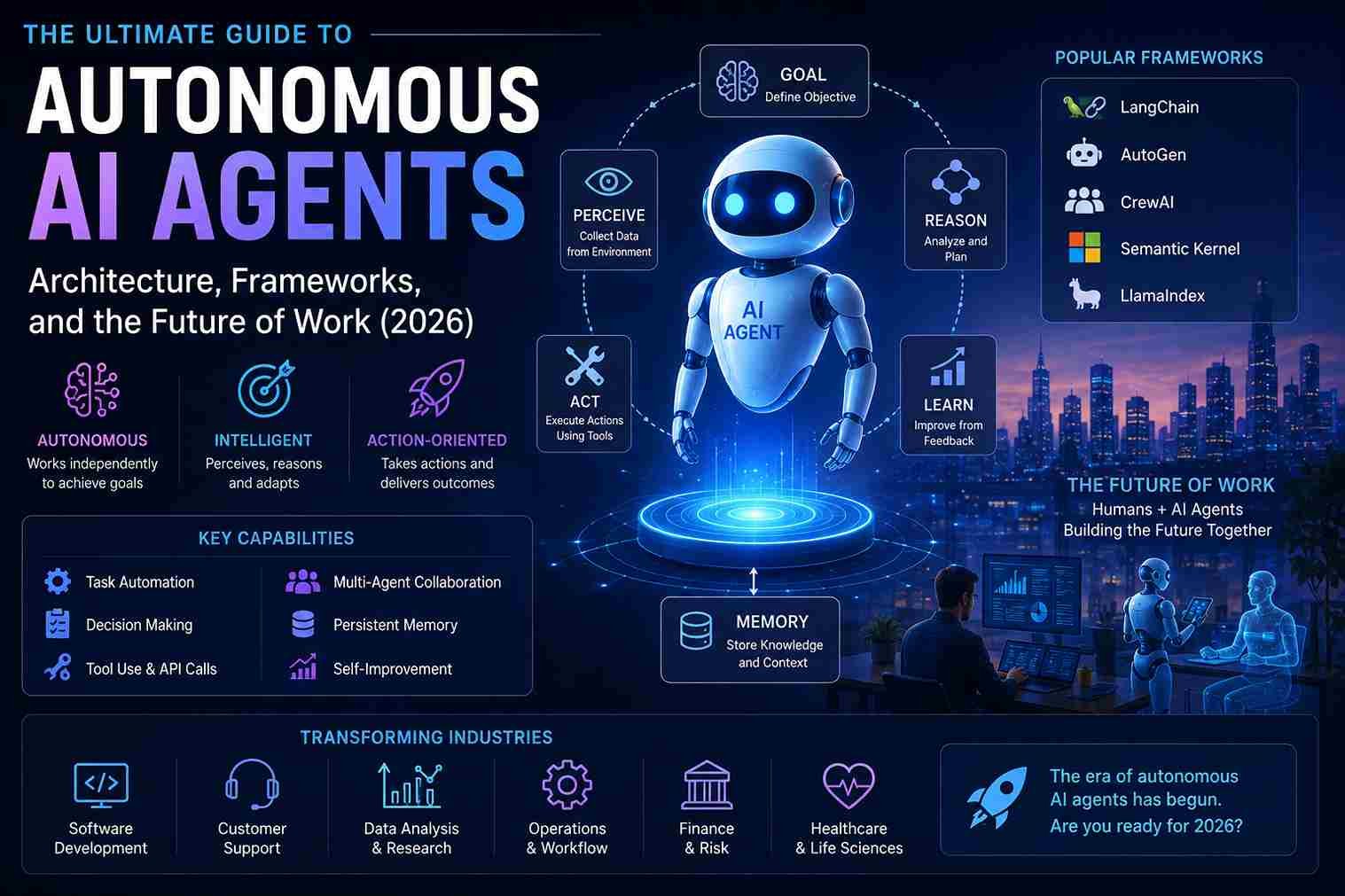
An Autonomous AI Agent is an intelligent software system driven by a foundation model (typically an LLM or large multimodal model) that perceives its environment, makes decisions, utilizes tools, and takes actions to achieve specific, high-level goals.
To understand the difference between standard LLM queries and agentic workflows, consider the following comparison:
| Feature | Standard LLM Query (Non-Agentic) | Autonomous AI Agent (Agentic) |
|---|---|---|
| User Input | Highly specific prompt requesting immediate output. | A broad goal (e.g., “Analyze competitor X\’s pricing strategy and write a report”). |
| Execution | Single-turn generation. | Iterative loop of planning, executing, checking, and refining. |
| Tool Access | Limited to built-in retrieval plugins. | Dynamic access to APIs, web browsers, databases, and local code environments. |
| Error Handling | Returns incorrect/hallucinated answers if data is missing. | Self-corrects by running tests, reading error logs, and seeking alternative data sources. |
The Core Architecture of an AI Agent
In 2026, agentic design patterns have matured into a standard, modular architecture. According to modern neural network research, an autonomous agent consists of four fundamental pillars:
1. The Brain (Core LLM / Foundation Model)
The foundation model serves as the central engine for reasoning, understanding semantics, and decision-making. Today\’s state-of-the-art models are fine-tuned specifically for agentic behaviors, possessing exceptional spatial reasoning, logic processing, and long-context comprehension capabilities.
2. Planning & Self-Reflection
To complete complex objectives, an agent must break down a goal into smaller, manageable subgoals. Various cognitive frameworks enable this:
- Chain-of-Thought (CoT): The agent writes down its step-by-step reasoning process before arriving at a final answer.
- ReAct (Reason + Act): A cycle where the agent thinks about what to do, acts using a tool, observes the output, and reasons about the next action.
- Self-Reflection / Refinement: The agent critiques its own output (e.g., analyzing its code execution output, detecting errors, and rewriting the script dynamically).
3. Memory Systems
Without memory, an agent is amnesic, treating every input as a completely new interaction. Modern AI agent architectures utilize dual-layered memory systems:
- Short-Term Memory: The in-context window of the LLM. It tracks the immediate conversation history, tool outputs, and current subtasks.
- Long-Term Memory: External storage (typically powered by high-performance Vector Databases). It stores historical run successes, user preferences, and persistent organizational knowledge base systems, retrieved dynamically via Retrieval-Augmented Generation (RAG).
4. Tool Integration (Action Capabilities)
Tools are what allow an agent to transition from abstract thought to physical/digital reality. Through structured API integrations, agents can query databases, browse the live web, execute sandboxed Python code, interact with third-party SaaS tools (Slack, HubSpot, Jira), and even control physical IoT devices.
The Shift to Multi-Agent Systems (MAS)
While a single agent can perform impressive tasks, complex enterprise environments require collaborative ecosystems. Enter Multi-Agent Systems (MAS). Instead of asking one “super-agent” to perform all duties, developers design specialized networks of agents that collaborate to solve major issues.
For example, a modern software development agentic team looks like this:
- Product Manager Agent: Translates user requirements into structured technical feature specifications.
- Software Engineer Agent: Reads the specification and writes high-performance, modular code.
- QA Tester Agent: Writes unit tests, executes code in a sandboxed runtime, and reports bug logs back to the engineer agent if errors occur.
- DevOps Agent: Containerizes the validated application and deploys it to cloud infrastructure.
By mimicking human organizational structures, Multi-Agent Systems limit scope creep, reduce the cognitive load on individual foundation models, and drastically lower hallucination rates.
Top Autonomous AI Agent Frameworks in 2026
If you are looking to build or deploy autonomous AI agents today, several developer frameworks stand out as industry standards:
1. LangGraph (By LangChain)
LangGraph has emerged as the premier framework for building complex, cyclic agentic workflows. Unlike linear DAGs (Directed Acyclic Graphs), LangGraph excels at handling circular reasoning paths, agent-to-agent negotiations, and human-in-the-loop interventions, making it incredibly resilient for enterprise tasks.
2. CrewAI
CrewAI focuses on pragmatic, role-based multi-agent systems. It is highly intuitive, allowing developers to define clear agents with specific roles, backstories, tools, and delegation guidelines. It abstracts much of the complex orchestration logic, making it perfect for orchestrating content marketing pipelines, sales outreach, and financial analysis squads.
3. Microsoft AutoGen
AutoGen remains a pioneer in highly customizable conversational agent infrastructures. It allows developers to build agents that talk to each other to solve tasks, offering incredible performance in research-intensive, code-generating, and math-solving domains.
Real-World Enterprise Applications of AI Agents
Autonomous AI agents are no longer just exciting GitHub repositories; they are driving tangible business value across sectors:
Autonomous Software Engineering
Tools built on agentic frameworks can build complete web applications, debug existing enterprise codebases, and migrate legacy codebases (e.g., COBOL to modern Go/Rust frameworks) entirely on their own, needing only a supervisor to review the pull request.
End-to-End Financial Auditing
Financial agents can ingest tens of thousands of corporate transaction records, synthesize tax documents, cross-reference them with regional regulatory compliance rules, detect anomalies, and generate audit-ready compliance reports autonomously.
Hyper-Personalized Healthcare Navigation
While not replacing medical professionals, healthcare agents securely review patient medical history, cross-reference current research databases, monitor real-time biometrics from wearables, and dynamically suggest wellness adjustments and preventive care appointments to doctors and patients.
Challenges and the Path Forward
Despite the immense promise, the widespread adoption of autonomous AI agents faces several technical hurdles:
- Cost and Latency: Agentic workflows are computationally expensive. A single comprehensive research goal can run thousands of model queries, resulting in high API costs and execution latency.
- Infinite Loops and Cascade Failures: If an agent encounters an unhandled edge case or an API error, it can get stuck in an expensive, repetitive self-reflection loop without ever finishing the task.
- Security and Jailbreaking: Granting agents access to tools (such as terminal execution or database updates) introduces profound security vulnerabilities. Designing robust guardrails to prevent recursive prompt injections is a vital area of research in 2026.
Conclusion
Autonomous AI agents represent the next step in the evolution of artificial intelligence. By combining cognitive reasoning, deep memory retrieval, and digital tool operation, agents are transitioning from mere digital assistants to collaborative partners in the workplace.
For organizations looking to maintain a competitive advantage, integrating agentic workflows into daily operations is no longer optional. The companies of tomorrow will not just be powered by humans, but by dynamic, hyper-efficient digital workforces of autonomous AI agents working in tandem with human oversight.