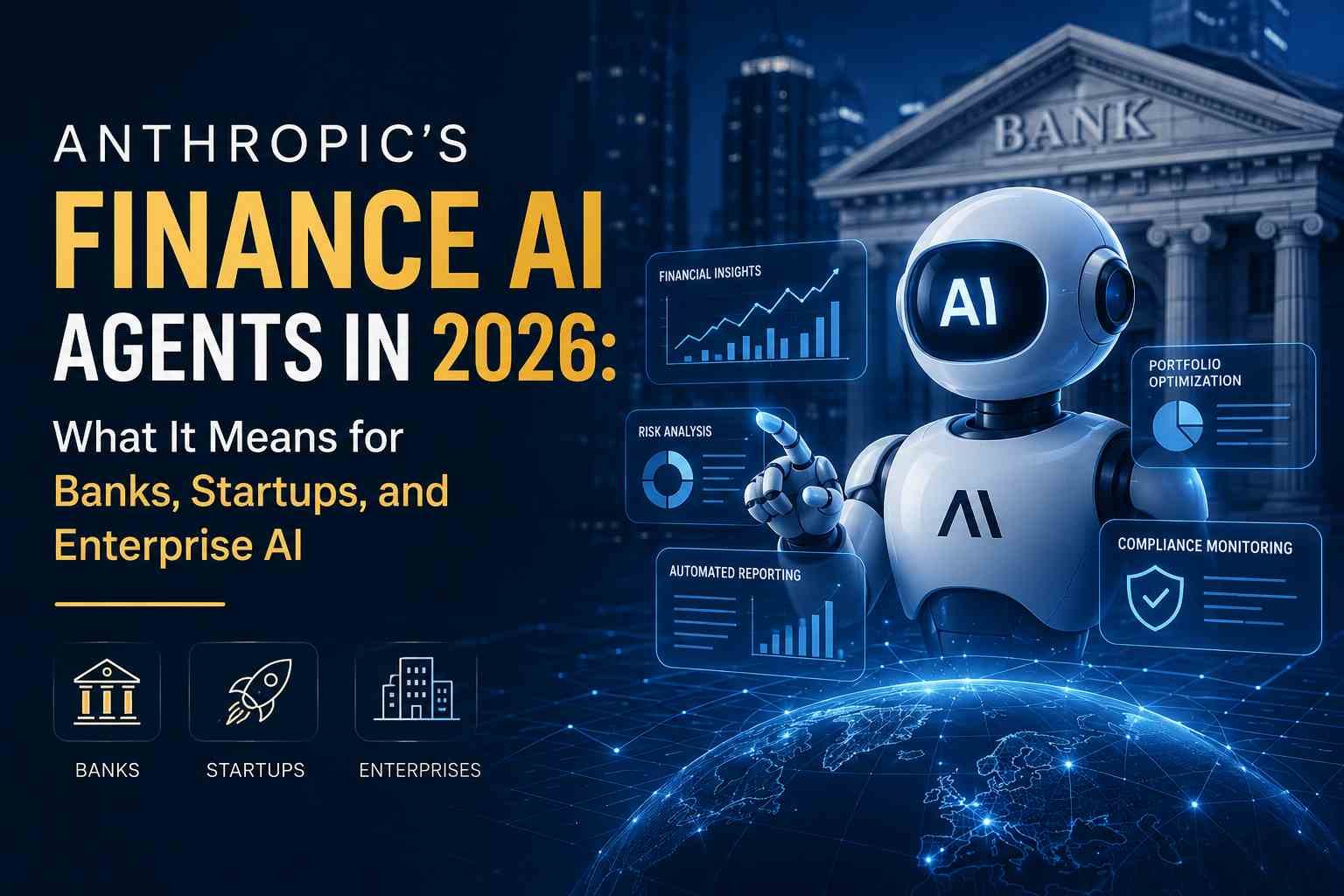
Anthropic’s Finance AI Agents in 2026: What It Means for Banks, Startups, and Enterprise AI
AI in finance is moving from experiments to real workflows.
And in early May 2026, that shift got much more concrete.
Anthropic introduced a new set of finance-focused AI agents and expanded its enterprise delivery push with major institutional partners.
If you work in banking, fintech, SaaS, or operations, this is not just another headline. It is a signal that agent-based work is becoming standard in high-value, high-compliance industries.
Why This Trend Matters Right Now
In my experience, there are moments when a trend changes shape.
Not just “more tools,” but a new operating model.
This feels like one of those moments.
Over the last week of April and first week of May 2026, multiple signals lined up:
- Anthropic launched dedicated finance agents for banking and financial workflows.
- Anthropic also announced a new enterprise AI services venture with large financial and private equity partners.
- OpenAI and other frontier labs accelerated enterprise packaging and governance positioning.
- Government and defense-related AI validation discussions moved further into the mainstream.
Most people miss this: when product packaging, distribution partnerships, and policy pressure rise together, adoption speed usually jumps in the next 2-4 quarters.
What Anthropic Actually Announced
Based on reporting from early May 2026, Anthropic rolled out a set of AI agents aimed at financial services tasks like pitch materials, financial review flows, and compliance escalation support.
At a high level, this is about workflow specialization, not just generic chat.
The company also announced a major enterprise services structure with institutional partners to accelerate Claude deployments in core business operations.
This is where things get interesting: the product and go-to-market strategy were launched together.
| Update | What Changed | Why It Matters |
|---|---|---|
| Finance-focused AI agents | Task-oriented agent set for financial workflows | Moves AI from “assistant” to “operator” model |
| Enterprise services venture | Joint deployment entity with major partners | Reduces execution friction for large buyers |
| Broader enterprise push | Faster implementation pathway for Claude in firms | Signals aggressive capture of regulated verticals |
Primary SEO Opportunity for DigitalBrief
This topic sits at the intersection of three high-intent search clusters:
- AI agents for business workflows
- Anthropic and Claude enterprise strategy
- Finance and fintech AI automation
That overlap is excellent for ranking because readers are usually decision-makers, not casual browsers.
Keyword Strategy
Primary keyword: Anthropic finance AI agents
Secondary keywords: Anthropic AI agents 2026, Claude for financial services, enterprise AI services firm, AI agents for banking
Long-tail keywords: how banks can use Anthropic AI agents, Anthropic vs OpenAI for enterprise finance AI, best AI agent workflows for financial teams
LSI/semantic terms: compliance automation, financial modeling automation, AI governance, regulated industry AI adoption, operational AI copilots
How This Compares With the Broader AI Market
Anthropic is not alone. But its timing is smart.
OpenAI, Google, Microsoft, and others are all pushing enterprise-grade AI stacks, each with different strengths in distribution, platform, and developer ecosystem reach.
| Company | Current Positioning (May 2026) | Likely Advantage | Main Risk |
|---|---|---|---|
| Anthropic | Verticalized agents + enterprise services partnerships | Trust + regulated workflow fit | Scaling implementation consistently |
| OpenAI | Broad platform adoption + developer mindshare | Ecosystem momentum | Enterprise customization pressure |
| Agentic ecosystem + cloud integration | Infrastructure + product surface area | Fragmented product narratives | |
| Microsoft | Security/governance framing + enterprise channels | Distribution through existing enterprise stack | Integration complexity across products |
Honestly, enterprises won’t choose one model forever.
They will likely build multi-model AI operating layers with task routing by cost, speed, and compliance profile.
Real-World Use Cases for Finance Teams
After testing AI workflows across content, ops, and analytics teams, one pattern repeats: ROI comes from process redesign, not just tool access.
So where do finance agents create practical value?
1. Pre-Meeting Intelligence Packs
Agents can compile KPI snapshots, last-quarter deltas, customer concentration risk notes, and narrative summaries before internal or client meetings.
Human teams then edit and validate the final output.
2. Drafting Financial Narratives Faster
Quarterly updates, board prep, pitch summaries, and internal memo drafts can be produced quickly with consistent structure.
This saves analyst time for higher judgment tasks.
3. Compliance-Aware Escalation
Instead of auto-approving sensitive steps, agents can route edge cases to legal/compliance with contextual summaries and source traces.
This balances speed with guardrails.
4. Due Diligence Workflow Compression
Agents can first-pass long documents, identify anomalies, and propose follow-up questions.
Review teams spend less time on document triage and more time on conclusions.
5. CRM + Financial Context Layering
For revenue teams, AI can merge account history, payment behavior, and pipeline context into one snapshot before strategic calls.
Benefits and Limits You Should See Clearly
| Benefits | What Teams Gain |
|---|---|
| Cycle-time reduction | Faster document prep and workflow handoffs |
| Higher analyst leverage | Senior talent spends more time on judgment |
| Process standardization | More consistent output quality across teams |
| Operational memory | Structured logs of reasoning and decisions |
| Limits | What Teams Must Control |
|---|---|
| Hallucination risk | Require citation checks and approval layers |
| Policy gaps | Define data boundaries and role permissions |
| Change management friction | Train teams on workflow redesign, not just prompts |
| Vendor concentration | Avoid lock-in with interoperability planning |
Pros and Cons for Decision-Makers
| Pros | Cons |
|---|---|
| Clear vertical focus improves product-market fit | Vertical claims need outcome proof over time |
| Partnership-led services can speed enterprise rollouts | Services-heavy models can become expensive |
| Strong narrative around trustworthy AI | Trust messaging must match real governance controls |
| Growing enterprise urgency supports adoption | Budget owners still demand measurable ROI |
Implementation Playbook for 2026
If your team is considering Anthropic or similar agent stacks, keep your rollout practical.
Phase 1: Identify Workflow Friction
- Map 3 to 5 repeatable processes with heavy manual effort.
- Prioritize one high-volume and one high-value use case.
- Set baseline metrics: turnaround time, error rate, and cost per task.
Phase 2: Launch a Guardrailed Pilot
- Keep sensitive output behind human approval.
- Use role-based access and data masking where needed.
- Log prompts, outputs, and overrides for auditability.
Phase 3: Integrate Into Existing Systems
- Connect CRM, BI, document stores, and communication tools.
- Build reusable templates for top workflows.
- Create escalation policies for high-risk outputs.
Phase 4: Measure and Scale
- Track ROI monthly with business owners.
- Expand to adjacent workflows only after target gains are consistent.
- Maintain fallback paths for outages or model-quality issues.
Industry Insight: The Services Layer Is Back
For a few years, software buyers wanted pure self-serve SaaS.
Now AI is flipping that expectation in complex industries.
What stood out to me in these May 2026 announcements is the return of service-enabled software adoption.
Why? Because agentic workflows touch policy, operations, and people at the same time.
Large companies do not just buy an API and hope for the best.
They buy implementation certainty.
What This Means for Startups
If you are a startup founder, this trend is both a threat and an opportunity.
- Threat: Big platforms are packaging vertical workflows faster than before.
- Opportunity: Niches with deep domain context are still open, especially in integration and post-deployment analytics.
Smart startup angle for 2026: build workflow intelligence around enterprise agents, not generic “another chatbot” products.
The money is in outcomes, orchestration, auditability, and ROI reporting.
Future Predictions (Next 12 Months)
- Finance-specific AI agents will become default in enterprise RFPs.
- Model choice will become secondary to governance and deployment velocity.
- Hybrid human+agent operating models will outperform full automation attempts.
- Interoperability layers will emerge as a core SaaS category.
- Procurement teams will demand auditable AI workflow logs by default.
Suggested Visuals for Better Engagement
- Featured image idea: “AI agents on a trading desk dashboard with compliance overlays.”
- Infographic idea: “From AI copilot to AI operator: 4-stage enterprise adoption ladder.”
- Chart idea: “Pilot-to-scale timeline for finance AI workflow deployment.”
FAQ: Anthropic Finance AI Agents in 2026
1. What are Anthropic’s finance AI agents?
They are specialized AI agent workflows announced in May 2026 for financial services tasks like drafting, analysis support, and compliance-oriented routing.
2. Are these agents replacing financial analysts?
No. The practical model is analyst augmentation. Teams get faster first drafts and triage, while humans keep decision control.
3. Why is this announcement important for enterprises?
Because it combines product specialization with deployment partnerships, which can shorten implementation cycles in regulated environments.
4. How is this different from a normal AI chatbot?
Chatbots answer prompts. Agents are designed for multi-step tasks, tool use, routing logic, and process-level execution.
5. Is this only relevant for large banks?
No. Mid-size fintechs, accounting automation teams, and B2B SaaS platforms can use the same workflow principles.
6. What is the biggest risk in adoption?
Weak governance. If teams deploy without approval flows and data policies, speed gains can create quality or compliance issues.
7. How should teams evaluate ROI?
Track task cycle-time reduction, error/override rates, and cost per completed workflow versus baseline manual operations.
8. Should companies commit to a single AI vendor?
Usually no. A multi-model strategy with routing and fallback paths is safer for cost and resilience.
9. Can this help startup fundraise workflows?
Yes. Agents can accelerate pitch narrative drafts, data-room summaries, and investor update preparation when properly reviewed.
10. What should teams do in the next 30 days?
Pick one measurable workflow, launch a controlled pilot, define governance checkpoints, and document baseline metrics.
Final Thoughts
The real story here is not “Anthropic launched more AI features.”
The story is that enterprise AI is becoming workflow-native, verticalized, and services-backed at the same time.
That combination usually marks the start of serious market consolidation.
If you wait for a perfect moment, you will move too late.
If you move with a clear pilot framework, you can gain speed without losing control.
Call to Action
If you want, I can prepare the next companion piece for DigitalBrief: “Anthropic vs OpenAI for Enterprise Finance Workflows (2026 Buyer’s Guide)” with side-by-side stack analysis, pricing logic, and implementation scorecards.
That article can target high-conversion commercial intent keywords and link internally to this trend analysis post.
Source notes (for editorial verification): Reporting and announcements from early May 2026 across Axios, Bloomberg, Nasdaq/Business Wire release coverage, TechCrunch, Google Blog AI updates, and Microsoft official blog policy/security notes.
30-60-90 Day Execution Plan for Content, Ops, and Leadership
If you are leading transformation, the execution timeline matters more than the press release.
Here is a practical rollout structure teams can copy.
First 30 Days: Baseline and Scope
- Audit repetitive workflows with clear handoff points.
- Identify data sensitivity tiers for each step.
- Define clear “do not automate” boundaries.
- Create a lightweight policy for prompt logging and approvals.
Day 31-60: Pilot and Human Review Loop
- Run one high-volume workflow and one high-risk workflow in parallel.
- Measure latency, quality score, rework rate, and escalation frequency.
- Document where agents save time and where they create extra review burden.
- Train managers to evaluate output quality, not just output quantity.
Day 61-90: Standardize and Expand
- Turn successful prompts into controlled templates.
- Add fallback logic for uncertain outputs.
- Publish a team playbook with risk tiers and reviewer roles.
- Expand only into workflows where metrics improve for two consecutive cycles.
In my experience, this staged approach prevents the most common failure mode: trying to scale before governance is real.
Comparison Table: Finance AI Adoption Models
| Adoption Model | Speed | Control | Cost Profile | Best Fit |
|---|---|---|---|---|
| Tool-only rollout | Fast start | Low | Low initial, hidden rework later | Small teams testing early demand |
| Guardrailed pilot | Moderate | High | Moderate | Regulated teams needing trust |
| Services-backed enterprise rollout | Fast at scale | Medium to high | Higher upfront | Large organizations with complex ops |
| Hybrid multi-vendor stack | Moderate | Very high | Variable, often optimized long-term | Mature AI programs avoiding lock-in |
Internal Linking Opportunities for DigitalBrief
To improve topical authority and session depth, this post should link to existing DigitalBrief enterprise and AI ecosystem stories.
- Link to the Enterprise AI Infrastructure Race 2026 draft as context on provider competition.
- Link to Frontier Firms and AI agents content for organizational adoption patterns.
- Link to practical AI workflow guides for teams that want tactical implementation help.
A smart cluster structure here can help both search rankings and AI retrieval systems understand your domain coverage.
Featured Snippet and AI Overview Targets
Snippet-friendly answer: Anthropic’s finance AI agents are task-focused systems announced in May 2026 to support workflows in banking and financial services, including drafting, analysis support, and compliance escalation with human oversight.
AI overview angle: Enterprises should evaluate these agents through pilot metrics, governance readiness, integration complexity, and total cost of workflow ownership.