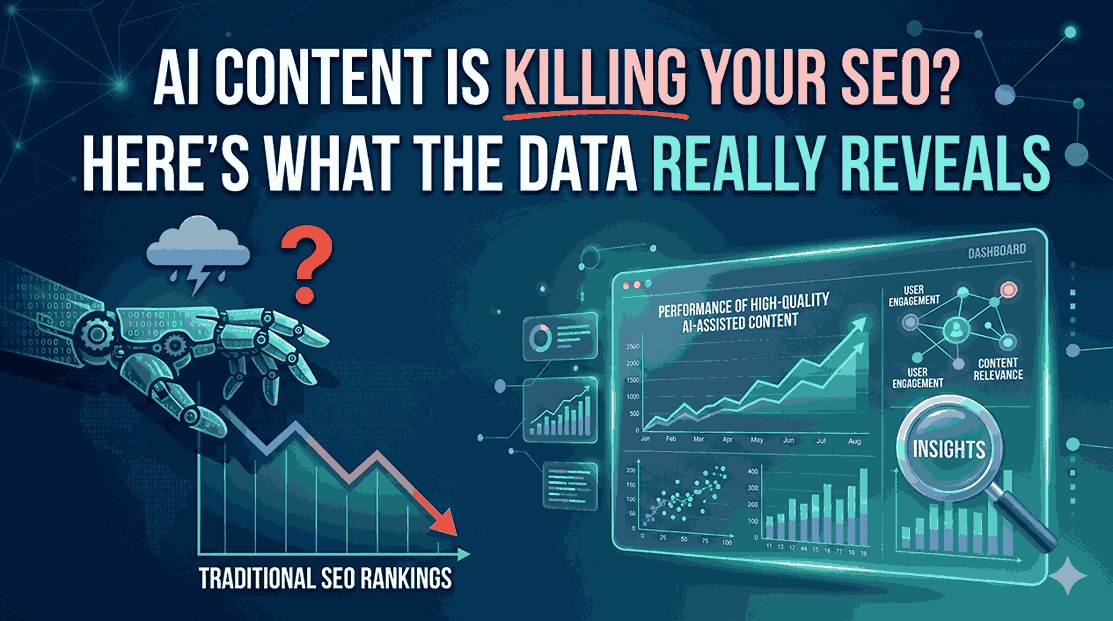
The rapid rise of advanced language models has made it incredibly easy to publish AI-generated content at scale. But there’s a catch. According to Google’s own guidance and multiple independent studies, relying heavily on AI-written articles can actually hurt you in the long run. While AI drafts are useful for brainstorming and getting started, they tend to deliver only short-lived traffic spikes rather than sustainable SEO growth. In fact, research consistently shows that “AI content is short-term arbitrage, not a long-term strategy.”
Let’s break down the latest data, search engine insights, and best practices for using AI without compromising quality.
Google’s Guidelines: Quality Comes First
Google has been very clear about one thing: it doesn’t care how content is created—it cares about what the content delivers. According to Google Search Central, content that performs well is “original, high-quality,” and demonstrates strong E-E-A-T (Experience, Expertise, Authoritativeness, and Trustworthiness).
AI-generated content isn’t banned. What Google penalizes is content created purely to manipulate rankings. In other words, if your content isn’t genuinely helpful to people, it doesn’t matter whether a human or AI wrote it—it won’t perform well.
In practice, Google has been tightening the screws on low-quality, mass-produced content. The March 2024 Core Update specifically targeted unoriginal and low-value pages. By April 2024, Google reported a roughly 45% drop in such results. New spam policies around “scaled content abuse” now flag any content produced in bulk with little to no value—whether it’s written by humans or AI.
Updated Quality Rater Guidelines from 2025 go even further, highlighting AI as a risk when used with minimal effort. Reviewers are now trained to look for real experience and credible authorship—areas where AI often falls short.
Content that stands out today includes first-hand insights, original data, and clearly identified authors. Google puts it simply: using AI doesn’t give you an advantage. If your content is helpful, original, and trustworthy, it can rank. If not, it won’t.
Key takeaway: Google rewards quality signals—uniqueness, expertise, credibility, and engagement—regardless of how content is created. Publishing AI content without real value is a fast track to penalties.
AI vs. Human Content: What the Data Reveals
Recent studies give us a clearer picture of how AI content performs in real-world SEO.
A large-scale experiment by DigitalApplied tracked over 4,200 articles across 16 months. The result? Pure AI content ranked about 23% lower on average compared to human-written articles. The gap widened significantly for competitive keywords, where AI content lagged behind by as much as 41%.
However, there’s an important nuance. When AI drafts were refined by human editors—adding structure, expert input, and original data—the performance improved dramatically. These hybrid articles ranked nearly as well as fully human-written ones, with only about a 4% difference.
Backlinks told a similar story. AI-only content attracted 61% fewer editorial links, which is a major disadvantage since backlinks remain a key ranking factor. Over time, this gap compounds: human-written content continues to gain authority, while AI-heavy pages plateau or decline.
Index stability is another concern. Human-written pages maintained their rankings 81% of the time between updates, compared to just 54% for AI-generated content. Even more striking, AI pages were 3.2 times more likely to be removed from Google’s index after spam updates.
Hybrid content, on the other hand, performed much better—retaining strong rankings and earning nearly as many backlinks as human-written articles.
Key data points:
- AI content ranks ~23% lower overall (up to 41% worse on competitive terms).
- AI articles earn 61% fewer backlinks.
- AI pages are 3.2× more likely to be deindexed.
- AI + human editing nearly matches human-only performance (within ~4%).
These findings align with broader industry trends. One analysis found that 83% of top-ranking pages showed no detectable AI involvement. When low-quality AI content drops, replacing it with expert-driven material often restores rankings quickly.
The Short-Term Arbitrage Trap
AI makes it easy to produce content at scale, which can create an initial surge in traffic. But that success is often short-lived.
Take one well-known case: a site published 1,800 AI-generated articles overnight and quickly gained nearly half a million monthly visits. But as Google reassessed the content’s quality, traffic collapsed to almost zero.
This pattern is becoming increasingly common. Google’s systems are designed to identify and filter out content that exists solely to game rankings. New policies explicitly target large-scale content production intended to boost visibility without delivering real value.
If your content looks like it could be generated in seconds without human oversight, it’s likely to be flagged as low quality. Even worse, openly promoting AI-driven content strategies can attract scrutiny.
The bottom line is simple: bulk AI publishing may offer a temporary boost, but it leaves your site vulnerable to algorithm updates and long-term decline.
The Mediocrity Problem
AI tools like GPT-4 and Claude are powerful, but they have limitations. They’re excellent at summarizing and rephrasing existing information, but they rarely produce truly original ideas.
That’s because they work by predicting the most likely next word—essentially generating an “average” of existing content. This works fine for basic facts, but falls short when depth, creativity, or personality is needed.
Common issues with AI-only content include:
- No real information gain—just rehashed ideas.
- Occasional inaccuracies or fabricated details.
- Generic tone with no brand identity.
- Weak personalization or audience understanding.
- Potential copyright concerns.
- Repetition of outdated or biased information.
To readers, this lack of depth is obvious. AI-generated articles often feel flat, forgettable, and impersonal. They may answer a question, but they don’t build trust or leave a lasting impression.
Even when traffic is high, the value can be low. One study showed an AI-driven site generating significant traffic but far less revenue potential compared to a well-edited, expert-driven blog with similar audience size.
Building Brand Trust and Value
Content isn’t just about rankings—it’s about perception. Every article shapes how people see your brand.
Flooding your site with generic AI content can dilute your identity. These articles often lack personality, depth, and memorability. As a result, users may click—but they rarely return.
Engagement metrics reflect this. AI-heavy content tends to generate fewer shares, fewer backlinks, and lower on-site engagement. It also struggles to convert, as it often targets low-intent keywords.
Human-written content, by contrast, naturally incorporates storytelling, insights, and strategic intent—key elements for building trust and driving conversions.
Every piece of content should leave a positive impression. Real examples, customer stories, and actionable insights make a difference. Without them, content becomes disposable.
No Competitive Edge Without Originality
One of the biggest drawbacks of AI content is how easy it is to replicate. If you can generate thousands of articles, so can your competitors.
This creates a race to the bottom. With similar content flooding the web, differentiation disappears. Eventually, larger or more authoritative sites will outrank you.
To build a lasting advantage, you need content that others can’t easily copy:
- Original research and data.
- Expert insights and interviews.
- Real-world case studies.
- Unique visuals and tools.
- Niche or local expertise.
These elements create defensible value—something AI alone can’t produce.
Using AI the Right Way
This doesn’t mean you should avoid AI altogether. When used properly, it can be a powerful tool.
AI works best as a support system:
- Generating ideas and outlines.
- Assisting with basic research.
- Drafting initial content structures.
- Creating metadata and simple assets.
- Helping with translations or localization.
The key is human involvement. Editing, refining, and enhancing AI drafts with original insights transforms them into high-quality content.
Studies show that with just 90 minutes of human editing, AI-generated drafts can achieve results close to fully human-written articles—while saving significant time.
Conclusion: Quality Always Wins
AI-generated content can deliver quick wins, but it’s not a sustainable SEO strategy on its own. Google’s guidance and real-world data both point to the same conclusion: quality, originality, and expertise matter most.
Treat AI as a tool—not a replacement. Use it to streamline workflows, but ensure every piece of content is shaped by human insight and creativity.
Focus on what only you can offer: your experience, your data, your perspective. That’s what builds long-term rankings, brand authority, and real business impact.
Because in the end, the truth remains: AI content may win the short game—but human-quality content wins the long one.