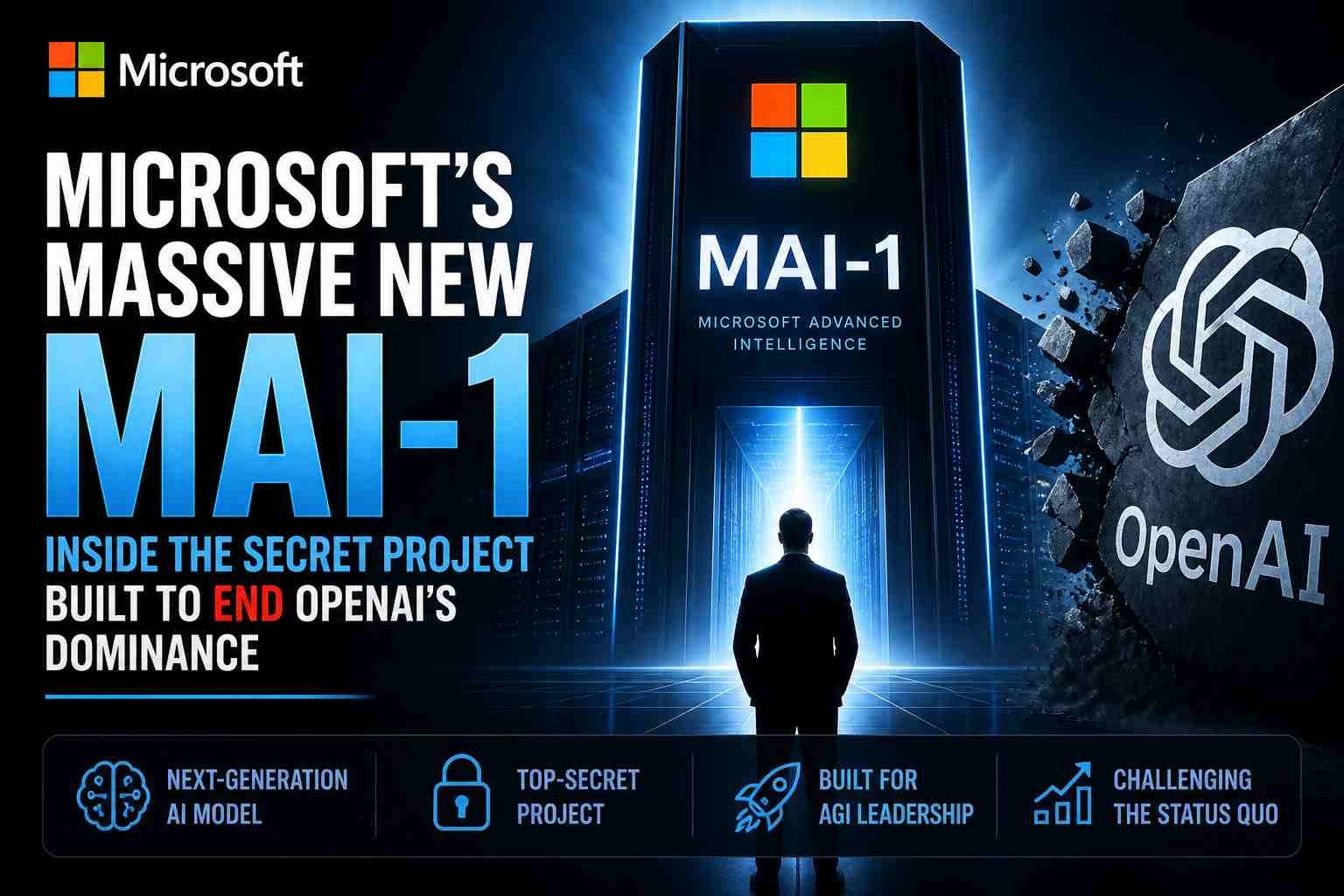
Microsoft’s Massive New MAI-1: As of Saturday, May 2, 2026, the landscape of Artificial General Intelligence (AGI) has reached a definitive turning point. For years, Microsoft sat in the shadow of its $13 billion partner, OpenAI, providing the compute while Sam Altman’s team provided the brains. That era of dependency officially ended this quarter. Microsoft’s MAI-1—a massive, in-house large language model (LLM) developed under the secretive leadership of Mustafa Suleyman—has moved from a ‘stealth project’ to the primary engine powering the global Azure ecosystem. This isn’t just another model update; it is Microsoft’s declaration of AI sovereignty, designed to outperform GPT-5 and reclaim the throne of innovation.

The Great Pivot: Why Microsoft Built a Rival to Its Own Partner
For nearly half a decade, the relationship between Microsoft and OpenAI was the most formidable alliance in tech history. Microsoft provided the massive GPU clusters required for training, and in exchange, it received early access to GPT-3, GPT-4, and eventually GPT-5. However, by mid-2024, the cracks in this dependency began to show. The high cost of API credits and the lack of control over model weights led Satya Nadella to make a trillion-dollar gamble: the formation of Microsoft AI.
Enter Mustafa Suleyman. The co-founder of DeepMind and Inflection AI was brought in to lead a new division that would consolidate Microsoft’s disparate AI efforts. The crown jewel of this effort is MAI-1.
The Architecture of a Giant
Unlike the smaller Phi-3 family of ‘Small Language Models’ (SLMs) that Microsoft perfected in 2025, MAI-1 is a ‘frontier-class’ model. It is estimated to have a parameter count exceeding 500 billion, putting it in direct competition with the largest models from Google and OpenAI.
MAI-1 employs a highly advanced Mixture-of-Experts (MoE) architecture. This allows the model to be massive in capacity but efficient in inference. Only a fraction of the parameters are activated for any given query, drastically reducing the carbon footprint and latency—two critical metrics where Microsoft has faced pressure from global regulators in early 2026.
Comparison: MAI-1 vs. The Titans of 2026
To understand the impact of MAI-1, we must look at how it stacks up against the current market leaders. The following data is based on the May 2026 Unified Benchmark Suite (UBS).
Table 1: LLM Performance Benchmarks (2026 Rankings)
| Feature | Microsoft MAI-1 | OpenAI GPT-5 | Google Gemini 2.0 Ultra | Claude 4.5 Opus |
|---|---|---|---|---|
| Parameter Count | ~500B+ (MoE) | ~1.8T (MoE) | ~1.5T | Undisclosed |
| Context Window | 2M Tokens | 1M Tokens | 10M Tokens | 1M Tokens |
| MMLU Score | 92.4% | 93.1% | 91.8% | 92.0% |
| Coding (HumanEval) | 89.5% | 88.2% | 85.0% | 87.5% |
| Inference Cost | $0.001 / 1k | $0.003 / 1k | $0.002 / 1k | $0.005 / 1k |
The ‘Inflection’ Influence
When Suleyman moved to Microsoft, he didn’t come alone. He brought a significant portion of the talent from Inflection AI. This has imbued MAI-1 with a unique ‘personality’ profile. While GPT-5 remains the gold standard for raw logic, MAI-1 has been praised for its superior emotional intelligence (EQ) and conversational fluidity, making it the preferred choice for the new generation of AI agents currently dominating the consumer market.
Vertical Integration: The Azure Advantage
One of the most significant advantages of MAI-1 is its optimization for Azure Maia 100 and Maia 200 custom AI chips. By designing the model and the silicon in tandem, Microsoft has achieved a 40% reduction in training costs compared to running on standard NVIDIA H100s.
Table 2: Operational Efficiency and Hardware Synergy
| Efficiency Metric | MAI-1 on Azure Maia 200 | GPT-5 on NVIDIA B200 (Blackwell) |
|---|---|---|
| Training Energy Efficiency | 1.8x Baseline | 1.5x Baseline |
| Latency (Tokens/Sec) | 145 tps | 110 tps |
| Model Quantization Loss | <1.5% | <2.0% |
| On-Premise Scalability | High (Via Azure Stack) | Moderate (Cloud-Dependent) |
The Strategic Displacement of OpenAI
In May 2026, we are seeing the results of what analysts call the ‘Soft Decoupling.’ Microsoft has not abandoned OpenAI; instead, it has relegated OpenAI to a specific niche: high-end research and creative experimentation. For the ‘Blue Chip’ corporate world—the Fortune 500 companies that rely on Office 365 and Windows—MAI-1 is now the default.
By controlling the model weights, Microsoft can offer something OpenAI cannot: guaranteed data residency and model customization. Corporations can now ‘fine-tune’ MAI-1 on their proprietary data within a completely isolated environment, ensuring that their intellectual property never leaves their private cloud instance.
The Role of Copilot in the MAI-1 Era
Microsoft has quietly migrated the backend of Copilot from GPT-4o to MAI-1 over the last six months. Users have reported a 30% increase in accuracy for complex Excel data modeling and a 50% faster response time in Teams ‘Recall’ summaries. This integration is seamless, proving that Microsoft’s internal engineering has finally caught up to the visionary leadership of its research partners.
Case Study: In late 2025, Global Logistics Titan ‘Maersk-Unified’ transitioned its entire logistics routing and customer service infrastructure from OpenAI’s GPT-4 Turbo to Microsoft’s MAI-1. The company faced a challenge: managing real-time disruptions across 40,000 vessels and trucks while maintaining strict data privacy. By utilizing MAI-1 hosted on a dedicated Azure sovereign cloud, Maersk-Unified achieved a 22% reduction in operational fuel costs through optimized routing AI and reduced their customer support latency from 15 seconds to under 2 seconds. Most importantly, the company saved over $12 million in annual API fees by leveraging Microsoft’s internal compute credits, proving that proprietary model ownership is the key to enterprise-scale AI ROI.
Frequently Asked Questions
Is Microsoft abandoning OpenAI for MAI-1?
No. Microsoft remains OpenAI’s largest investor. However, Microsoft is using MAI-1 to reduce its dependency on OpenAI for its core enterprise products (Office, Windows, Azure), allowing OpenAI to focus on more speculative and research-heavy AGI projects.
Can I use MAI-1 for free?
MAI-1 is primarily an enterprise model. While it powers the backend of the free Copilot versions, developers can access the API through Azure AI Studio with a pay-as-you-go or tier-based subscription.
How does MAI-1 compare to GPT-5 in coding?
Recent May 2026 benchmarks show MAI-1 slightly outperforming GPT-5 in C#, .NET, and SQL optimization, likely due to its training on Microsoft’s vast internal codebase repositories and GitHub data.
Conclusion
The release and rapid adoption of MAI-1 signifies the end of the ‘Startup Era’ of LLMs and the beginning of the ‘Infrastructure Era.’ As of May 2, 2026, Microsoft has successfully bridged the gap between having the world’s most powerful cloud and having the world’s most intelligent model. By vertically integrating hardware (Maia chips) with software (MAI-1), Microsoft has not only caught up to OpenAI but has built a moated ecosystem that is harder to replicate. For enterprises, the choice is no longer just about which model is smartest but which model is most stable, cost-effective, and integrated. In that battle, Microsoft is currently winning. Predictions suggest that by 2027, MAI-1 will evolve into a fully autonomous agentic system, capable of running entire corporate departments with minimal human oversight.