As of Saturday, May 2, 2026, the landscape of digital publishing has fundamentally shifted from volume-based spam to high-authority, agentic-driven intelligence. AI content arbitrage in 2026 is the strategic exploitation of the cost gap between low-cost, multi-modal AI production and the high-value monetization of specialized human-verified traffic. To succeed today, publishers must move beyond simple prompting and embrace ‘Human-in-the-Loop’ (HITL) frameworks that satisfy both Search Generative Experiences (SGE) and the sophisticated Answer Engine Optimization (AEO) requirements of 2026.

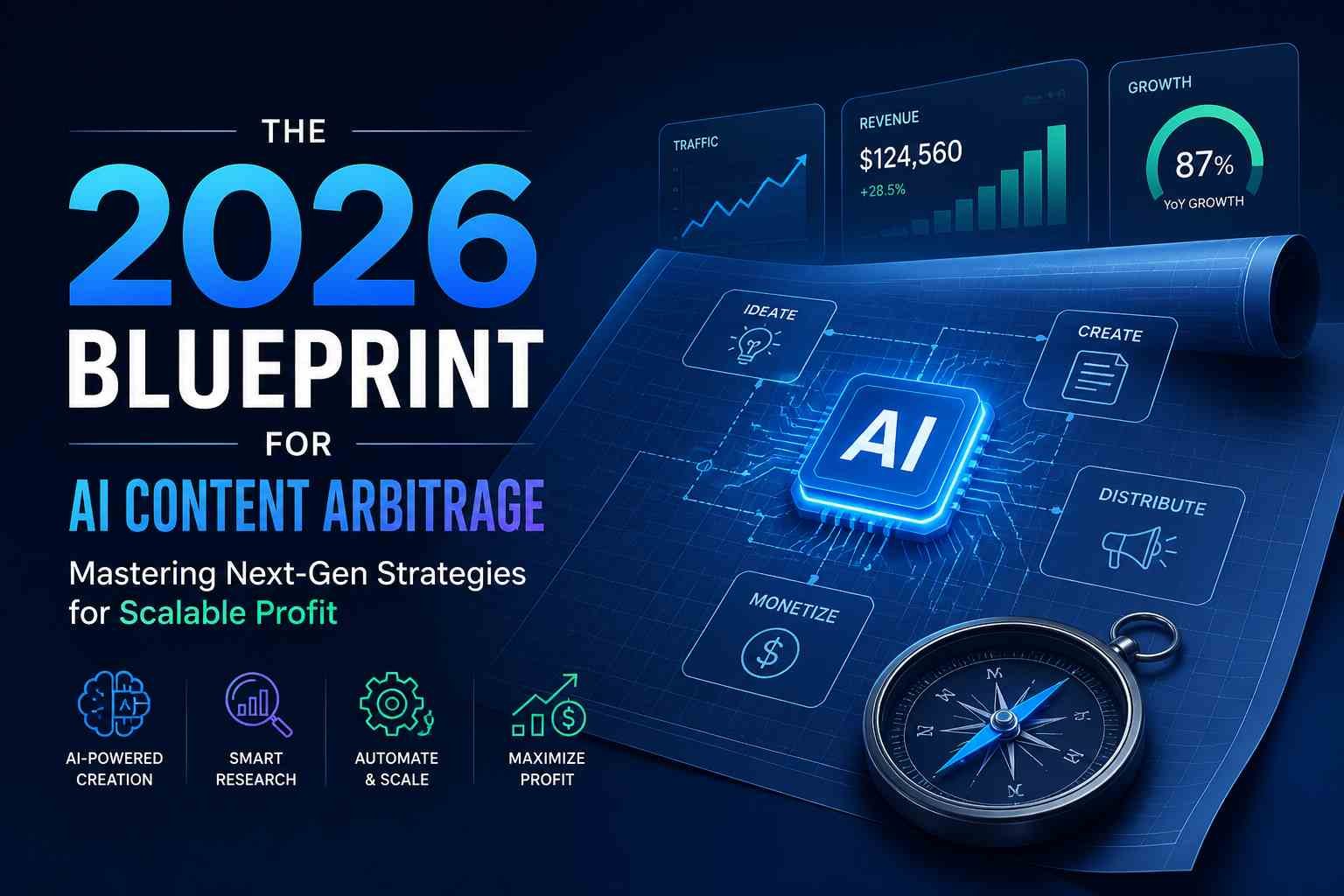
The 2026 Blueprint for AI Content Arbitrage: Mastering Next-Gen Strategies for Scalable Profit
By May 2026, the ‘Gold Rush’ of generic AI content has ended. The era of the high-authority ‘Niche Authority Site’ powered by sophisticated agentic workflows has begun. This blueprint details how to navigate the current ecosystem where Google’s AI Overviews and independent Answer Engines dictate the flow of digital capital.
1. The Evolution & Origin: From GPT-3 to Agentic Dominance
The history of AI content arbitrage is a story of rapid adaptation.
- The Primitive Era (2022-2023): Early adopters used GPT-3 and tools like Jasper to churn out low-quality SEO articles. Google responded with the Helpful Content Updates, wiping out sites that lacked human depth.
- The Hybrid Shift (2024-2025): Publishers began using ‘Human-in-the-Loop’ (HITL). The focus shifted to ‘programmatic SEO’ where AI filled templates with data.
- The Agentic Revolution (2026): Current systems use ‘Agents’—specialized AI entities that browse the live web, verify facts, conduct interviews via API, and cross-reference data before a single word is written. Arbitrage is no longer about quantity; it is about the cost-efficiency of quality.
2. The 2026 Tool Stack Comparison
Navigating the current market requires understanding the difference between legacy LLMs and the current state-of-the-art (SOTA) tools available as of mid-2026.
| Feature | 2024 Era (GPT-4/Claude 2) | 2026 Era (GPT-5/Claude 4/Gemini 2 Ultra) |
|---|---|---|
| Research Depth | Static training data / Limited browsing | Real-time multi-source synthesis & API integration |
| Fact-Checking | Prone to hallucinations; required manual check | Autonomous recursive verification agents |
| Formatting | Standard Markdown | Semantic AEO-ready JSON-LD & Component-based blocks |
| Multi-Modal | Text-focused, separate image gen | Integrated video, voice, and interactive data visualization |
| Cost per 1k Words | ~$5.00 (API + Human Edit) | ~$0.45 (Agentic Flow + Final Human Polish) |
3. The New Mechanics of Arbitrage: Multi-Agent Workflows
Arbitrage in 2026 relies on a 4-tier agentic architecture. This minimizes human intervention while maximizing E-E-A-T.
Tier 1: The Researcher Agent
This agent identifies trending ‘Information Gaps’ using real-time Google Search data and social sentiment. It gathers raw data, statistics, and expert quotes.
Tier 2: The Architect Agent
This agent structures the article based on AEO (Answer Engine Optimization) patterns—ensuring the ‘Featured Snippet’ is clear and the semantic hierarchy is perfect for AI crawlers.
Tier 3: The Creative Writer Agent
Using advanced personality models, this agent injects ‘Experience’ and ‘Brand Voice,’ ensuring the content doesn’t sound like a generic LLM.
Tier 4: The Fact-Checker & Compliance Agent
This final AI layer cross-references every claim against trusted databases (e.g., Statista, Reuters, Peer-reviewed journals) before flagging it for human approval.
4. Monetization Strategy: Beyond Display Ads
In 2026, RPMs for standard display ads have stabilized, but the real arbitrage profit lies in High-Intent Conversion.
High-Authority Arbitrage Metrics (2026 Estimates)
| Metric | Generic AI Site | High-Authority Agentic Site |
|---|---|---|
| Avg. CTR from SGE | 1.2% | 8.5% |
| Conversion Rate (Affiliate) | 0.5% | 4.2% |
| Domain Rating (DR) Growth | Slow (High Bounce) | Fast (High Dwell Time) |
| Primary Traffic Source | Google Search | SearchGPT, Perplexity, TikTok Search |
5. Strategic Implementation: The ‘Authority Flip’
To execute this blueprint, follow the ‘Authority Flip’ method:
- Identify Under-Served Technical Niches: Use AI to scan Reddit and Quora for questions that have ‘Thin’ Google results.
- Deploy Multi-Modal Agents: Generate a long-form article, an accompanying 60-second summary video (using Sora 2 or similar), and an interactive tool (via AI-coded React snippets).
- Semantic Saturation: Ensure your content covers the ‘LSI Galaxy’—using terms that 2026 search engines expect to see in high-authority clusters.
Frequently Asked Questions
Is AI content arbitrage still profitable in 2026?
Yes, but only if you move away from volume and focus on ‘Agentic Quality.’ The gap between AI production costs and high-intent traffic value remains large for those who can satisfy E-E-A-T requirements.
How does AEO differ from SEO?
SEO focuses on keyword rankings in SERPs. AEO (Answer Engine Optimization) focuses on becoming the ‘cited source’ for AI models like Perplexity and Google’s AI Overviews.
What is the biggest risk to AI arbitrage today?
The biggest risk is ‘Content Provenance.’ Search engines and social platforms are increasingly using C2PA standards to identify AI content. Disclosure and ‘Human-in-the-Loop’ editing are mandatory for long-term site survival.
Conclusion
The 2026 blueprint for AI content arbitrage is no longer about ‘tricking’ the algorithm. It is about using next-gen AI tools to become a high-velocity, high-authority publisher. By leveraging multi-agent workflows, focusing on AEO, and maintaining strict HITL quality controls, publishers can achieve profit margins that were previously impossible. The future belongs to those who use AI to enhance human expertise, not replace it. Expect ‘Personalized Search’ to be the next frontier by 2027.