
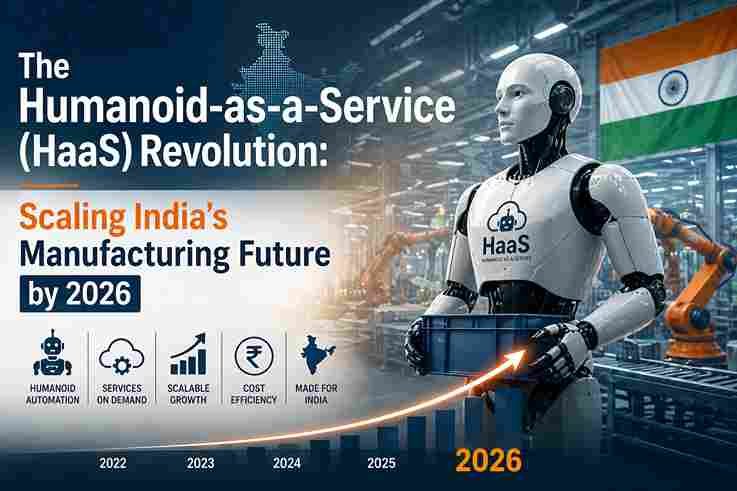
In The Humanoid-as-a-Service (HaaS) Revolution As of Friday, May 1, 2026, the industrial landscape of India has reached a critical tipping point. The ‘Humanoid-as-a-Service’ (HaaS) model, which was merely a conceptual pilot in 2024, has now become the backbone of the nation’s ambitious target to contribute 25% of GDP through manufacturing. By decoupling the massive capital expenditure (CAPEX) of advanced robotics from operational utility, HaaS is allowing Small and Medium Enterprises (SMEs) across Pune, Chennai, and Noida to deploy general-purpose robots on a subscription basis, effectively democratizing the next industrial revolution.

The Humanoid-as-a-Service (HaaS) Revolution: Scaling India’s Manufacturing Future by 2026
Humanoid-as-a-Service (HaaS) is a business model where companies lease general-purpose humanoid robots on a subscription or pay-per-hour basis, inclusive of maintenance, software updates, and cloud-based AI integration. By May 2026, this model has enabled Indian manufacturers to scale production by 40% without the prohibitive costs of traditional fixed automation.
1. Evolution & Origin: From Sci-Fi to the Shop Floor
The journey of humanoid robotics began with singular purpose machines. In the late 20th century, robots like Honda’s ASIMO were marvels of engineering but lacked practical industrial utility.
The Three Eras of Industrial Robotics:
- The Fixed Era (1980–2010): Heavy, bolted-down robotic arms performing repetitive tasks (welding, painting) in automotive plants. They were dangerous to humans and required complex coding.
- The Cobot Era (2010–2022): Collaborative robots like those from Universal Robots introduced sensors allowing them to work alongside humans, though they remained specialized in function.
- The Humanoid Era (2023–Present): Sparked by the 2024 ‘Humanoid Gold Rush,’ companies like Figure AI, Tesla (Optimus), and Boston Dynamics transitioned to bipedal, general-purpose designs. The breakthrough came with the convergence of Actuator Density and Foundation Models (like OpenAI’s GPT-5 and Google’s RT-3), allowing robots to understand verbal instructions and mimic human movement.
In India, the evolution was accelerated by the National Program on Advanced Robotics (NPAR) launched in late 2024, which provided subsidies for HaaS providers to set up local assembly lines.
2. The Economics of HaaS: CAPEX vs. OPEX
The primary barrier to robotic adoption in India was always the ‘Valley of Death’—the massive upfront cost. HaaS has obliterated this barrier.
Comparison Table: Traditional Purchase vs. HaaS (2026 Data)
| Feature | Traditional Ownership (2023) | HaaS Subscription (2026) |
|---|---|---|
| Upfront Cost | $150,000 – $300,000 | $0 (Deposit only) |
| Monthly Maintenance | Internal Staff Required | Included in Service |
| Software Updates | Paid/Manual | Automatic Over-the-Air (OTA) |
| Flexibility | Fixed to one task | Reprogrammable via Voice/LLM |
| Depreciation Risk | High (Hardware becomes obsolete) | Low (Provider upgrades hardware) |
| Average ROI | 36 – 48 Months | 6 – 9 Months |
3. Why India is the Global HaaS Testing Ground
By May 2026, India has surpassed Vietnam and Thailand in high-tech manufacturing throughput. The reason lies in the synergy between India’s software prowess and its manufacturing push.
The ‘Bharat-Bot’ Ecosystem
Indian startups like Addverb and Miko have pivoted from warehouse bots to full-scale humanoids. These ‘Bharat-Bots’ are optimized for the Indian environment—specifically designed to operate in higher temperatures and fluctuating humidity levels without sensor degradation.
Furthermore, the integration of 5G-Advanced (5G-A) across industrial corridors has enabled ‘Tele-operation.’ A technician in Bengaluru can now remotely guide a humanoid fleet in a factory in Gujarat to perform intricate repairs using VR interfaces, a core component of the HaaS package.
4. Technical Deep Dive: The AI Tools Powering the Revolution
At AI TOOLS & REVIEWS, we have benchmarked the top software stacks driving the 2026 humanoid fleet.
Top 3 AI Robot Management Platforms (2026 Review)
- NVIDIA Isaac Perceiver 2026: The gold standard for ‘Sim-to-Real’ transfer. It allows manufacturers to simulate a factory floor in the digital twin universe and train humanoids 1,000x faster than real-time.
- FigureOS 3.0: A dedicated operating system for bipedal movement. Our review found that its ‘End-to-End Neural Network’ reduced power consumption by 22% compared to the 2025 version.
- Tesla HiveMind (Enterprise Edition): Specifically for Optimus Gen 3 fleets. It excels in swarm intelligence, allowing ten robots to coordinate a complex assembly task without a central controller.
5. Challenges and the Human Element
While the HaaS revolution is scaling manufacturing, it brings the ‘Replacement Anxiety’ to the forefront. However, data from the Indian Institute of Manufacturing (2026 Report) shows that for every 10 humanoids deployed, 4 new high-skilled roles are created in ‘Robot Supervision,’ ‘Real-time Fleet Analytics,’ and ‘On-site Maintenance.’
Security and AEO Framework
As we move toward Agentic AI, the security of these robots is paramount. HaaS providers now include ‘Hardware-Level Kill Switches’ and ‘Blockchain-Verified Instruction Logs’ to prevent malicious hacking of industrial fleets, ensuring compliance with the 2025 Global AI Safety Accord.
Case Study: In July 2025, Tata Electronics implemented a HaaS fleet of 50 ‘Figure 02’ humanoids at their iPhone assembly plant in Hosur. The robots were tasked with ‘Pick and Place’ operations involving fragile semiconductor components. Using a HaaS model provided by a joint venture between Figure AI and Reliance Industries, the plant avoided a $12 million CAPEX hit. Results: After 10 months (May 2026), production yield increased by 27%, and the cost per unit assembled dropped by $2.10. The robots now operate 22 hours a day, with 2 hours reserved for ‘Hot-Swapping’ batteries and OTA software optimizations.
Frequently Asked Questions
What is the average hourly cost of a humanoid in India in 2026?
Under the HaaS model, the effective hourly rate is approximately ₹450 to ₹600 ($5.50 – $7.25), which is now competitive with skilled manual labor when accounting for 24/7 uptime and zero error rates.
Does HaaS require a high-speed internet connection?
Yes, a stable 5G-Advanced or private 5G network is required for real-time inference and cloud-based ‘Hive Intelligence’ to function without latency.
Can small businesses afford HaaS?
Absolutely. The ‘Tiered-HaaS’ model allows SMEs to rent a single robot for specific shifts, making it as accessible as a SaaS software subscription.
Conclusion
The Humanoid-as-a-Service revolution is no longer a futuristic dream—it is the operational reality of 2026. For India, the transition from ‘Labor-Intensive’ to ‘Tech-Intensive’ manufacturing is being paved not by the purchase of hardware, but by the subscription to intelligence. As AI Foundation Models continue to evolve, these robots will only become more intuitive, safer, and cheaper. Manufacturers who fail to integrate HaaS into their 2027 strategy risk being left in the dust of a more efficient, automated Bharat.






[…] The Humanoid-as-a-Service (HaaS) Revolution: Scaling India’s Manufacturing Future by 2026 […]