
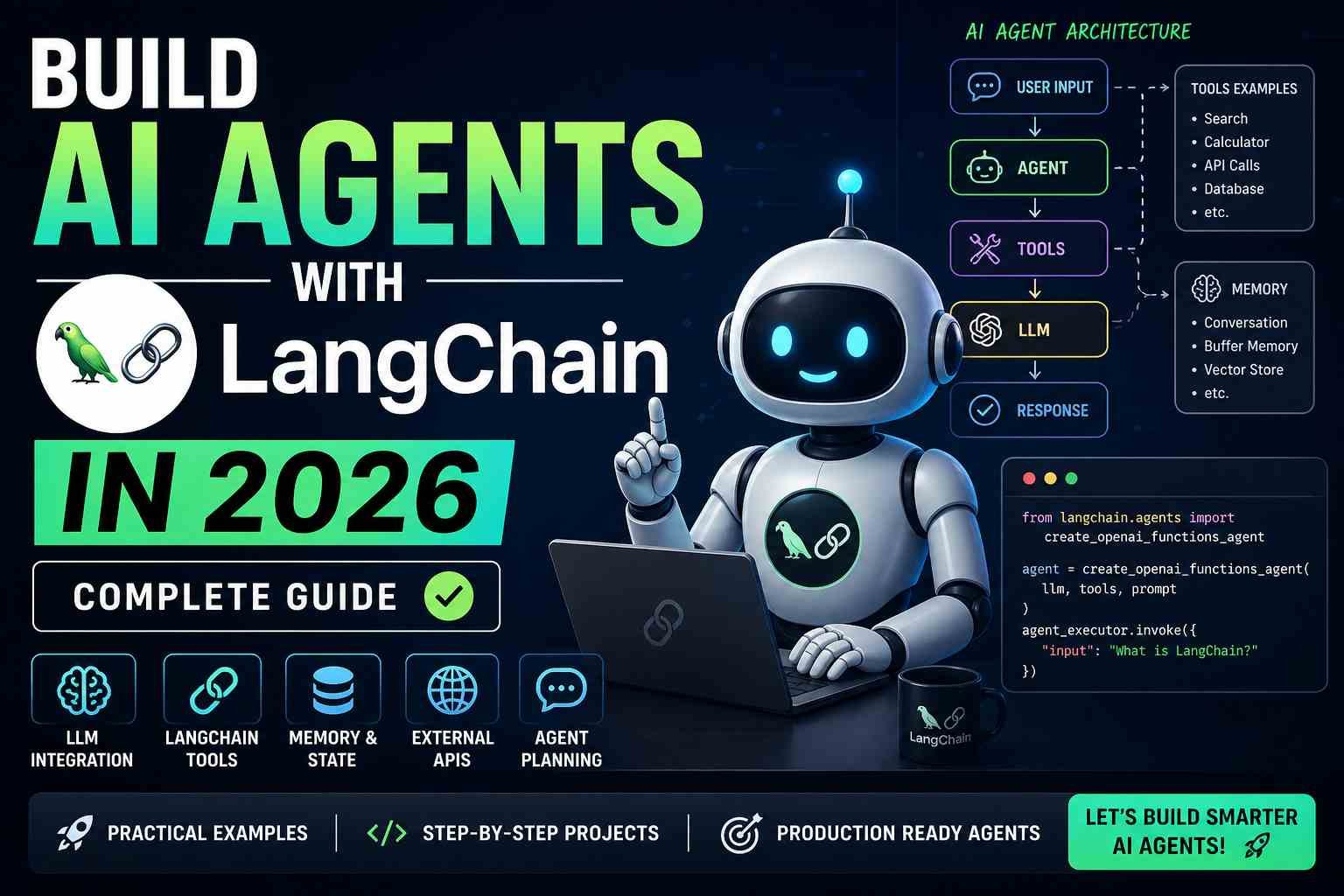
How to Build an AI Agent with LangChain in 2026
Let’s find ot some key Takeways of Build AI Agents with LangChain in 2026 Below first
Key Takeaways
- LangChain in 2026 offers enhanced capabilities for building AI agents with improved memory, reasoning across tools, and knowledge retrieval from custom data sources
- Setting up the 2026 Stack for LangChain development requires a Python environment with specific dependencies and model configurations
- As of 2026, successful AI agents with LangChain can handle complex tasks including chatbots, document Q&A, and multi-step reasoning
- LangSmith provides comprehensive debugging and testing capabilities for LangChain agents in 2026
- Building AI agents with LangChain has become more accessible in 2026 with pre-built architectures and model integrations
The world of AI agent development has changed so much in 2026. LangChain now stands out as a go-to framework for creating smart AI agents that actually remember conversations, reason across tools, and pull knowledge from your own data sources.
As we move through 2026, LangChain’s capabilities have expanded significantly. Developers can now build more reliable, efficient, and context-aware AI agents with fewer hurdles than ever before.
This guide will walk you through building AI agents with LangChain in 2026, from setting up your dev environment to implementing advanced features and deploying production-ready solutions.
Getting Started with LangChain in 2026
LangChain has evolved considerably in 2026, offering more robust features and better performance for AI agent development. The framework now includes enhanced memory systems, better tool integration, and more efficient knowledge retrieval mechanisms.
To start with LangChain in 2026, you’ll need to set up a proper dev environment with the right dependencies and configurations. This ensures you have access to the latest features and optimizations.
Understanding the fundamental concepts behind LangChain agents is crucial before diving into implementation. These concepts form the foundation for building more complex and capable AI systems.
Installing the 2026 Stack
Setting up your Python environment for LangChain development in 2026 is straightforward. Start by creating a dedicated virtual environment to isolate your project dependencies.
As of 2026, the core LangChain package should be installed along with several essential dependencies. The recommended version of the main LangChain package is 0.2.0, which includes the latest performance improvements and features.
Here are the key dependencies you’ll need for LangChain development in 2026:
| Dependency | Version | Purpose |
|---|---|---|
| langchain | 0.2.0 | Core framework for building AI agents |
| langchain-openai | 0.1.0 | OpenAI model integration |
| langchain-community | 0.2.0 | Community integrations and extensions |
| python-dotenv | 1.0.1 | Environment variable management |
After installing these dependencies, configure your development environment with an IDE that supports Python development, such as PyCharm or VS Code. Set up proper linting and formatting tools to maintain code quality throughout your project.
LangChain Architecture Overview
The core components of LangChain agents in 2026 have been refined to provide better modularity and extensibility. The framework now consists of several interconnected modules that work together to create sophisticated AI systems.
The key components include LLM wrappers, memory systems, tool integrations, and document loaders. Each component has been optimized in 2026 to provide better performance and more reliable functionality.
Compared to previous versions, the 2026 architecture of LangChain includes improved error handling, more efficient memory management, and enhanced tool integration capabilities. These improvements make it easier to build production-ready AI agents with fewer common issues.

Building Your First AI Agent with LangChain
Creating your first AI agent with LangChain in 2026 is an exciting journey that will familiarize you with the framework’s core capabilities. Following a structured approach ensures you build a solid foundation for more complex implementations.
The process begins with clearly defining your agent’s goals and objectives. This step is crucial as it guides all subsequent development decisions and helps establish measurable success criteria.
Once you have a clear vision, you can proceed to implement the core functionality of your agent. This involves setting up your LLM with the latest configurations and writing the initial implementation code.
Defining Your Agent’s Goal
Clarifying objectives and expected outcomes for your AI agent is the first critical step in the development process. In 2026, LangChain agents can handle increasingly complex tasks, making precise goal definition even more important.
Break down complex tasks into manageable components that your agent can handle effectively. This decomposition helps in designing a more robust and maintainable system.
Setting performance benchmarks for 2026 ensures your agent meets the standards expected by users. Consider factors like response time, accuracy, and the ability to handle edge cases in your benchmarks.
Implementing Core Functionality
Writing your first agent implementation using LangChain in 2026 involves leveraging the framework’s pre-built architectures and model integrations. Start with a simple implementation that can be gradually enhanced.
Test basic functionality thoroughly before moving to more complex features. Common issues in 2026 include memory management problems and tool integration errors, which can be identified through systematic testing.
Here’s a comparison of top tools and metrics for LangChain development in 2026:
| Tool/Metric | 2026 Capabilities | Best Use Case |
|---|---|---|
| LangSmith | Enhanced debugging and testing | Production agent monitoring |
| Memory Systems | Persistent and contextual | Long-running conversations |
| Tool Integration | Multi-step reasoning | Complex task automation |
As you implement your agent, consider creating a visual flowchart that illustrates the development workflow. This helps in understanding how different components interact and can serve as a reference during development.
Advanced Features and Capabilities in 2026
LangChain in 2026 offers a wealth of advanced features that enable developers to create more sophisticated and capable AI agents. These features include enhanced memory systems, improved tool integration capabilities, and more efficient knowledge retrieval mechanisms.
The growth in LangChain adoption and feature development has been substantial in 2026, with organizations increasingly leveraging these capabilities to solve complex business problems and improve user experiences.
Memory and conversation handling in modern LangChain agents has seen significant improvements, allowing for more natural and contextually aware interactions that can span multiple sessions.
Enhanced Memory Systems
Implementing persistent memory in 2026 LangChain agents allows your AI systems to remember past interactions and context across multiple conversations. This capability is crucial for creating truly intelligent and helpful assistants.
Context management across multiple conversations has been significantly improved in 2026. LangChain now offers more sophisticated memory management techniques that balance the need for context with performance considerations.
Memory optimization techniques for better performance in 2026 include selective memory retention, efficient vector storage, and intelligent context pruning. These techniques ensure your agent remains responsive even with extensive conversation histories.
Tool Integration and Reasoning
Connecting external APIs and services to your LangChain agent in 2026 has become more streamlined. The framework now offers enhanced integration capabilities that make it easier to leverage existing tools and services.
Implementing multi-step reasoning processes allows your agent to tackle complex problems by breaking them down into manageable steps. This capability has been significantly enhanced in 2026, making LangChain agents more capable of sophisticated problem-solving.
Error handling and fallback mechanisms in 2026 have improved substantially, ensuring your agent can gracefully handle unexpected situations and provide meaningful responses even when things don’t go as planned.
Testing, Debugging, and Optimization
Using LangSmith for comprehensive testing in 2026 is essential for building reliable AI agents. The platform provides powerful tools for monitoring, debugging, and optimizing your agent’s performance throughout the development lifecycle.
Performance optimization techniques for production-ready agents in 2026 focus on reducing latency, improving response times, and minimizing resource consumption while maintaining or improving output quality.
Security considerations and guardrails implementation have become increasingly important in 2026. As AI agents become more capable, ensuring they operate safely and responsibly is paramount.
Debugging with LangSmith
Setting up LangSmith for agent monitoring and debugging in 2026 provides developers with unprecedented visibility into their AI systems’ operations. The platform offers comprehensive tracing and logging capabilities.
Identifying and resolving common issues in 2026 LangChain agents is now more straightforward thanks to improved error reporting and diagnostic tools. LangSmith helps pinpoint exactly where and why problems occur.
Performance metrics to track for optimal agent behavior in 2026 include response time, accuracy, token usage, and error rates. Monitoring these metrics helps ensure your agent meets performance expectations.
Optimization Strategies
Reducing latency and improving response times in 2026 involves several strategies, including model selection, prompt optimization, and caching mechanisms. These improvements enhance user experience significantly.
Cost optimization techniques for API calls in 2026 have become more sophisticated as model usage continues to grow. Strategies include selective model usage, request batching, and intelligent caching of frequent queries.
Scalability considerations for enterprise deployment in 2026 include load balancing, resource allocation, and horizontal scaling. These considerations ensure your agent can handle increasing demand without performance degradation.
Real-World Applications and Use Cases
Document Q&A systems implementation in 2026 has become one of the most popular applications of LangChain. Organizations are leveraging these systems to extract insights from vast amounts of unstructured data efficiently.
Building specialized agents for specific industries in 2026 allows organizations to address unique challenges and requirements. LangChain’s flexibility makes it suitable for a wide range of vertical applications.
Case studies of successful LangChain implementations in 2026 demonstrate the framework’s versatility and effectiveness across various domains, from customer service to healthcare and financial services.
Document Processing and Analysis
Implementing document retrieval and question answering in 2026 has been enhanced by improved document loaders and vector stores. These improvements make it easier to build systems that can understand and respond to queries about complex documents.
Handling different document formats in 2026 is now more seamless, with LangChain supporting a wide range of file types including PDFs, Word documents, and even multimedia content with appropriate processing pipelines.
Extracting insights from unstructured data in 2026 has become more powerful with advanced natural language processing capabilities. LangChain agents can now identify key information, relationships, and patterns in complex datasets.
Industry-Specific Implementations
Healthcare applications with LangChain in 2026 are revolutionizing patient care through AI-powered diagnostics, treatment recommendations, and administrative automation. These applications must adhere to strict regulatory requirements while delivering value.
Financial services and compliance use cases in 2026 leverage LangChain’s capabilities for risk assessment, fraud detection, and regulatory reporting. The framework’s reliability and accuracy make it suitable for these high-stakes applications.
Customer service automation examples in 2026 show how LangChain agents can handle complex customer inquiries, process orders, and provide personalized support at scale. These implementations significantly improve customer satisfaction while reducing operational costs.
Frequently Asked Questions
What programming skills are needed for LangChain development in 2026?
Required Python knowledge and best practices form the foundation of LangChain development in 2026. You should be comfortable with Python syntax, data structures, and object-oriented programming concepts.
Understanding of AI/ML concepts is essential for effectively leveraging LangChain’s capabilities. This includes knowledge of large language models, prompt engineering, and basic machine learning principles.
Additional skills for advanced implementations in 2026 include API integration, database management, and cloud computing. These skills become important as you scale your applications and move toward production deployment.
How does LangChain compare to other AI agent frameworks in 2026?
Key differentiators and advantages of LangChain in 2026 include its comprehensive ecosystem, extensive documentation, and active community support. These factors make it particularly accessible for developers at various skill levels.
When to choose LangChain over alternatives depends on your specific use case. LangChain excels in applications requiring complex tool integration, memory management, and knowledge retrieval from custom sources.
Integration capabilities with other tools in 2026 have expanded significantly, making LangChain a versatile choice for organizations already invested in various AI and data processing technologies.
What are the costs associated with building and deploying LangChain agents?
API and model costs in 2026 represent the primary expense in LangChain development. These costs vary depending on the models used, API call frequency, and the complexity of your implementation.
Infrastructure requirements for LangChain agents in 2026 include computational resources for running models, storage for memory and data, and networking capabilities for API integrations. Cloud-based solutions are commonly used for these requirements.
Cost optimization strategies in 2026 include model selection based on task requirements, caching frequent queries, and implementing request batching to reduce API call frequency without significantly impacting performance.
How can I ensure my LangChain agent is secure and reliable?
Implementing security best practices in 2026 includes input sanitization, access control, and secure API key management. These practices help prevent common security vulnerabilities in AI applications.
Testing for vulnerabilities in LangChain agents should be a regular part of your development process. This includes adversarial testing to identify potential weaknesses in your agent’s responses and decision-making processes.
Monitoring and maintenance in production environments in 2026 involve continuous performance tracking, error logging, and regular updates to both your code and the underlying models. This ensures your agent remains reliable and secure over time.



[…] Build AI Agents with LangChain in 2026 | Complete Guide […]