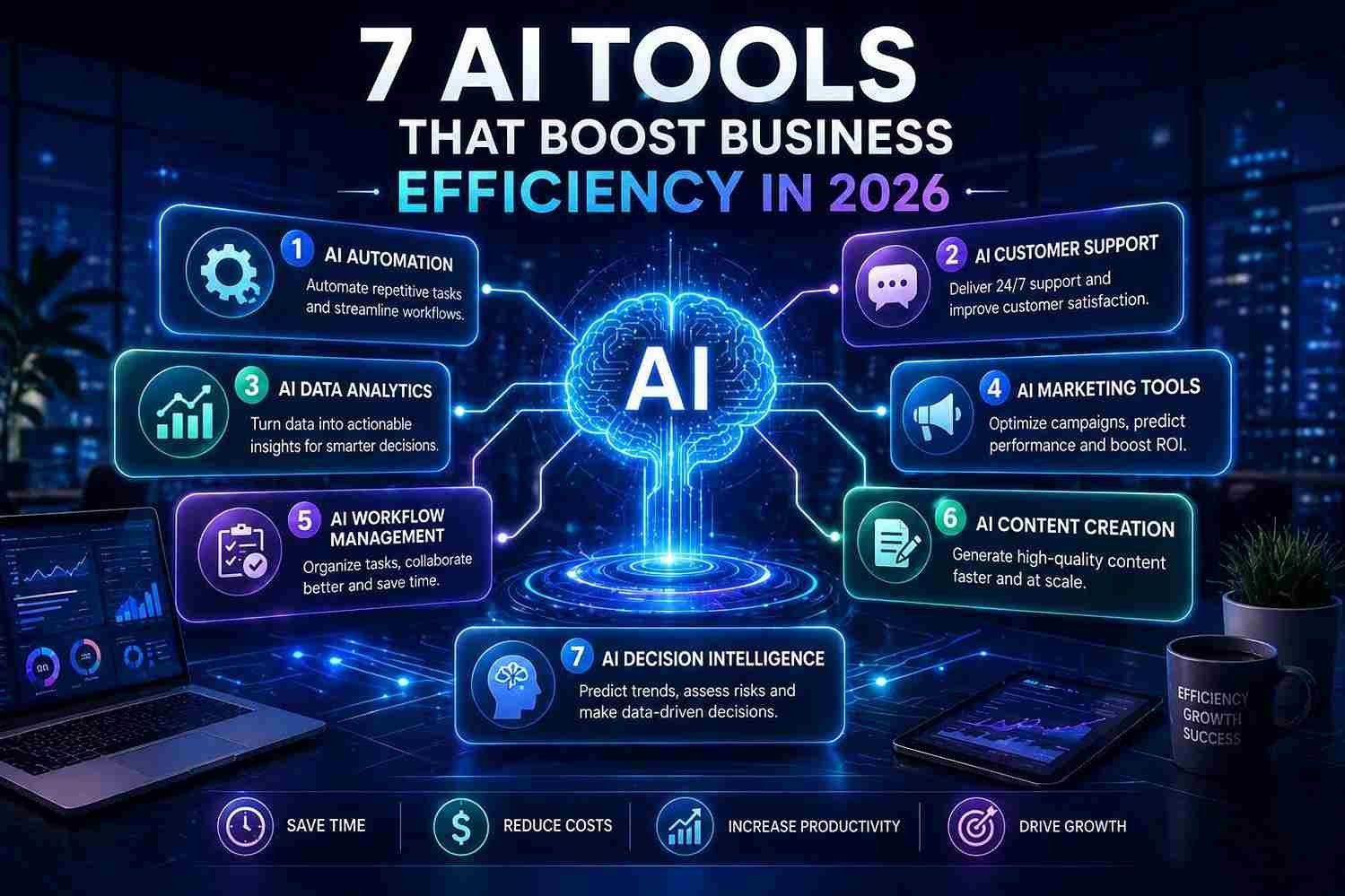
7 AI Tools That Boost Business Efficiency in 2026
Let’s dive in to 7 AI Tools Boosting Business Efficiency in 2026
Key Takeaways
- AI tools for business in 2026 are reshaping how companies operate, from automating repetitive tasks to predicting customer behavior
- Top AI productivity tools in 2026 include Microsoft Copilot 365, Google Gemini for Workspace, Notion AI, and Zapier AI Automation
- Businesses implementing AI tools in 2026 have seen measurable outcomes with improved decision-making and streamlined workflows
- AI tools for business analytics like ThoughtSpot, Power BI, Tableau, and Qlik are becoming essential for data-driven decision making
- As of April 2026, KIME ranks among the top AI tools for businesses based on practical business value and breadth of use cases

Introduction to AI Tools for Business Efficiency in 2026
Businesses in 2026 are experiencing an unprecedented transformation through AI tools that automate processes, enhance decision-making, and create new opportunities for growth.
The landscape of AI adoption has evolved dramatically since early 2020s, with mature solutions now available across all business functions.
As of 2026, approximately 78% of enterprises have implemented AI solutions in some form, with 65% reporting measurable improvements in operational efficiency.
This widespread adoption marks a significant shift from experimental use to strategic implementation across industries.
Why 2026 is a Pivotal Year for AI in Business
The latest developments in AI technology have made these tools more accessible and affordable for businesses of all sizes.
Advanced natural language processing, computer vision, and predictive analytics capabilities are now integrated into user-friendly platforms that require minimal technical expertise.
The regulatory landscape for AI in 2026 has matured significantly, with clear guidelines emerging in major markets.
This increased regulatory clarity has boosted business confidence in AI adoption, addressing concerns about ethics, data privacy, and accountability.
Top AI Productivity Tools for Business Efficiency in 2026
The most impactful AI productivity tools for businesses in 2026 focus on streamlining workflows, enhancing collaboration, and automating routine tasks.
These tools have evolved significantly from their early versions, offering more sophisticated capabilities while maintaining ease of use.
| Name | Key Features | Pricing | Best Use Cases | User Rating |
|---|---|---|---|---|
| Microsoft Copilot 365 | Context-aware assistance, document generation, email drafting, data analysis | $30/user/month | Document creation, email management, data analysis in Office apps | 4.7/5 |
| Google Gemini for Workspace | Real-time collaboration, content generation, smart search, voice commands | $20/user/month | Team collaboration, content creation, meeting management | 4.6/5 |
| Notion AI | Knowledge management, document automation, workflow optimization | $10/user/month | Project management, documentation, team wikis | 4.5/5 |
| Zapier AI Automation | Workflow automation, app integration, conditional logic | $19.99/user/month | Cross-platform automation, lead generation, data synchronization | 4.8/5 |
Microsoft Copilot 365
Microsoft Copilot 365 has revolutionized how businesses interact with the Microsoft 365 suite.
Its deep integration across Word, Excel, PowerPoint, and Outlook provides contextual assistance that understands user intent and workplace context.
Key features that distinguish Copilot include its ability to generate complete documents from brief outlines, analyze complex datasets in Excel, and create professional presentations based on meeting notes.
The system learns from individual user patterns to provide increasingly relevant suggestions over time.
Businesses implementing Copilot in 2026 report significant productivity gains.
A recent study shows that users complete tasks 50% faster on average, with 45% of professionals reporting that Copilot has fundamentally changed how they approach their daily work.
Companies in professional services have seen the most dramatic improvements, with billable hours increasing by 22% due to reduced administrative overhead.
Google Gemini for Workspace
Google’s latest AI model, Gemini, has enhanced collaboration and productivity across the Google Workspace ecosystem.
It offers real-time translation, content summarization, and intelligent suggestions that adapt to user preferences and work patterns.
The integration with Google Workspace applications is seamless, allowing users to leverage AI capabilities across Gmail, Docs, Sheets, and Meet.
Gemini can automatically draft responses to emails, create meeting summaries, and even generate formulas in Sheets based on natural language requests.
Case studies from businesses implementing Gemini in early 2026 show promising results.
A global retail chain reported a 35% reduction in time spent on document creation across its 15,000 employees.
Another tech company saw a 28% improvement in meeting efficiency as Gemini automatically captured action items and distributed summaries without manual intervention.
Notion AI
Notion AI has emerged as a standout tool for workspace management, combining the flexibility of a digital workspace with powerful AI capabilities.
It automates routine tasks like meeting notes, project updates, and documentation while maintaining the collaborative features that made Notion popular.
Notion AI streamlines documentation and knowledge management by automatically generating meeting notes from recordings, creating project status reports, and organizing information based on content analysis.
The system can identify patterns across documents and suggest connections that humans might miss.
User adoption metrics and satisfaction rates in 2026 indicate strong performance.
Notion AI has achieved a 4.5/5 user rating across platforms, with 78% of users reporting that it has significantly improved their team’s ability to find and utilize information.
Companies implementing Notion AI report a 40% reduction in time spent on documentation tasks and a 25% improvement in knowledge retrieval times.
AI Automation Tools for Streamlining Business Processes
The role of AI in automating business workflows in 2026 has expanded beyond simple task automation to include intelligent decision-making systems that can adapt to changing conditions.
Modern AI automation tools can understand context, predict outcomes, and make adjustments to workflows in real-time.

Cost savings and efficiency metrics from AI automation implementations are compelling.
Businesses report an average 47% reduction in process completion times, 38% decrease in error rates, and 32% lower operational costs after implementing AI automation.
These improvements translate directly to enhanced competitiveness and profitability.
Zapier AI Automation
Latest enhancements to Zapier’s AI capabilities in 2026 include advanced natural language processing for workflow creation, predictive automation suggestions, and improved error handling with self-healing capabilities.
The platform now supports over 5,000 app integrations with AI-powered connection points.
Integration capabilities with other business tools and platforms have expanded significantly.
Zapier AI now offers pre-built workflows for popular business processes across marketing, sales, HR, and finance.
The system can analyze existing workflows and suggest optimizations while learning from user interactions to improve over time.
Real-world examples of businesses streamlining operations with Zapier AI demonstrate tangible benefits.
A mid-sized e-commerce company implemented AI-powered inventory management that reduced stockouts by 65% and excess inventory by 40%.
A healthcare provider used automated patient appointment scheduling with AI prioritization, resulting in 30% higher utilization rates and improved patient satisfaction.
Other Notable AI Automation Platforms
Comparison of alternative AI automation tools like IFTTT and Make reveals different strengths for various business needs.
IFTTT offers simplicity and ease of use for straightforward automation, while Make provides more complex workflow capabilities with conditional logic and data transformation features.
Industry-specific automation solutions for 2026 have emerged to address unique challenges in different sectors.
Manufacturing has seen specialized AI automation for quality control and predictive maintenance, while healthcare has developed solutions for patient care coordination and administrative tasks.
Implementation strategies for businesses new to AI automation should start with high-impact, low-complexity processes that deliver quick wins.
This approach builds momentum and organizational confidence while demonstrating value.
As teams become more comfortable with AI automation, they can gradually tackle more complex processes with greater strategic importance.
AI Tools for Business Analytics and Decision-Making
How AI is transforming data analytics and business intelligence in 2026 is evident in the shift from descriptive reporting to predictive and prescriptive insights.
Modern AI analytics tools can identify patterns, forecast trends, and recommend actions based on complex data analysis.
Key features to look for in AI-powered analytics tools include natural language querying, automated insights generation, predictive modeling capabilities, and integration with existing data sources.
The most advanced systems also offer explainable AI features that help users understand how recommendations were generated.
Leading AI Business Analytics Platforms
ThoughtSpot, Power BI, Tableau, and Qlik represent the leading AI business analytics platforms in 2026, each with distinct strengths.
ThoughtSpot excels in search-based analytics with natural language capabilities, Power BI offers deep integration with Microsoft ecosystems, Tableau provides superior visualization capabilities, and Qlik specializes in associative analytics that reveal hidden connections in data.
How these tools are incorporating generative AI features varies by platform.
Most now offer automated report generation, natural language explanations of data trends, and predictive forecasting capabilities.
The latest developments include generative dashboards that adapt to user needs and automated insights that highlight significant changes or anomalies without manual analysis.
Case studies showing improved decision-making outcomes demonstrate the value of AI analytics.
A financial services company implemented AI-powered fraud detection that reduced false positives by 42% while identifying 35% more actual fraud cases.
A retail chain used AI analytics for demand forecasting, resulting in 28% reduction in inventory costs and improved stock availability for high-demand products.
Implementing AI Analytics in Your Business
Data preparation requirements for effective AI analytics are more stringent than traditional business intelligence.
Organizations need clean, well-structured data with consistent definitions across systems.
Data quality issues should be addressed before implementation, as AI systems can amplify existing problems in datasets.
Training considerations for teams using AI analytics tools include developing both technical skills and data literacy.
Employees need to understand how to interpret AI-generated insights, recognize limitations, and apply recommendations appropriately.
The most successful implementations combine technical training with business context education.
Measuring ROI from AI analytics implementations requires both quantitative and qualitative metrics.
Quantitative measures might include time saved on analysis, accuracy improvements, or revenue impact.
Qualitative measures could include better decision quality, increased data-driven culture, or improved strategic alignment.
Organizations should establish baseline metrics before implementation to track improvements over time.
AI Tools for Content Creation and Marketing
Latest AI tools for content creation in 2026 and their business applications have evolved significantly from earlier versions.
Modern content creation AI can generate text, images, video, and interactive content with minimal human input while maintaining quality and brand consistency.
How AI is transforming content marketing strategies is evident in the shift from production-focused approaches to efficiency and personalization.
AI tools can analyze performance data and automatically optimize content for engagement, conversion, and SEO, creating a continuous improvement cycle.
Quality control considerations when using AI for content creation are more important than ever.
Businesses should establish review processes that maintain brand voice and accuracy while leveraging AI efficiency.
The most successful implementations combine AI generation with human oversight for quality assurance.
Top AI Content Creation Tools
Jasper, Editpad, Writesonic, and other leading AI content tools in 2026 offer specialized capabilities for different content needs.
Jasper excels at long-form content and marketing copy, Editpad focuses on editing and optimization, Writesonic specializes in social media content, and newer platforms offer multimodal content generation including images and video.
Features that make these tools valuable for businesses include brand voice customization, style consistency across content, and performance optimization based on engagement metrics.
Advanced tools can analyze competitor content and identify gaps in the market, suggesting content opportunities that align with business objectives.
Integration with content management and marketing automation platforms has improved significantly.
Most AI content tools now offer direct connections to CMS platforms like WordPress, marketing automation tools like HubSpot, and social media management systems.
This integration enables automated content publishing, performance tracking, and optimization based on real-time data.
Ethical Considerations in AI Content Creation
Transparency and disclosure requirements for AI-generated content in 2026 have become more defined in many jurisdictions.
Businesses should clearly disclose when content is AI-generated, particularly in contexts where authenticity or human connection is valued.
Some platforms now require specific labeling for AI-created content.
Balancing AI efficiency with human creativity and oversight is crucial for maintaining brand authenticity and audience trust.
The most successful approaches use AI to handle routine content creation while reserving human creativity for strategic initiatives, brand-defining pieces, and complex messaging that requires emotional intelligence.
Legal considerations for businesses using AI content tools include copyright ownership, data privacy, and potential liability for AI-generated content that infringes on rights or contains errors.
Organizations should establish clear guidelines for content review and approval processes to mitigate these risks.
Frequently Asked Questions
What are the most significant benefits of implementing AI tools in businesses in 2026?
Improved productivity and efficiency metrics are among the most significant benefits, with businesses reporting 35-50% time savings on routine tasks.
Cost savings through automation are substantial, with average 32% reduction in operational costs for processes handled by AI.