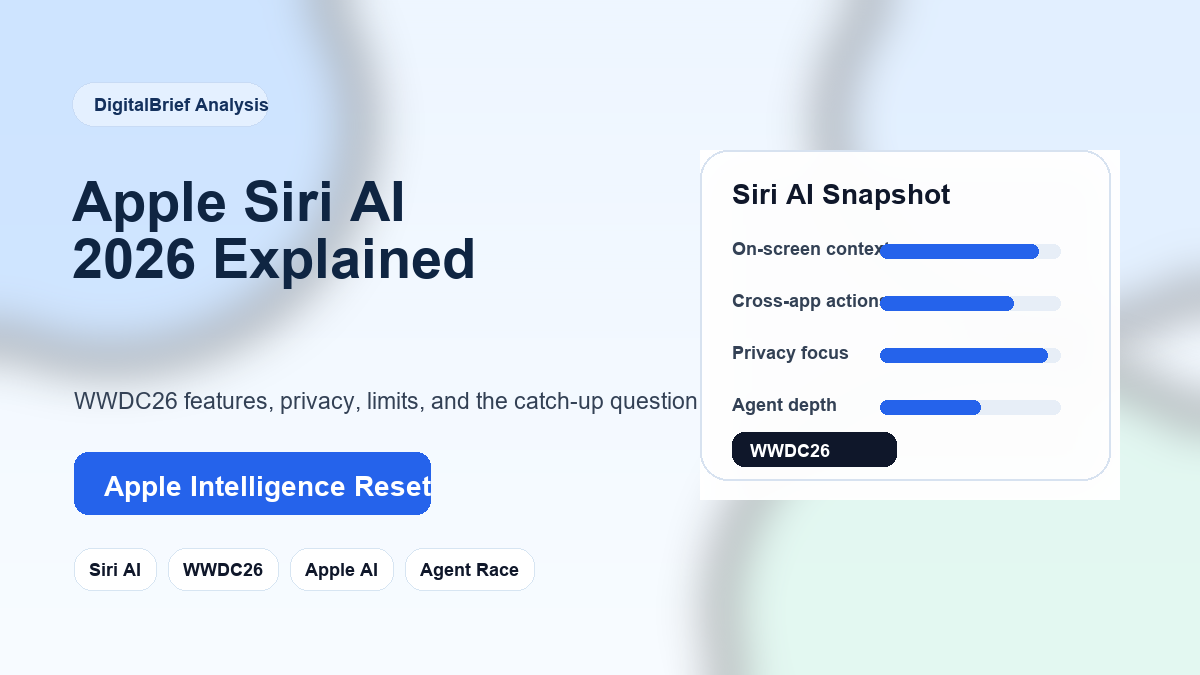
Apple Siri AI 2026 Explained: What WWDC26 Changed and Why It Matters
Apple finally did the thing people have been waiting for.
On June 8, 2026, at WWDC26, the company unveiled Siri AI, which it described as an entirely new version of Siri inside the next generation of Apple Intelligence.
That sentence sounds simple.
But for Apple, this is one of the highest-stakes product resets it has made in years.
For a long time, Siri felt like the assistant that was everywhere but rarely the one you actually wanted to use.
It could set timers, send messages, and handle basic requests.
It could not keep up with what people now expect from AI assistants.
That expectation changed fast.
ChatGPT made conversational AI mainstream. Google pushed Gemini deeper into search and Android. Anthropic kept raising the bar for long-form reasoning and coding help.
Meanwhile, Apple kept talking about privacy, device integration, and getting AI right.
Now the company is trying to prove that waiting was worth it.
In this DigitalBrief breakdown, I will explain what Apple announced on June 8, 2026, what Siri AI can actually do, who gets it first, where the limitations are, and why Apple still looks like it is catching up to a market that has already shifted toward agents.
| Quick take | Why it matters |
|---|---|
| Siri AI was announced on June 8, 2026 | This is a fresh, high-curiosity AI topic with strong search demand. |
| Apple says it is a completely new Siri | The company is repositioning Siri from voice command helper to full assistant layer. |
| It can read on-screen context and work across apps | That moves Siri closer to modern AI assistant behavior. |
| Rollout is limited by region, language, and hardware | Many readers searching for it today mainly want to know whether they can use it yet. |
What Apple Announced at WWDC26 on June 8, 2026
Apple used WWDC26 to relaunch its AI story.
According to Apple’s June 8, 2026 newsroom announcement, Siri AI is deeply integrated across iPhone, iPad, Mac, Apple Watch, and Apple Vision Pro.
Apple also said Siri AI can understand what is on your screen, use personal context to search across messages, emails, and photos, and pull in up-to-date information from the web when needed.
That is a meaningful shift.
The old Siri mostly waited for a command.
The new Siri AI is being framed more like a context-aware assistant that can see, understand, and act inside the system.
Apple also introduced a dedicated Siri app.
That detail matters more than it may seem at first glance.
It signals that Apple now sees assistant interaction as an ongoing conversation, not only as one-off voice commands.
| Announcement detail | What Apple confirmed | Reader takeaway |
|---|---|---|
| Announcement date | June 8, 2026 | This is breaking-cycle AI news, not an old rumor. |
| Core positioning | An entirely new Siri powered by the next generation of Apple Intelligence | Apple is treating this as a product reset, not a small update. |
| Context awareness | Understands on-screen content and personal context | The assistant is finally designed for real workflow help. |
| App actions | Can get things done across apps with more systemwide actions | This is Apple’s answer to the broader agent trend. |
| Dedicated app | Siri now has its own app with synced history | Apple wants assistant sessions to feel continuous across devices. |
What Siri AI Can Actually Do
Here is the plain-English version.
Siri AI is meant to be more conversational, more aware of your personal data, and more useful inside everyday apps.
Based on Apple’s official materials and follow-up coverage, the practical upgrades fall into a few buckets.
1. It can understand what is on your screen
This is one of the biggest changes.
If you are looking at a message, email, photo, or webpage, Siri AI can use that context to answer a question or suggest the next step.
That reduces the friction of constantly re-explaining what you mean.
2. It can search across personal context
Apple says Siri AI can pull from messages, email, photos, and other app data to find relevant information.
For normal users, that means questions like “What was that podcast Sara sent me?” or “Find the photo from last weekend with Rahul in it” become much more realistic.
3. It can take more actions across apps
This is where things get interesting.
Apple is pushing Siri beyond retrieval and into action.
Examples shown around the launch included helping with reminders, notes, browsing tasks, and broader app interactions.
4. It can use the web for fresh information
Apple explicitly said Siri AI can go out to the web for up-to-date information using broad world knowledge.
That matters because old assistants often felt trapped inside a stale local bubble.
5. It now behaves more like a cross-device chat assistant
With the dedicated Siri app and synced history, Apple is borrowing the interaction model people already understand from ChatGPT, Claude, and Gemini.
That was overdue, honestly.
| Capability | Old Siri | Siri AI in 2026 |
|---|---|---|
| Conversation quality | Functional but limited | More natural and expressive |
| Screen awareness | Very limited | Can answer based on what is visible on screen |
| Personal context | Weak | Searches across messages, emails, photos, and more |
| App actions | Basic commands | Broader systemwide app actions |
| Cross-device continuity | Minimal | Dedicated app with privately synced history |
Why This Launch Is Trending So Hard
There are a few reasons this story is moving quickly.
First, this is not a niche developer feature.
Siri is one of the most visible AI surfaces in consumer tech.
When Apple changes it, mainstream users notice.
Second, Apple has been under pressure here for a while.
The company promised a smarter Siri and broader Apple Intelligence story earlier, and many people felt the original momentum fizzled.
So this relaunch carries a mix of excitement, skepticism, and pure curiosity.
Third, the competitive backdrop is brutal.
Google is already pushing Gemini 3.5 Flash into AI Mode in Search as the default model globally, with a bigger focus on action-oriented AI behavior.
OpenAI, Anthropic, and others are increasingly framing AI as agents that can do longer-horizon tasks.
That is why the Apple story is bigger than “Siri got better.”
The real question is whether Apple has finally built an assistant that feels current.
Apple’s Privacy Angle Is the Real Strategic Bet
If you strip away the keynote polish, Apple’s pitch is pretty clear.
The company wants users to believe it can offer useful AI without forcing them to hand over their digital life to a cloud-first chatbot company.
Apple and The Verge both emphasized the same point: many requests are processed on-device or through Apple’s Private Cloud Compute architecture.
That is not just a technical detail.
It is the center of Apple’s competitive story.
In my experience, this gives Apple a real opening with normal users.
A lot of people want better AI help, but they do not necessarily want a fully autonomous assistant constantly shipping sensitive context to third-party systems.
For developers and power users, though, privacy alone is not enough.
If the assistant feels slower, narrower, or less capable than rival tools, privacy becomes a nice bonus instead of the deciding factor.
| Apple’s pitch | What users may like | Possible downside |
|---|---|---|
| On-device processing where possible | Stronger privacy story | May limit which devices get the best features |
| Private Cloud Compute for heavier tasks | Feels safer than generic cloud AI branding | Apple still has to prove the experience is fast and reliable |
| Deep system integration | Potentially smoother help across apps | Works best only inside Apple’s own ecosystem |
Where Apple Still Looks Behind
This is the uncomfortable part for Apple fans.
Siri AI looks meaningfully better than the old Siri.
But it also looks like a product entering a market that has already moved to its next phase.
Axios captured the mood well in its June 9, 2026 analysis: Apple is finally shipping the conversational, context-aware assistant it promised, while rivals are already talking about agents.
That is the exact tension here.
Apple has improved assistant quality.
But Google, OpenAI, and Anthropic are fighting over who owns action-heavy workflows, coding help, search tasks, research flows, and workplace automation.
That is a different race.
Craig Federighi reportedly acknowledged this in follow-up comments, saying long-horizon agent tasks are still early.
That is a fair point.
But it is also a quiet admission that Siri AI is not yet the most ambitious thing happening in AI assistants.
Release Timing, Access, and Hardware Limits
This is where a lot of readers get tripped up.
Apple announced Siri AI on June 8, 2026, but that does not mean everyone can use it immediately.
According to Apple, developers can start testing now, and broader beta access is planned later in 2026.
Apple also said the initial rollout starts in English and expands later.
Region rules matter too.
Apple said Siri AI will not initially be available in the EU on iOS, iPadOS, and watchOS, though Mac and Vision Pro users in the EU can access it when set to a supported language.
Apple also said Siri AI and the other new Apple Intelligence features will not initially be available in China while the company works through regulatory requirements.
Hardware is another filter.
Some of the strongest on-device AI features are limited to newer hardware tiers, according to launch coverage, which means older or lower-end Apple devices will not get the full experience.
| Access question | What is confirmed as of June 15, 2026 |
|---|---|
| Can people use Siri AI today? | Developers can test it now; broader user rollout is later in 2026. |
| Which language launches first? | English. |
| Is it fully available in the EU? | No. It is initially delayed on iOS, iPadOS, and watchOS in the EU. |
| Is it available in China? | No, not initially. |
| Will all Apple devices get the full AI experience? | No. Some advanced on-device features need newer hardware. |
Real-World Use Cases That Actually Sound Useful
Not every AI demo turns into daily behavior.
These are the Siri AI use cases that look most practical right now.
- Message recall: finding something a friend or colleague sent without manually searching multiple apps.
- Travel and planning help: pulling details from mail, messages, calendars, and notes in one step.
- Photo retrieval: using natural language to find images based on people, dates, or context.
- Light task automation: turning conversations into reminders, notes, or follow-up actions faster.
- On-screen assistance: asking about a webpage, message, or image without copying everything into another app.
Most people miss this.
The most valuable AI assistant features are usually not the flashy ones.
They are the ones that quietly remove five or ten pieces of friction from your day.
Pros and Cons of Apple Siri AI Right Now
| Pros | Cons |
|---|---|
| Big improvement over the old Siri model | Arrives late compared with the broader AI assistant market |
| Strong privacy and on-device positioning | Regional and regulatory availability limits are real |
| Deeper app and device integration | Some of the best features need newer hardware |
| Dedicated Siri app makes the experience feel current | Still not the clearest leader in agent-style tasks |
| Useful for mainstream consumers who live inside Apple products | Power users may still prefer ChatGPT, Gemini, or Claude for deeper work |
What This Means for the AI Assistant Market
Siri AI matters because Apple entering the modern assistant race changes competitive pressure for everyone else.
Even if Apple is late, its distribution is massive.
If Siri AI works well enough, millions of users may decide they do not need a separate AI app for many everyday tasks.
That could squeeze a lot of smaller assistant tools.
At the same time, Apple may split the market instead of owning it.
Mainstream users may prefer Siri AI for personal-device help, while professionals keep using ChatGPT, Claude, or Gemini for research, writing, coding, and longer task chains.
That hybrid future feels more realistic to me.
Consumer convenience and power-user depth are not always won by the same product.
Future Predictions
Here is what I would watch next.
- Apple will keep pushing Siri AI deeper into core apps and system actions over the next 12 months.
- The privacy narrative will become more important as AI assistants get more access to personal context.
- Google, OpenAI, and Anthropic will keep forcing the market toward more agent-like behavior.
- Apple’s real test will not be the keynote. It will be whether Siri AI feels dependable in normal daily use.
- Hardware gating will become a bigger consumer frustration if Apple’s best AI features stay locked to premium devices.
Frequently Asked Questions
1. What is Apple Siri AI?
Apple Siri AI is the new version of Siri announced by Apple on June 8, 2026 at WWDC26. It is designed to be more conversational, more context-aware, and more capable across apps and devices.
2. When did Apple announce Siri AI?
Apple announced Siri AI on June 8, 2026 during WWDC26.
3. What can Siri AI do?
Apple says Siri AI can understand on-screen content, search across personal context like messages and email, take more actions across apps, and use the web for up-to-date information.
4. Is Siri AI available now?
As of June 15, 2026, developer testing has started, but the broader rollout to users is scheduled later in 2026.
5. Which devices support Siri AI?
Apple says Siri AI is integrated across iPhone, iPad, Mac, Apple Watch, and Apple Vision Pro, though some advanced features require newer hardware.
6. Is Siri AI available in Europe?
Not fully. Apple said Siri AI will not initially be available in the EU on iOS, iPadOS, and watchOS, though Mac and Vision Pro users in the EU can access it in supported languages.
7. Is Siri AI available in China?
No. Apple said Siri AI and other new Apple Intelligence features will not initially be available in China while it works through regulatory requirements.
8. What language does Siri AI launch in first?
Apple said the initial rollout begins in English, with more languages planned later.
9. How is Siri AI different from old Siri?
The new Siri AI is more conversational, can use on-screen and personal context, supports broader app actions, and now has a dedicated app with synced conversation history.
10. Is Siri AI better than ChatGPT or Gemini?
That depends on the task. Siri AI looks stronger for on-device Apple workflows, while ChatGPT and Gemini still appear stronger for many deeper research, writing, and agent-style use cases.
11. Why is Siri AI important for Apple?
Because it resets Apple’s AI credibility. The company needed a modern assistant story that feels competitive after earlier delays and rising pressure from Google, OpenAI, and Anthropic.
12. Why is Apple focusing so much on privacy?
Privacy is central to Apple’s AI strategy. The company wants to make AI more useful without giving up its brand position around secure, trusted personal-device computing.
Final Thoughts
Apple Siri AI is one of the most important consumer AI launches of June 2026.
Not because it is the most futuristic thing announced this month, but because it puts modern assistant behavior into a product hundreds of millions of people already know.
That alone makes it a big deal.
At the same time, Apple is not entering an empty field.
It is entering a market where rivals have already pushed the conversation from chat to action.
So the real verdict is mixed.
Siri AI looks like a serious improvement.
It also looks like the beginning of Apple’s catch-up phase, not the end of it.
If Apple nails reliability, privacy, and everyday usefulness, that may be enough for mainstream users.
If not, people will keep using Siri for timers and reach for something else when they need real AI help.
If you want more practical AI launch breakdowns, product analysis, and no-hype explainers on what actually matters in tech, keep following DigitalBrief.in.