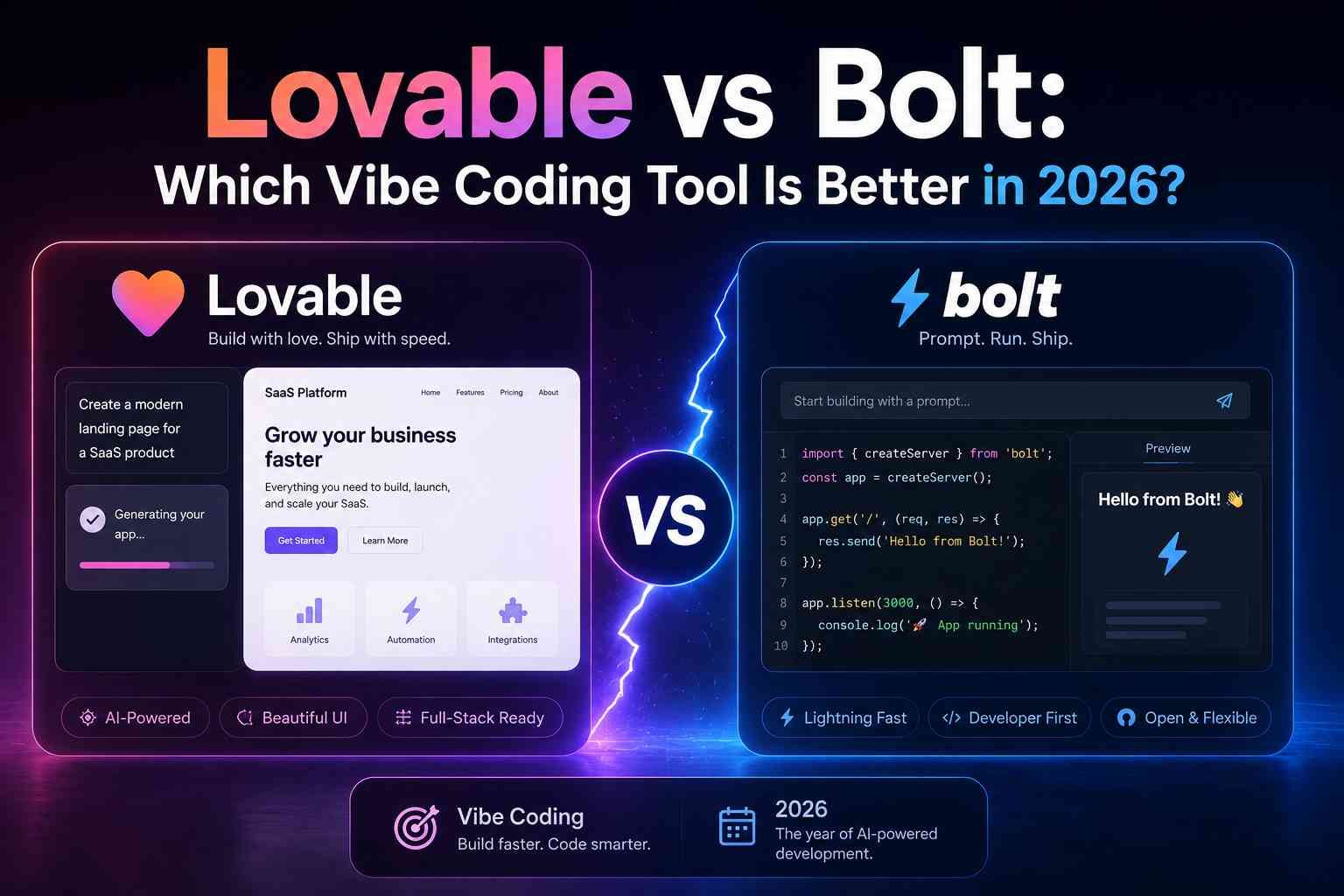
Lovable vs Bolt is one of the most common comparisons in vibe coding because both tools promise something very attractive: describe an app in plain English and get a working product faster than traditional development.
But they are not identical.
Lovable feels more like a design-friendly AI app builder for founders, creators, and non-technical users. Bolt feels more like a browser-based development environment where you can generate, run, inspect, and edit a full-stack app without installing a local setup.
Both can be useful. Both can also create messy results if you treat AI-generated code as finished software without testing it.
This comparison breaks down Lovable vs Bolt across ease of use, pricing, code control, deployment, databases, design quality, best use cases, and real-world risks.
Quick Verdict
Choose Lovable if you want the easiest path from idea to polished MVP.
Choose Bolt if you want a browser-based full-stack builder with more direct visibility into the code and runtime.
Choose neither blindly for mission-critical production software unless you have a testing and security review process.
Lovable vs Bolt: Quick Comparison
| Feature | Lovable | Bolt |
|---|---|---|
| Best For | Non-coders, founders, MVPs | Browser-based full-stack apps |
| Learning Curve | Easier | Slightly more technical |
| Interface Style | Conversational app builder | Browser IDE with live preview |
| Code Visibility | Available, but less code-first | More code-forward |
| Pricing | Free plan; paid from $25/month | Free plan; Pro listed at $25/month |
| Deployment | Built-in publishing options | Website hosting and custom domains on paid plans |
| Best User | Founder or creator | Builder who wants more control |
| Biggest Risk | Credit usage and over-trusting output | Token usage and project complexity |
What Is Lovable?
Lovable is an AI app builder that lets you create apps through conversation. You explain the app you want, refine the screens, ask for new features, and publish.
The official Lovable pricing page currently lists a free plan with daily credits and paid plans starting at $25/month. The Pro plan includes monthly credits, credit rollovers, custom domains, unlimited Lovable domains, and the option to remove the Lovable badge.
Lovable is best when you want:
- A SaaS MVP
- A client demo
- A simple dashboard
- A directory
- A lead capture app
- A polished prototype
- A product validation tool
It is especially good for people who think in product screens rather than files, components, and terminal commands.
What Is Bolt?
Bolt is an AI-powered app builder from StackBlitz. It runs in the browser and uses StackBlitz’s WebContainers technology, which allows Node.js-style development to happen inside the browser.
The official Bolt pricing page currently lists a free plan and Pro at $25/month billed monthly. The free plan includes daily and monthly token limits, while Pro removes the daily token limit and adds more monthly tokens, custom domain support, hosting features, SEO boosting, expanded database capacity, and image editing with AI.
Bolt is best when you want:
- A browser-based coding environment
- Live app previews
- More code visibility
- Full-stack web app experiments
- GitHub-connected workflows
- Faster technical prototyping
It is still beginner-friendly, but it feels more technical than Lovable.
Ease of Use
Lovable wins on pure ease of use.
If someone has never used GitHub, VS Code, npm, or a terminal, Lovable will usually feel less intimidating. You can describe what you want in normal language and focus on the app experience.
Bolt is still much easier than traditional development, but it exposes more of the development environment. That is good if you want control. It is less ideal if code makes you nervous.
My practical rule:
Use Lovable if you want to stay close to the product idea.
Use Bolt if you want to stay closer to the app’s technical structure.
Design and UI Quality
Lovable often feels stronger for polished app screens and product-style MVPs. It is good at turning broad product ideas into usable interfaces.
Bolt can also create good UI, but its biggest advantage is the live development environment. If your design needs are simple and your app logic matters more, Bolt can be a better fit.
For landing pages, onboarding flows, dashboards, directories, and lightweight SaaS products, Lovable has a strong beginner-friendly feel.
For apps where you expect to edit files, inspect errors, and refine technical behavior, Bolt feels more natural.
Code Control
Bolt wins for code visibility.
Because Bolt behaves more like an in-browser development environment, it is easier to see the structure of the generated app. That matters if you plan to continue developing the project or hand it to a developer.
Lovable does give users control over projects and code, but the experience is more product-builder-first. That is not a bad thing. It is actually the reason many non-coders like it.
If your goal is “make a working MVP and validate demand,” Lovable is excellent.
If your goal is “generate a codebase I can continue editing seriously,” Bolt may feel better.
Pricing and Usage Limits
Both tools use usage-based systems, which means the real cost depends on how much you build and how often you ask the AI to revise things.
Lovable’s official pricing currently shows:
- Free plan with daily credits
- Pro from $25/month
- Business from $50/month
- Enterprise custom pricing
Bolt’s official pricing currently shows:
- Free plan with token limits
- Pro at $25/month billed monthly
- Teams at $30/month per member billed monthly
- Enterprise custom pricing
The important part is not only the monthly price. It is how fast your credits or tokens disappear when you iterate. Beginners often burn usage by giving vague prompts, asking for huge changes, or making the AI repeatedly fix errors.
Better prompt discipline saves money.
Deployment and Publishing
Both tools are designed to help you get something online.
Lovable supports publishing and custom domains on paid plans. Bolt’s pricing page mentions website hosting, custom domain support on Pro, SEO boosting, and database-related capacity.
For simple public demos, both can work.
For production apps, you need to think beyond publishing:
- Is authentication secure?
- Are database rules correct?
- Are API keys hidden?
- Are forms protected from spam?
- Is customer data private?
- Can you roll back if something breaks?
- Do you have backups?
Publishing is easy. Operating software safely is harder.
Best Use Cases for Lovable
Lovable is best for:
- Non-technical founders building MVPs
- Creators testing app ideas
- Agencies making quick client demos
- Consultants building internal tools
- Solo builders who care about speed and UI polish
Example projects:
- AI content planner
- Client onboarding portal
- Lead magnet directory
- Fitness habit tracker
- Simple CRM
- Course dashboard
- SaaS landing page plus signup flow
Best Use Cases for Bolt
Bolt is best for:
- Builders who want browser-based development
- Indie hackers who want code visibility
- Students learning full-stack development
- Developers prototyping without local setup
- Teams testing app concepts quickly
Example projects:
- Full-stack dashboard
- API-connected prototype
- Admin panel
- Small SaaS app
- Form-based internal tool
- Data visualization app
- Authentication-based web app
Real Case Study: Why the Lovable vs Bolt Category Is Growing
Lovable’s growth is one of the clearest signals that demand for vibe coding is real. TechCrunch reported in July 2025 that Lovable crossed $100 million in annual recurring revenue eight months after launch. That is unusually fast growth for a software company and shows how strongly founders and non-technical builders want prompt-based app creation.
Bolt’s story is different but equally important. Bolt comes from StackBlitz, whose WebContainers technology made it possible to run Node.js-style development inside the browser. That browser-based foundation is a big reason Bolt feels more technical and runtime-oriented than many no-code builders.
Together, they show the two directions of vibe coding:
Lovable is pushing app creation toward non-coders.
Bolt is pushing development environments into the browser with AI built in.
Security Warning: Do Not Skip This
Recent reporting has shown that vibe-coded apps can expose sensitive data when users publish apps without understanding security. This is not only a Lovable or Bolt issue. It is a broader risk in AI-generated software.
Before you publish anything serious, check:
- Database access rules
- Authentication and user roles
- API key handling
- Admin-only pages
- Public/private data boundaries
- Payment flow security
- Error messages
- Backup and rollback options
If customer data is involved, get a developer to review it.
Which One Should You Buy?
Buy Lovable if your main goal is a beautiful MVP with the least friction.
Buy Bolt if your main goal is a browser-based full-stack build with more technical control.
Try both free plans before paying. Build the same small app in each: a form, dashboard, database, and login flow. You will quickly feel which workflow matches your brain.
FAQs About Lovable vs Bolt
Is Lovable better than Bolt?
Lovable is better for non-coders who want a polished MVP quickly. Bolt is better for users who want more code visibility and a browser-based full-stack development experience.
Is Bolt better for developers?
Yes, Bolt may feel better for developers or technical builders because it exposes more of the app environment and lets you work closer to the code.
Can Lovable and Bolt build real SaaS apps?
They can help build SaaS prototypes and even production apps, but serious SaaS products need security checks, testing, database review, payment testing, and ongoing maintenance.
Which is cheaper, Lovable or Bolt?
Both currently have free plans and paid plans starting around $25/month. The real cost depends on usage, credits, tokens, project size, and how often you ask the AI to revise the app.
Which tool is easier for beginners?
Lovable is usually easier for complete beginners because it feels more like a guided product builder. Bolt is still accessible, but it feels more technical.
Can I export code from Lovable or Bolt?
Both tools are designed around code-backed projects, but export and workflow details can change. Check each tool’s current documentation before committing to a long-term project.
Final Verdict
Lovable is the better first choice for non-technical founders, creators, consultants, and marketers who want to build an MVP fast.
Bolt is the better choice for technical builders who want a browser-based development environment with AI generation and live execution.
The smartest path is not emotional. Build a small test app in both, compare the output, check how many credits or tokens you used, and then choose the workflow you can sustain.
Sources
- Lovable: Official pricing
- Bolt: Official pricing
- StackBlitz: WebContainers introduction
- TechCrunch: Lovable crosses $100M ARR
- Axios: Vibe coding privacy risks