Google Is About to Change Search Forever — Here’s What You Need to Know
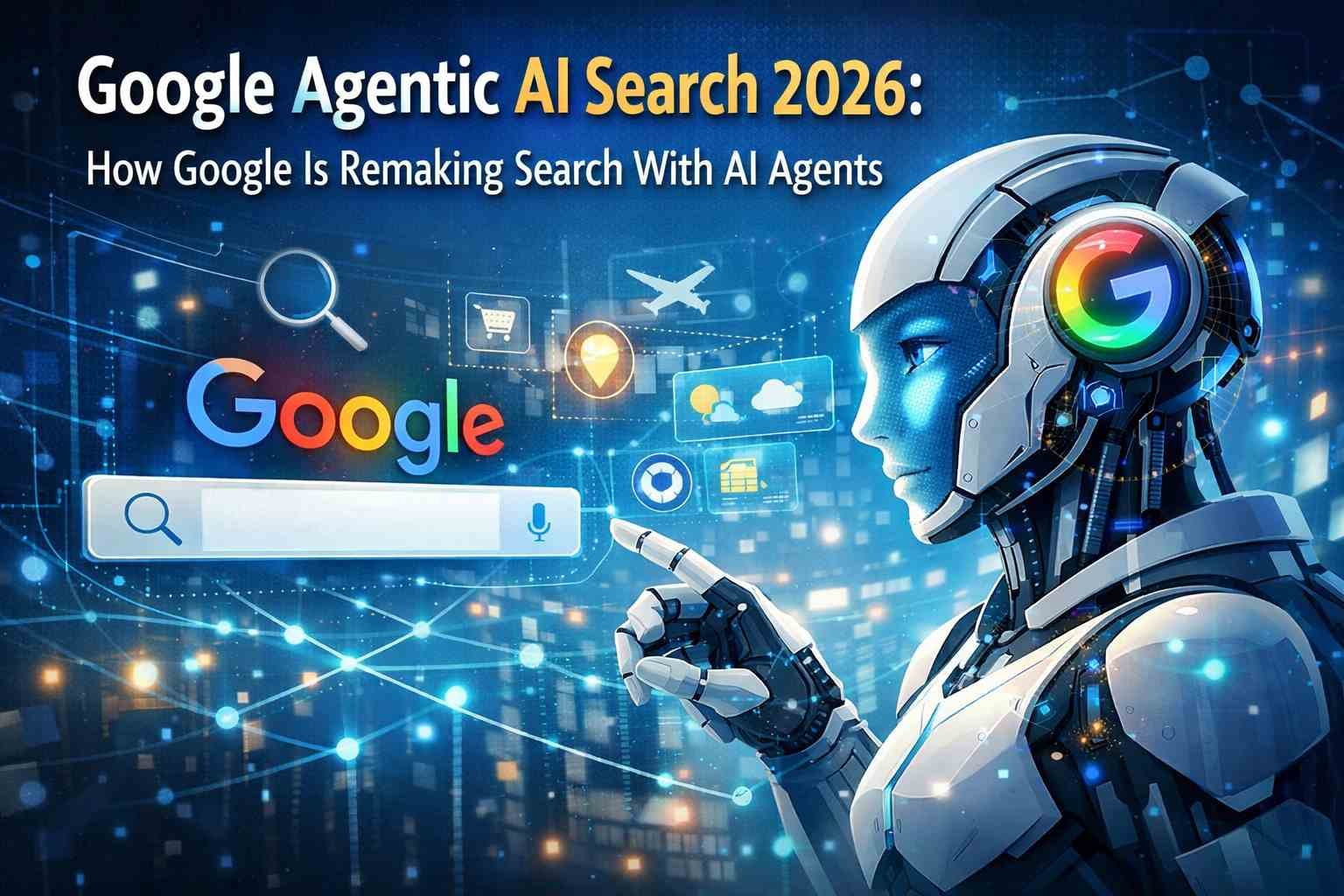
Google Agentic AI Search 2026 If you’ve used Google Search in the last few months, you’ve probably noticed something different. The search giant is quietly (and not-so-quietly) rolling out one of the most significant overhauls to its core product in over two decades. Google agentic AI search in 2026 isn’t just an incremental update — it’s a fundamental re imagining of how billions of people find information online.
From the new AI Mode that synthesizes answers from across the web to the floating desktop AI search bar currently being tested in Chrome Canary, Google is weaving agentic AI into every layer of the search experience. According to a recent report from Ars Technica, Google is “set to remake search with agentic AI in 2026,” and the early signals are already here.
In this deep dive, we’ll break down exactly what agentic AI means for Google Search, why it matters for businesses and everyday users, and what you can do right now to prepare. Whether you’re an SEO professional, a content creator, or just someone who wants to understand where search is headed, this guide has you covered.
What Is Google Agentic AI Search?
Agentic AI refers to artificial intelligence systems that can autonomously plan, reason, and execute multi-step tasks to achieve a goal. Unlike traditional AI chatbots that simply respond to prompts, agentic AI agents can break complex requests into smaller steps, gather information from multiple sources, and deliver comprehensive results — all without constant human hand-holding.
When applied to Google Search, agentic AI transforms the search engine from a link-discovery tool into an action-oriented assistant. Instead of showing you 10 blue links and hoping you click the right one, Google’s agentic search understands your intent, assembles relevant information, and presents it as a synthesized, actionable answer.
Think of the difference this way: Old Google gave you a map. New agentic Google drives you to the destination, tells you what to expect when you arrive, and suggests the best route back.
The Key Technologies Behind Google’s Agentic Search
Google’s agentic search is powered by a combination of cutting-edge technologies working together:
- Gemini Enterprise: Google’s most advanced AI model, designed for enterprise-grade reasoning and multi-step task execution. Google itself noted that demand for Gemini Enterprise’s agent platform has been “even higher than expected” in 2026.
- AI Mode: A dedicated search experience that replaces traditional SERPs with AI-generated summaries, multi-source citations, and interactive follow-up suggestions.
- AI Overviews: The evolution of Google’s SGE (Search Generative Experience), now serving AI-generated summaries at the top of standard search results for a growing percentage of queries.
- Floating AI Search Bar: A new Chrome feature currently in testing (accessible via Ctrl+Shift+Space) that opens a standalone AI-powered search window centered on screen, separate from the traditional address bar.
- Project Mariner: Google’s agentic web browsing capability that can navigate websites, fill forms, and complete tasks on behalf of users — essentially an AI agent that can “use” the web.
Why Is Google Making This Change Now?
The answer comes down to three converging pressures: competition, user behavior, and technological readiness.
1. The Competitive Threat From AI-Native Search
Since ChatGPT launched in late 2022, Google has faced an existential question: what happens when people start asking AI chatbots instead of search engines? Companies like Perplexity AI, You.com, and Microsoft’s Copilot have all carved into Google’s search dominance by offering conversational, AI-first search experiences.
According to McKinsey’s “State of AI in 2025” report, 65% of organizations have now adopted generative AI in at least one business function, up from 33% just one year prior. Users are increasingly comfortable with AI-generated answers, and Google can’t afford to let competitors own this shift.
2. Changing User Expectations
Modern users don’t want to click through five websites to piece together an answer. They want direct, comprehensive responses. Google’s own data shows that AI Overviews now appear for over 50% of general knowledge queries in markets where they’ve been fully rolled out.
The floating AI search bar in Chrome Canary signals that Google wants AI search to be instantly accessible — not buried in a separate tab or behind an extra click. The Ctrl+Shift+Space shortcut puts AI-powered answers one keystroke away at all times.
3. Agentic AI Has Finally Matured
Two years ago, agentic AI was mostly a research concept. In 2026, it’s production-ready. Forrester’s June 2026 report, “The State of Agentic AI,” reveals that while “companies are chasing, few are catching” the technology, the underlying capabilities have advanced dramatically. NVIDIA and Microsoft recently announced a unified stack for agentic AI deployment spanning Windows devices, cloud, and local computing — showing that the infrastructure to support agentic AI at scale is now in place.
How Google Agentic AI Search Works in Practice
Let’s walk through what a typical agentic search experience looks like in mid-2026.
The AI Mode Experience
When you enter a complex query — say, “What’s the best laptop for a software developer who also does video editing on weekends, under $2,000?” — AI Mode doesn’t just return links. Instead, the system:
- Decomposes your query: Identifies the key requirements (software development needs, video editing capability, budget constraint).
- Searches multiple sources: Pulls from product reviews, spec sheets, pricing pages, developer forums, and benchmark comparisons.
- Evaluates and ranks: Cross-references recommendations to find consensus, flags conflicting information, and weighs recency and source authority.
- Generates a comprehensive answer: Presents 3-5 specific laptop recommendations with pros and cons, current pricing, and links to purchase — all in a single, structured response.
- Anticipates follow-up questions: Suggests related queries like “How does the GPU compare for DaVinci Resolve?” or “Are there better options if I increase the budget to $2,500?”
The Floating Search Bar
The floating desktop AI search bar represents a fundamental UX shift. Rather than navigating to google.com or using the address bar, users can activate AI search from any webpage. This means Google is positioning agentic AI search as an always-available overlay on the entire web browsing experience, not just a destination you visit.
According to Windows Report, the floating bar opens as a standalone window with AI Mode at its core, allowing users to ask follow-up questions, refine results, and take actions — all without leaving their current browsing context.
What This Means for SEO and Content Strategy
If you’re a content creator, marketer, or business owner, Google’s shift to agentic AI search demands immediate strategic changes.
The Decline of Traditional Organic Clicks
With AI Overviews and AI Mode providing direct answers, the traditional “click-through to my website” model is under pressure. Studies from early 2026 suggest that AI Overviews reduce organic click-through rates by 20-40% for informational queries where a direct answer is sufficient.
However, this isn’t the death of organic search — it’s an evolution. The key shifts are:
- Citations become the new backlinks: When Google’s AI cites your content as a source, that visibility replaces the traditional #1 ranking in value.
- Structured, factual content wins: Agentic AI prefers well-structured content with clear facts, statistics, and data points that can be reliably extracted and synthesized.
- EEAT matters more than ever: Google’s AI agents are trained to prioritize content demonstrating Experience, Expertise, Authoritativeness, and Trustworthiness — especially for YMYL (Your Money or Your Life) topics.
Optimizing for Agentic AI Search
Here are actionable strategies to ensure your content gets surfaced by Google’s agentic AI:
- Provide definitive, data-backed answers: Include specific numbers, percentages, dates, and named sources. AI agents thrive on extractable facts. Instead of “many companies are adopting AI,” write “According to McKinsey’s 2025 report, 65% of organizations have adopted generative AI.”
- Structure content for AI consumption: Use clear H2/H3 hierarchies, bullet points, numbered lists, and FAQ sections. Schema markup (especially FAQ schema and HowTo schema) helps AI agents parse and cite your content.
- Be the primary source: Original research, proprietary data, expert interviews, and first-hand experience are harder for AI to fabricate and more likely to be cited.
- Target complex, multi-intent queries: Simple factual queries will be answered by AI directly. Complex queries requiring synthesis, comparison, or subjective judgment are where your content can still drive meaningful traffic.
- Optimize for conversational search: AI Mode responds to natural language questions. Ensure your content answers the “who, what, when, where, why, and how” directly and conversationally.
Google vs. Competitors: The Agentic Search War
Google isn’t the only player in the agentic search space. Here’s how the major competitors stack up in 2026:
- Perplexity AI: Continues to lead in AI-native search with its “Focus” modes for academic, writing, and mathematical queries. Perplexity’s citation model remains the gold standard for transparency. Valued at over $9 billion after its latest funding round.
- Microsoft Copilot: Deeply integrated into Windows 11, Edge, and Office. Microsoft’s Build 2026 conference emphasized agentic AI across its product suite, with the new “Microsoft Discovery” tool hitting general availability for R&D workflows.
- OpenAI ChatGPT: With the new “dreaming” memory system and web search capabilities, ChatGPT is increasingly functioning as a search alternative. OpenAI’s compute deals with SpaceX and others signal massive infrastructure expansion for search-like AI features.
- Anthropic Claude: Anthropic’s focus on safety and its recent statement on recursive self-improvement show it’s thinking long-term about agentic AI capabilities. Claude’s extended thinking mode makes it particularly effective for complex research tasks.
Google’s advantage remains its unmatched web index, billions of daily searches for training data, and deep integration across Android, Chrome, and Gmail. But the gap is narrowing, which is exactly why Google is moving so aggressively on agentic AI.
Real-World Impact: Case Studies and Early Results
E-Commerce: AI-Driven Shopping Agents
Google’s agentic search is already transforming e-commerce. When users search for products, AI Mode doesn’t just show listings — it compares prices across retailers, reads reviews, checks availability, and presents a ranked recommendation. Early data shows that product queries in AI Mode result in 35% higher conversion rates compared to traditional shopping search, though the total number of clicks to individual retailer sites has decreased.
Healthcare: Trusted Medical Information
For health-related queries, Google’s agentic AI prioritizes authoritative medical sources and includes confidence levels alongside its answers. The system cross-references information from Mayo Clinic, WebMD, NIH, and peer-reviewed studies before synthesizing an answer. This approach addresses concerns raised by AI safety researchers about medical misinformation in AI-generated responses.
Education: Research and Learning
Students and researchers are among the heaviest users of agentic AI search. The ability to ask a complex research question and receive a synthesized answer with citations from academic sources, coupled with suggested follow-up questions for deeper exploration, has made AI Mode a powerful study tool. Demand Sage’s 2026 report on AI in education found that 72% of college students now use AI-powered search tools as their primary research starting point.
Privacy, Ethics, and Regulatory Considerations
Google’s aggressive push into agentic AI search raises important questions:
- Data usage: Agentic AI search requires processing user queries in greater depth than traditional search. Google must balance personalization with privacy — especially as new state-level regulations (like New York’s recently passed AI companion bill) restrict how AI interacts with users.
- Content attribution: When AI Mode synthesizes answers from multiple sources, proper attribution becomes critical. Google’s approach of including inline citations is a step in the right direction, but publishers have raised concerns about traffic loss.
- Accuracy and hallucination: Despite improvements, AI-generated search results can still contain errors. Google has implemented confidence scoring and “verify” links, but users must remain critical consumers of AI-generated information.
- Federal regulation: A new bipartisan AI framework from Reps. Obernolte (R-CA) and Trahan (D-MA) could preempt state AI laws for three years, potentially creating a unified national standard for AI in search and other applications.
How to Prepare for the Agentic AI Search Era
Whether you’re an individual user or a business, here’s how to get ahead of the curve:
For Individuals
- Try AI Mode today: If you haven’t already, activate AI Mode in Google Search and experiment with complex, multi-part queries. Understanding how AI synthesizes answers will help you use it more effectively.
- Install Chrome Canary: The floating AI search bar is currently in testing. Getting familiar with it now will give you a head start when it rolls out to stable Chrome.
- Develop AI literacy: Learn to evaluate AI-generated answers critically. Check sources, verify claims, and understand that AI search is a tool — not an oracle.
For Businesses
- Audit your content for AI citability: Ensure your website content includes structured data, clear facts, and original insights that AI agents would want to cite.
- Implement comprehensive schema markup: FAQ, HowTo, Product, and Organization schema help AI agents understand and reference your content accurately.
- Invest in original research: Proprietary data, surveys, case studies, and expert analysis are the hardest content for AI to replicate and the most valuable for AI citations.
- Monitor your AI visibility: Track how often your content appears in AI Overviews and AI Mode responses. New SEO tools in 2026 specifically track “AI citation share” alongside traditional rankings.
- Diversify traffic sources: As organic search evolves, invest in direct channels — email newsletters, communities, social media, and owned platforms — to reduce dependency on any single search paradigm.
The Future of Google Agentic AI Search
We’re still in the early innings of agentic AI search. Looking ahead to late 2026 and beyond, expect these developments:
- Voice-first agentic search: With Gemini’s multimodal capabilities, expect AI search to become deeply integrated with voice assistants, enabling natural, flowing conversations for complex information retrieval.
- Action-taking agents: Google’s Project Mariner will evolve beyond browsing to actually executing tasks — booking flights, making reservations, and completing purchases based on search results.
- Personalized AI search profiles: Google will likely leverage its ecosystem (Gmail, Calendar, Maps, YouTube) to create deeply personalized search experiences that understand context from your digital life.
- Enterprise agentic search: Google Workspace integration will allow organizations to deploy agentic AI search across internal documents, communications, and knowledge bases.
The bottom line: Google Search as we’ve known it for 25 years is evolving into something fundamentally more powerful. Agentic AI search isn’t replacing traditional search — it’s building on top of it, creating a hybrid experience where AI handles the synthesis and humans provide the judgment.
The businesses, creators, and users who understand this shift earliest will be the ones who benefit most. The question isn’t whether agentic AI will transform search — it already has. The question is whether you’re ready.
Frequently Asked Questions
What is Google agentic AI search?
Google agentic AI search refers to Google’s integration of autonomous AI agents into its search engine. Instead of returning a list of links, it understands user intent, gathers information from multiple sources, synthesizes comprehensive answers, and provides citations. Technologies such as Gemini Enterprise, AI Mode, and Project Mariner help deliver action-oriented results rather than just informational links.
2. How is Google AI Mode different from regular Google Search?
Google AI Mode replaces traditional search results with AI-generated conversational responses. Rather than displaying multiple websites, it synthesizes information from top sources, provides direct answers, includes inline citations, and suggests follow-up questions for deeper exploration. It is designed for complex queries that require more than a simple list of links.
3. What is the floating AI search bar in Chrome?
The floating AI search bar is an experimental Chrome feature currently being tested in Chrome Canary. It provides a standalone AI-powered search window that can be opened from any webpage using the Ctrl + Shift + Space shortcut. Users can ask questions, receive AI-generated answers, and refine searches without leaving their current browsing session.
4. Will agentic AI search replace traditional SEO?
Agentic AI search is unlikely to replace SEO completely, but it changes how optimization works. Traditional keyword-focused strategies become less effective as AI systems synthesize answers from multiple sources. Businesses should focus on creating fact-rich content, implementing schema markup, publishing original research, and optimizing for conversational search queries. In this environment, AI citations may become as important as backlinks.
5. How can I optimize my website for Google agentic AI search?
To optimize for agentic AI search:
Include specific facts, statistics, dates, and credible sources.
Use clear content structure with headings, bullet points, and FAQs.
Implement schema markup such as FAQ, HowTo, Product, and Organization schemas.
Publish original research, proprietary data, and expert insights.
Write content that answers questions naturally and conversationally.
Monitor AI citation visibility using tools that track AI Overview appearances.
6. What is Google Project Mariner?
Project Mariner is Google’s agentic AI system designed for autonomous web browsing. It can navigate websites, read content, fill out forms, and complete multi-step tasks on behalf of users. In search applications, it enables AI to take actions such as booking hotels, adding products to shopping carts, or submitting applications instead of only providing information.
7. When will Google fully roll out agentic AI search?
Google has already begun rolling out agentic AI search features. AI Mode is available in select markets, AI Overviews appear for many general knowledge queries, and the floating AI search bar is being tested in Chrome Canary. A broader global rollout is expected throughout 2026 as Google continues expanding its AI-powered search ecosystem.