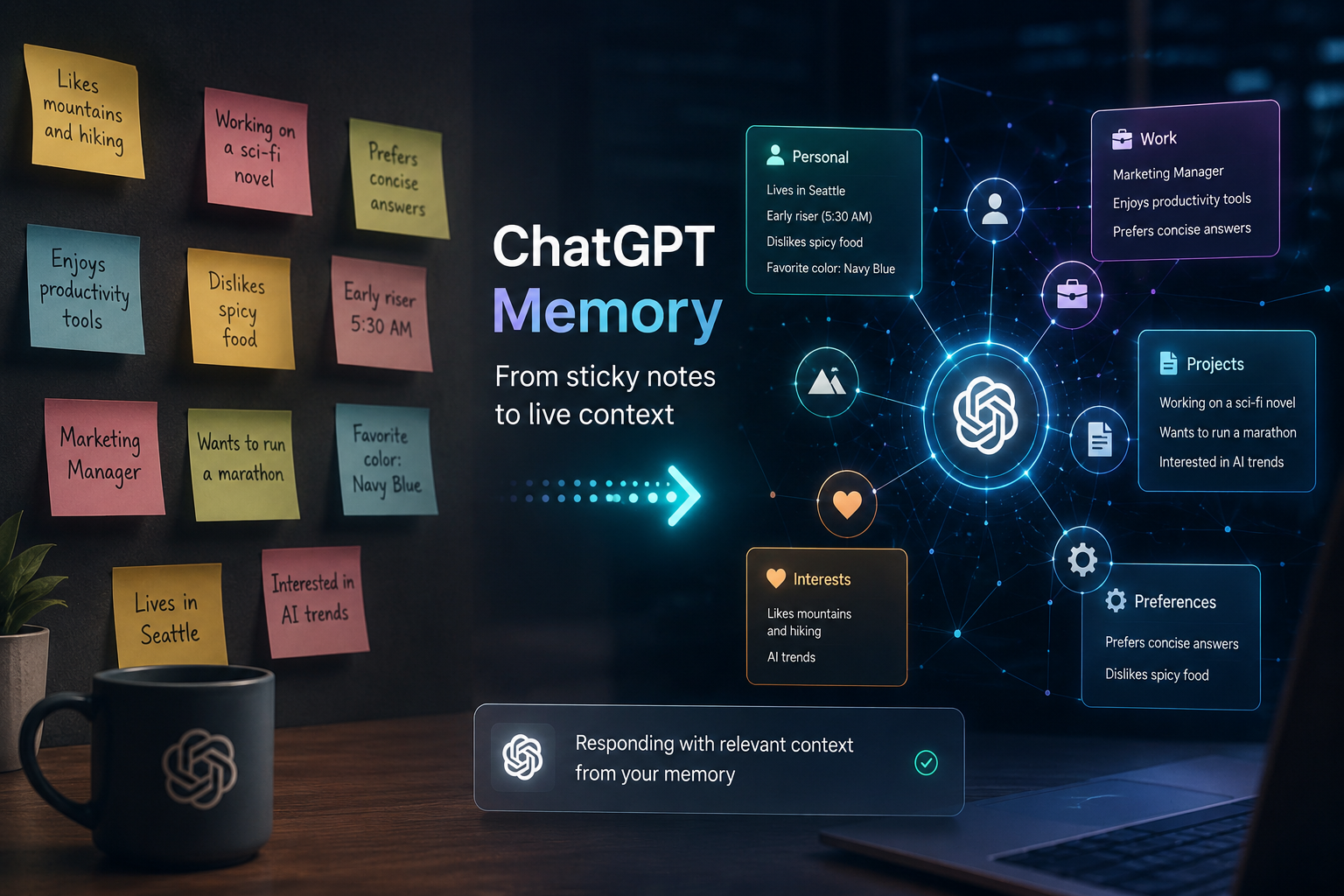
ChatGPT Memory Update 2026: What OpenAI’s Dreaming System Changes for Real Users
OpenAI just made one of the biggest ChatGPT usability changes of the year.
On June 4, 2026, the company started rolling out a new memory system for ChatGPT built around something it calls Dreaming.
If you use ChatGPT often, this matters a lot more than a flashy model launch.
Why?
Because memory is what decides whether ChatGPT feels like a useful long-term assistant or a tool that keeps making you repeat yourself.
And honestly, that has been one of the product’s biggest friction points for power users.
The old memory setup could be helpful, but it also felt inconsistent.
Sometimes ChatGPT remembered something useful. Sometimes it held onto old context for too long. Sometimes it missed details you thought were obvious.
OpenAI is trying to fix that with a more dynamic system that automatically updates what it knows about you over time.
This article breaks down what changed, who gets the update first, what the privacy tradeoffs look like, and why this could quietly become one of the most important ChatGPT improvements of 2026.

What Happened on June 4, 2026?
OpenAI published a product and research update titled “Dreaming: Better memory for a more helpful ChatGPT” on June 4, 2026.
On the same date, OpenAI’s release notes confirmed that ChatGPT memory now stays more up to date by automatically refreshing context instead of leaning only on manually saved facts.
The rollout started with Plus and Pro users in the United States on June 4, 2026, with broader expansion planned over the next few weeks.
| Update Detail | What OpenAI Confirmed | Why It Matters |
|---|---|---|
| Launch date | June 4, 2026 | This is a current live trend with strong news and search value. |
| Feature name | Dreaming-based memory system | Signals a shift from static memory to continuously updated personalization. |
| Initial availability | Plus and Pro users in the US | Important for readers searching whether they can access it right now. |
| Expansion plan | Additional countries plus Free and Go plans in coming weeks | Creates follow-up search demand around rollout timing. |
| Main goal | Reduce stale or contradictory memories | Fixes one of the most common complaints from regular users. |
That last point is the real story.
OpenAI is not just adding another settings page. It is changing how ChatGPT decides what is worth remembering at all.
What Is ChatGPT Dreaming, in Plain English?
The simplest way to understand Dreaming is this: ChatGPT is moving away from memory as a small manual notebook and toward memory as a living summary of what matters most about you, your work, and your preferences.
Under the older saved-memory model, ChatGPT could remember things you explicitly told it to store.
That worked for basic preferences like “I’m vegetarian” or “Remember I prefer concise answers.”
But it was not great for longer, messier, more human context.
Dreaming changes that.
Instead of waiting for perfect “remember this” instructions, ChatGPT can synthesize useful context from many past conversations and keep updating it as your situation changes.
In OpenAI’s own examples, this helps ChatGPT understand things like:
- ongoing projects
- travel plans that later become past events
- food preferences
- personal constraints
- tone and workflow habits
That sounds simple, but it is a major product shift.
It means ChatGPT is being shaped less like a search box and more like a long-term working companion.
Why This Update Is Trending So Fast
There are three reasons this topic is moving quickly right now.
First, it affects millions of people directly.
Unlike a backend API release, this changes the everyday ChatGPT experience for mainstream users.
Second, memory has become one of the biggest battlegrounds in consumer AI.
Model quality still matters, of course. But once the base quality is already high, the next big differentiator is whether the assistant actually knows you well enough to be useful over time.
Third, memory changes naturally trigger both excitement and anxiety.
People like better personalization. They also worry about privacy, unwanted inferences, and losing control over what the product knows.
| Trend Signal | What It Suggests | SEO Opportunity |
|---|---|---|
| Official OpenAI launch plus release notes | High-authority source and immediate curiosity | Strong “what changed” and “who gets it” search intent |
| User discussions on Reddit right after rollout | Real concern about how memory summaries work | High CTR for explainers about control, privacy, and downgrade fears |
| Growing AI assistant competition | Memory is becoming a sticky retention feature | Long-tail opportunities around ChatGPT vs other assistants |
In my experience, the best-performing AI coverage is not just “here is the announcement.”
It is “here is what this changes in your actual workflow.”
That is exactly the lane this update opens.
What Actually Changed Compared With Old ChatGPT Memory?
The old system mostly behaved like stored notes plus some reference to past chats.
The new system behaves more like an automatically refreshed memory layer that tries to keep only the most relevant context active.
| Old Memory Experience | New Dreaming-Based Experience | Why Users Care |
|---|---|---|
| Relied heavily on explicit saved memories | Synthesizes context across many conversations | Less repetition in future chats |
| Could become stale or contradictory | Updates memories automatically over time | Better relevance when circumstances change |
| Felt manual to manage | Offers a memory summary and source-based controls | Easier review without micro-managing every item |
| Memory felt separate from work context | Can connect preferences, files, chats, and in some plans Gmail | Much stronger assistant behavior for ongoing projects |
| Users often hit “memory full” or clutter issues | Automatic prioritization moves less relevant details into the background | Cleaner long-term personalization |
What stood out to me is not just the automation.
It is the fact that OpenAI now treats memory freshness as a core quality problem, not a side feature.
That is a smart product decision because stale memory is worse than no memory. It can make a tool feel unreliable very quickly.
The Best Part of the Update
The best part is simple: less setup friction.
If this works the way OpenAI intends, many users will spend less time teaching ChatGPT how to help them and more time actually using it.
That matters for:
- writers with recurring editorial preferences
- developers working across longer projects
- students managing ongoing research threads
- founders using ChatGPT for planning, notes, and drafts
- busy users who just want continuity across chats
Most people miss this part.
Better memory is not mainly about remembering your favorite color.
It is about reducing setup cost across dozens of future interactions.
That is where the compounding value lives.
The Biggest Concern: Privacy and Control
This is also where things get more complicated.
More helpful memory usually means broader context collection, broader synthesis, and more inferred personalization.
That is useful, but it also makes people understandably cautious.
OpenAI says users remain in control.
According to the Memory FAQ, users can review or edit the memory summary, turn memory off, use Temporary Chats, delete remembered details, and inspect some personalization sources used in responses.
But there is an important nuance.
The memory summary does not necessarily show everything ChatGPT may use as context.
OpenAI explicitly says the summary is a high-level view, not a full mirror of all remembered context.
That distinction matters a lot.
It explains why some early user reactions on Reddit described the new view as overly generic or even like a downgrade. In some cases, users were looking at the summary and assuming it was the complete memory layer.
| Control Area | What Users Can Do | Practical Advice |
|---|---|---|
| Memory summary | Review, edit, or correct summary text | Use this first if ChatGPT’s personalization feels off |
| Saved memories | Revert to legacy saved memories in settings | Useful for users who want more manual control |
| Temporary Chat | Chat without using or creating memory | Best choice for sensitive one-off conversations |
| Source inspection | See some sources behind a personalized response | Helpful for understanding why ChatGPT brought something up |
| Deletion | Delete memory items, chats, files, or connected app data | Needed for full cleanup of something you no longer want referenced |
After reading OpenAI’s documentation, my view is this: the controls are more serious than they used to be, but they still require users to understand the difference between summary, source, chat history, saved memory, and connected data.
That is not trivial.
Why OpenAI Is Doing This Now
This update is about retention as much as usability.
The best AI assistants are becoming sticky not just because they answer well, but because they fit into a user’s life and work over time.
Once an assistant knows your constraints, preferences, recurring projects, and style, switching gets harder.
That creates product lock-in, yes. But it also creates legitimate user value when done well.
OpenAI also says it reduced the compute needed to serve Dreaming to free users by roughly 5x.
That matters because better personalization is expensive at scale. If OpenAI can lower serving cost while improving quality, it can expand memory to more plans without turning the feature into a premium-only luxury forever.
Honestly, this may be the most strategic part of the whole release.
It turns memory from a niche premium perk into a platform capability that could eventually shape the default ChatGPT experience for a much larger user base.
What This Means for Everyday Users
If you use ChatGPT casually, the update should make conversations feel less repetitive.
If you use it heavily, the upside is much bigger.
Here is where I think the real-world value will show up fastest:
| Use Case | How Better Memory Helps | Expected Result |
|---|---|---|
| Writing and editing | Remembers preferred tone, structure, and audience | Less re-explaining style rules in every chat |
| Project planning | Keeps track of priorities, deadlines, and recurring constraints | More useful follow-up sessions over time |
| Learning and study help | Understands what topics you are working through repeatedly | Better continuity across lessons and revisions |
| Travel or life admin | Updates plans after they happen instead of freezing them in time | Less stale advice and fewer awkward reminders |
| Knowledge work | Brings in relevant chat, file, and preference context when useful | ChatGPT feels more like an actual assistant |
That said, I would still avoid treating ChatGPT memory like your only source of truth for critical details.
Use it as a convenience layer, not a permanent system of record.
Most people storing deeply important project context should still keep that in files, notes, docs, or their own workspace systems.
Pros and Cons of the ChatGPT Memory Update
| Pros | Cons |
|---|---|
| More relevant responses over time | Broader personalization can feel invasive to some users |
| Less manual memory management | The summary view may confuse users who expect full transparency |
| Better handling of changing life and work context | Deleting context fully may require action in multiple places |
| Potentially fewer stale or contradictory memories | Power users may prefer the old explicit-memory style |
| Stronger value for ongoing projects | Rollout is limited at first, so many users still won’t have it today |
What Early Reactions Are Telling Us
Early community reaction is mixed, which is exactly what you would expect from a memory overhaul.
Some users like the idea immediately because they want ChatGPT to stop feeling stateless.
Others are nervous that more automatic memory means less precise control.
The most interesting criticism so far is not “memory is bad.”
It is “automatic summaries may flatten details that some users intentionally curated.”
That is a fair concern.
If you are the kind of power user who has carefully built up a specific memory profile, a more abstracted summary can feel like the product is becoming less legible, even if the underlying system is smarter.
This is where OpenAI will need to be careful.
Better AI does not always mean better user trust unless the controls feel clear and reversible.
Industry Impact: Why This Matters Beyond ChatGPT
This update is bigger than one product setting.
It signals where the entire consumer AI market is going.
For the next wave of AI competition, memory will be just as important as raw model intelligence.
Once assistant quality gets close enough across major providers, the winner is often the one that best understands your context without becoming annoying, creepy, or wrong.
That balance is hard.
And it is why memory is becoming a product discipline of its own.
For AI companies, the challenge is clear:
- remember enough to be useful
- forget enough to stay fresh
- show enough to earn trust
- hide enough to keep the experience simple
If OpenAI gets this right, ChatGPT becomes much harder to replace in daily workflows.
If it gets it wrong, memory becomes a recurring source of friction and user skepticism.
My Practical Take
After going through the launch post, release notes, and Memory FAQ, I think OpenAI is directionally right.
The old memory system was too static for what people now expect from a modern AI assistant.
At the same time, the company still has a communication challenge.
Users need clearer mental models for what is remembered, what is summarized, what is inferred, and how to truly remove context they do not want used.
So the upgrade looks strong.
But the trust layer will matter just as much as the technical layer.
Keyword Strategy
Primary keyword: ChatGPT memory update 2026
Secondary keywords: ChatGPT Dreaming, OpenAI memory update, OpenAI memory update, ChatGPT personalization update, ChatGPT saved memories
Long-tail keywords: what is ChatGPT Dreaming, how to turn off ChatGPT memory summary, who gets ChatGPT memory update June 2026, ChatGPT memory privacy controls explained
Semantic terms: reference chat history, saved memories, personalization, temporary chat, memory sources, AI assistant memory, OpenAI privacy settings
Featured Snippet Targets
What is the ChatGPT memory update in 2026?
The June 4, 2026 ChatGPT memory update introduces a Dreaming-based system that automatically keeps memories more current, reduces stale context, and helps ChatGPT personalize responses using past chats and saved details more effectively.
Who gets the ChatGPT memory update first?
OpenAI says the new memory system started rolling out on June 4, 2026 to Plus and Pro users in the United States, with Free, Go, and more countries following in the coming weeks.
FAQ: ChatGPT Memory Update 2026
1. What is ChatGPT Dreaming?
Dreaming is OpenAI’s updated memory architecture for ChatGPT that synthesizes useful context from past chats and keeps that memory fresher over time.
2. When did OpenAI launch the new memory system?
OpenAI announced the rollout on June 4, 2026 through its official blog and ChatGPT release notes.
3. Who can use the new ChatGPT memory update right now?
As of June 4, 2026, OpenAI says the update is available to Plus and Pro users in the United States first.
4. Is the memory summary the same as all of ChatGPT’s memories?
No. OpenAI says the memory summary is a high-level view and may not include every detail ChatGPT can use to personalize responses.
5. Can I turn the new memory system off?
Yes. OpenAI says users can control memory settings, turn memory off, or use Temporary Chats that do not use or create memories.
6. Can I go back to the old saved memories system?
OpenAI says users can revert to the legacy saved memories experience through the memory settings while that option remains available.
7. Is this a privacy risk?
It can raise more privacy questions because stronger personalization depends on broader context use, which is why OpenAI emphasizes settings, deletion controls, and Temporary Chats.
8. Does deleting one chat remove the memory completely?
Not always. OpenAI says full removal may require deleting saved memories, chats, files, and any connected app data where that information appears.
9. Why are some users calling it a downgrade?
Some early reactions suggest users who manually curated detailed saved memories feel the new summary view is less explicit, even if the underlying system may be more capable.
10. Will this make ChatGPT better for work?
Probably yes for many users, especially those doing recurring writing, planning, research, or project-based tasks where continuity matters.
11. Will free users get it too?
OpenAI says it plans to expand the update to Free and Go users over the coming weeks after the initial June 4, 2026 rollout.
12. What is the smartest way to use this feature?
Use memory for convenience and continuity, but keep sensitive or mission-critical records in your own files and use Temporary Chat when you do not want context remembered.
Read this :OpenAI funding analysis,
OpenAI Dell Codex enterprise partnership article
agent runtime comparison article
Claude Opus 4.8 launch article
Visual Ideas
- Featured image showing ChatGPT memory evolving from sticky notes into a live contextual graph.
- Simple diagram comparing old saved memories vs new Dreaming-based memory flow.
- Privacy explainer graphic showing memory summary, chat history, files, and connected apps.
- User workflow visual: recurring writer, founder, student, and developer use cases.
Sources
- OpenAI: Dreaming: Better memory for a more helpful ChatGPT
- OpenAI Help Center: ChatGPT release notes
- OpenAI Help Center: Memory FAQ
- OpenAI: ChatGPT Privacy Settings
- Reddit discussion reflecting early user concerns
Final Thoughts
OpenAI’s new ChatGPT memory system is not the loudest AI release of June 2026.
But it may end up being one of the most important.
Smarter memory is what turns an impressive chatbot into something closer to a real assistant.
And that is where the market is heading.
If Dreaming improves continuity without making users feel boxed in or over-profiled, this update could quietly boost how often people rely on ChatGPT for everyday work.
If the controls feel murky, the feature will keep attracting skepticism no matter how strong the underlying system is.
Right now, the smartest stance is practical optimism.
The upgrade looks meaningful. The rollout is real. The product direction makes sense.
Now OpenAI has to prove that smarter memory can also feel trustworthy.
Follow DigitalBrief.in for source-backed AI launch analysis, practical product breakdowns, and smarter coverage of the tools that are actually changing how people work.