SpaceX Cursor Deal: IN the high-stakes tech underworld, real power isn’t built on writing code—it’s built on controlling the turf where code is born. Elon Musk just executed a masterstroke that solidifies his position as the ultimate don of the digital landscape. The newly finalized SpaceX Cursor deal isn’t just a basic corporate partnership; it is a structural liquidation of the competition, designed to corner the global artificial intelligence developer market from the ground up.
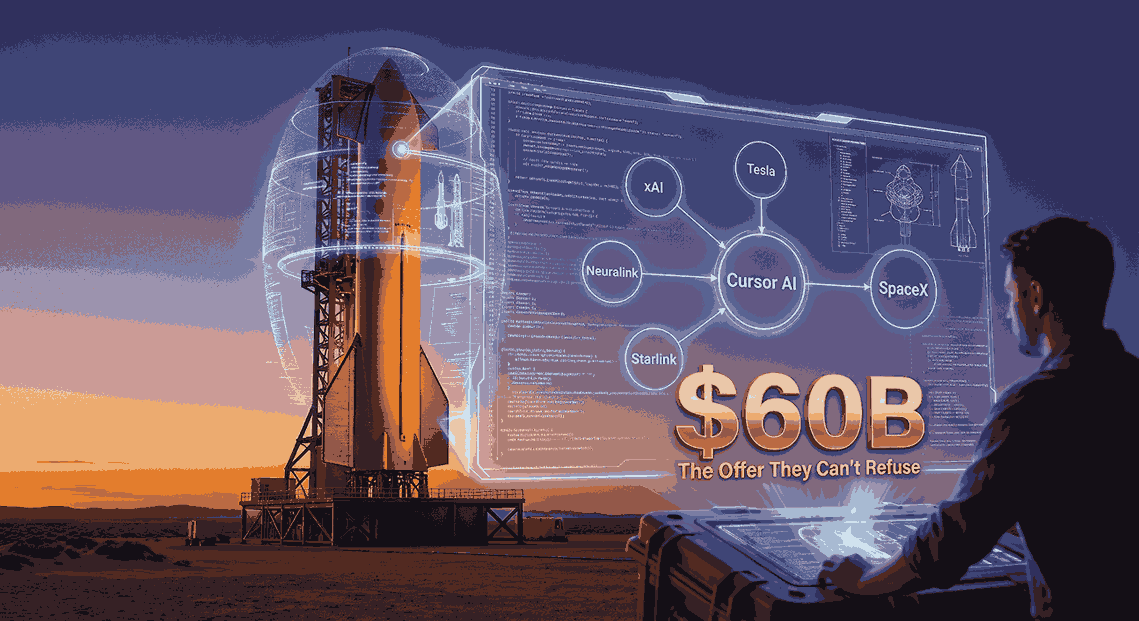
By orchestrating a massive, structured layout rather than a standard, messy buyout, SpaceX has bought a one-year call option. Under this April 2026 contract, Musk retains the absolute right to acquire AI coding startup Cursor for a staggering $60 billion later this year, or simply pay a clean $10 billion partnership fee for exclusive collaborative ecosystem integration.
This move effectively captures the infrastructure layer right before SpaceX launches its historic Wall Street public debut.
The Strategic Blueprint Behind the SpaceX Cursor Deal
In elite corporate strategy, you never risk your capital on a blind gamble when you can systematically lock down an asset instead. The SpaceX Cursor deal leverages an option-style structure that acts as the ultimate iron-clad insurance policy.
1. Dual-Path Execution & Structural Leverage
Musk didn’t want to deal with regulatory crossfire or immediate integration friction. If SpaceX triggers the full $60 billion purchase later this year, it stands as the largest tech startup acquisition in human history.
If the wind blows sideways, the alternative path kicks in: a $10 billion joint development payout. This isn’t a penalty; it is a direct down-payment for Cursor’s engineering alignment. It hands Cursor unprecedented capital liquidity while guaranteeing that their state-of-the-art code-generation models are hardcoded natively into the SpaceX and xAI software pipelines.
2. Annexing the Colossus Supercluster
The real muscle backing the SpaceX Cursor deal is infrastructure. Cursor’s biggest bottleneck was never its user interface—it was raw, unadulterated computing power.
Under this agreement, Cursor gains immediate access to xAI’s legendary “Colossus” supercomputer cluster in Memphis, Tennessee. Armed with roughly 1 million Nvidia H100-equivalent GPUs, Colossus gives Cursor the computing power to completely break through model training barriers.
In return for opening the doors to this computing sanctuary, Musk’s syndicate extracts a steep price: an immediate enterprise distribution channel and a direct pipeline to the highest-intent developer training data on earth.
Cornering the Developer Territory: Why the Interface Matters
Foundational large language models are reaching relative parity; everyone has smart algorithms. The real territory war is now fought over user habits and the interface layer. If you own the window where engineers spend eight hours a day, you own the entire ecosystem.
By pushing forward the SpaceX Cursor deal, Musk has bypassed traditional browser and API friction entirely.
This acquisition breaks down the wall between model inference and actual execution. Take a look at how this vertical integration reorganizes the power dynamic of the modern tech stack:
| The Core Syndicate Layers | The Power Component | The Monopolistic Advantage |
| Compute Layer | xAI Colossus Cluster | 1M H100-equivalent GPUs running massive model scaling |
| Model Layer | Grok & Custom Coding LLMs | Eliminates reliance on OpenAI and Anthropic foundational APIs |
| Interface Layer | Cursor AI-Native IDE | Direct control over the enterprise desktop and developer workflow |
This closed-loop system means that as engineers write code inside Cursor, the system continuously refines, trains, and deploys back into the Colossus cluster, creating a compounding data moat that legacy tech conglomerates simply cannot replicate.
What the Move Means for the Impending SpaceX IPO
The timing of this transaction is a calculated play for Wall Street’s attention. With financial firms aggressively mapping out a massive SpaceX Initial Public Offering (IPO) later this summer, this transaction fundamentally shifts how the market must value the firm.
SpaceX is no longer allowed to be viewed merely as a capital-heavy rocket builder or a satellite network operator. This move repositions SpaceX as an explosive, high-margin artificial intelligence and foundational software powerhouse.
By backing an aerospace balance sheet with Cursor’s blistering software-as-a-service (SaaS) scalability, Musk expands his valuation multiples right before the opening bell rings. Whether the final $60 billion buyout is formally executed or the $10 billion partnership remains the permanent bridge, the SpaceX Cursor deal has locked up the developer layer, forcing rivals to play on a field completely rigged in favor of Musk’s entities.
The $60 Billion Masterstroke: Inside SpaceX’s Structured Deal with AI Startup Cursor
The artificial intelligence arms race has reached escape velocity. In an unprecedented move that blurs the lines between aerospace, infrastructure, and software development, Elon Musk’s SpaceX has secured a highly structured deal with AI coding startup Cursor.
Rather than executing a standard outright acquisition, SpaceX has purchased a one-year call option that completely rewrites the M&A playbook. Under the terms of this April 2026 agreement, SpaceX holds the right to acquire Cursor for a staggering $60 billion later this year. Alternatively, it can pivot to a $10 billion partnership and joint development fee.
This unconventional deal structure signals a massive tactical push by Musk-led entities to vertically integrate the AI stack—from raw compute power down to the developer’s desktop interface—right before SpaceX’s highly anticipated public market debut.
The Masterful Anatomy of the Deal
Most tech acquisitions are all-or-nothing gambles. The SpaceX-Cursor agreement, however, is a masterclass in corporate real options strategy, designed to mitigate downside risk while securing unparalleled tech synergy.
1. Dual-Path Architecture and Downside Protection
The structure functions as a strategic hedge for SpaceX. If the acquisition moves forward at $60 billion, it will stand as one of the largest startup transactions in technology history. If macroeconomic factors or regulatory hurdles intervene, the alternative $10 billion partnership fee kicks in. This massive influx of capital essentially acts as downside protection for Cursor, offering the startup unprecedented liquidity while ensuring SpaceX integrates Cursor’s specialized code-generation workflows directly into its evolving ecosystem.
2. The xAI ‘Colossus’ Supercomputer Factor
The core operational catalyst of this deal lies in its infrastructure integration. Cursor will gain direct access to xAI’s legendary “Colossus” supercomputer cluster based in Memphis, Tennessee.
Boasting roughly 1 million Nvidia H100-equivalent GPUs, Colossus provides Cursor with the infinite compute needed to scale model training past current bottlenecks. In exchange, Musk’s xAI gains an immediate, massive enterprise distribution channel and a goldmine of proprietary, high-intent developer training data.
Market Significance: Vertical Integration of the AI Stack
As frontier AI models begin to achieve relative parity in raw capabilities, the competitive advantage is rapidly shifting from foundational models to distribution, workflow integration, and user habits. Controlling the “last mile” of AI interaction is where the war will be won.
By targeting Cursor—the fastest-growing AI-native development environment—Musk is effectively securing the primary gateway through which engineers interact with code.
| Strategic Layer | Component in Musk’s AI Ecosystem |
| Compute Layer | xAI Colossus Supercluster (1M H100-equivalent GPUs) |
| Model Layer | Grok & Proprietary Specialized Coding Models |
| Interface/Distribution | Cursor AI-Native IDE & Developer Workflow |
This vertical integration allows SpaceX and xAI to bypass traditional browser-to-IDE friction, creating a closed-loop system where code execution, model inference, and real-time data training happen natively under one umbrella.
Wall Street Impacts and the Anticipated SpaceX IPO
The timing of the Cursor deal is far from coincidental. With Wall Street actively prepping for a historic SpaceX initial public offering (IPO) later this summer, the financial narrative of the company is shifting. SpaceX is no longer being marketed strictly as an aerospace manufacturer or satellite internet operator; it is positioning itself as a foundational compute and infrastructure powerhouse for the next generation of human engineering.
While some traditional value investors express caution over a $60 billion valuation for an ecosystem that was recently a fraction of that size, tech analysts view it as a high-margin valuation anchor. Merging a capital-intensive aerospace business with Cursor’s highly scalable, fast-growing software-as-a-service (SaaS) revenues is a calculated play to drastically expand SpaceX’s valuation multiples ahead of its debut ticker launch.
Whether SpaceX triggers the final $60 billion buyout or moves forward with the $10 billion collaborative development track, this historic deal structurally locks up the developer interface layer, leaving rivals scrambling to control the future of AI-driven software development.
Frequently Asked Questions (FAQ)
What makes the structure of the SpaceX Cursor deal so unique?
It operates as a corporate call option rather than a rigid buyout. SpaceX bought a one-year window to fully acquire Cursor for $60 billion. If they choose not to buy, they pivot to a $10 billion long-term collaborative partnership framework, giving both companies immediate flexibility.
Why does Cursor need xAI’s Colossus supercomputer?
Cursor’s rapid enterprise expansion was bottlenecked by access to pure GPU clusters. By tapping into Colossus’s 1 million Nvidia H100-equivalent GPUs, Cursor can scale its agentic capabilities and custom models at a speed that standalone software platforms can no longer match.
How does this deal impact Cursor’s model neutrality?
Historically, Cursor acted as a neutral interface routing to third-party models like Anthropic and OpenAI. With the SpaceX Cursor deal and the integration of xAI, Cursor will naturally favor native Grok and custom internal models, severely limiting its rivals’ distribution inside the editor.
What are the core terms of the SpaceX and Cursor deal?
SpaceX secured a one-year call option in April 2026. It has the right to fully acquire the AI coding startup Cursor for $60 billion later this year, or alternatively pay a $10 billion fee dedicated to joint development work.
How does xAI’s Colossus supercomputer factor into the agreement?
The arrangement grants Cursor access to xAI’s Colossus cluster in Memphis, which contains roughly 1 million Nvidia H100-equivalent GPUs. This eliminates compute bottlenecks for Cursor’s model training, while providing xAI with valuable developer usage data and distribution.
Why is this deal considered an “interface acquisition”?
As foundational AI models become more similar, market dominance relies heavily on where user habits are formed. By securing Cursor, Elon Musk’s entities gain direct access to the developer’s screen and daily workflow, controlling the primary interface of software creation.
How does this affect the upcoming SpaceX IPO?
By integrating Cursor, SpaceX positions itself to public investors as a holistic AI infrastructure and software giant rather than just a rocket company. This narrative is intended to command significantly higher valuation multiples ahead of its public market debut.
For a deeper dive into how Silicon Valley venture capitalists and market experts are analyzing the long-term incentives of this massive transaction, you can check out this insightful analysis on Whether SpaceX Will Buy Cursor By The End of 2026. This breakdown highlights the shifting leverage between the startup and SpaceX’s immense compute infrastructure.