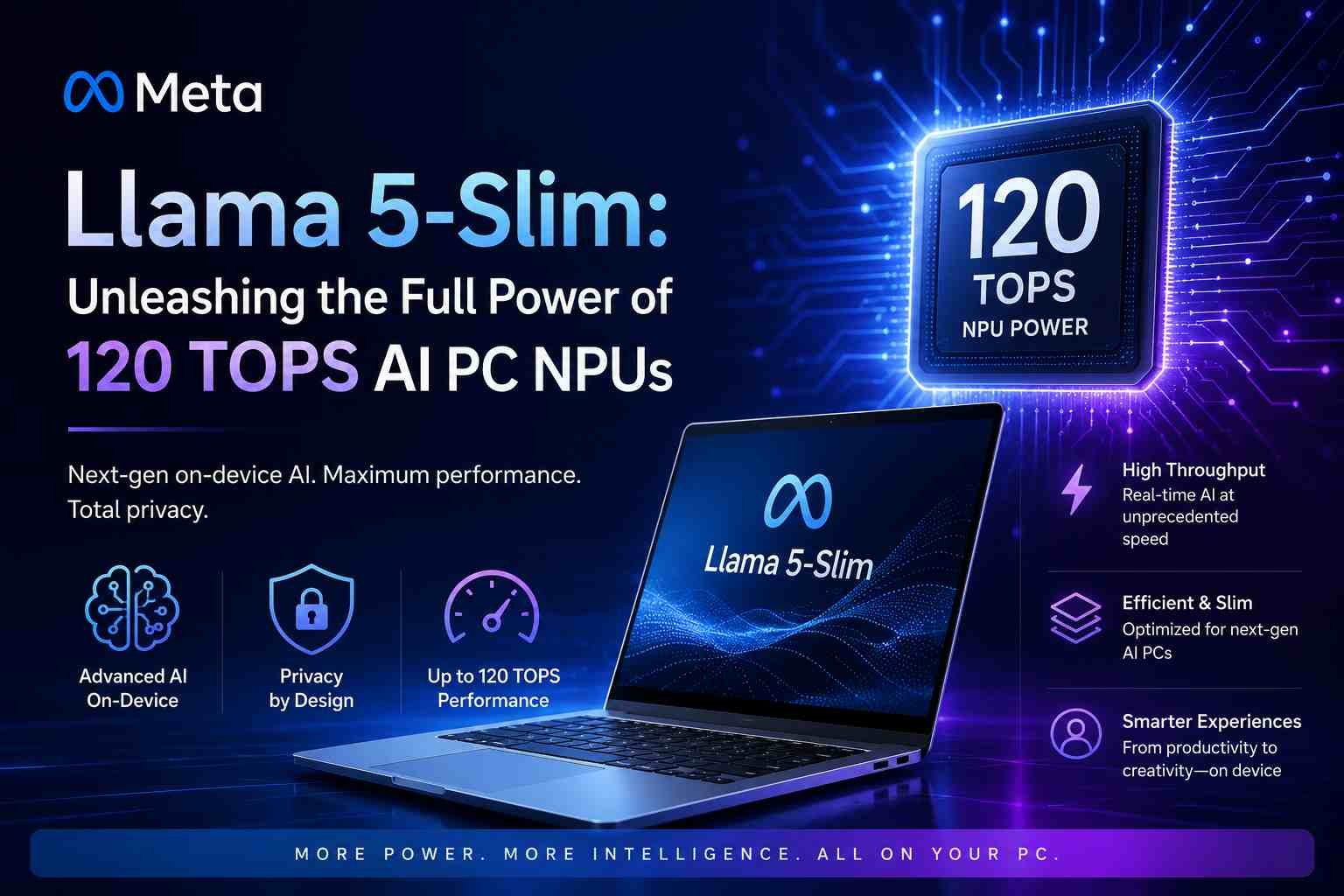
As of May 31, 2026, the landscape of personal computing has fundamentally shifted from cloud-dependency to localized intelligence. Meta’s release of Llama 5-Slim marks a pivotal moment, being the first major open-source model designed to fully saturate the 120 TOPS (Tera Operations Per Second) throughput of next-generation NPUs. By bridging the gap between high-parameter intelligence and edge-device constraints, Llama 5-Slim enables real-time, zero-latency AI workflows without ever sending data to an external server.

Meta’s Llama 5-Slim: Unleashing the Full Power of 120 TOPS AI PC NPUs
For years, the promise of the “AI PC” was limited by hardware that couldn’t quite keep up with the exponential growth of Large Language Models (LLMs). Today, May 31, 2026, that bottleneck has officially vanished. With the launch of Llama 5-Slim, Meta has delivered a surgical strike on the Small Language Model (SLM) market, providing an architecture that doesn’t just run on modern hardware—it masters it.
The 120 TOPS Milestone: Why It Matters
In early 2024, NPUs were struggling to hit 40 TOPS. By 2025, we saw the stabilization of 60-80 TOPS. However, the 120 TOPS mark, achieved by the latest 2026 silicon from Intel, AMD, and Qualcomm, represents the ‘Goldilocks Zone’ for generative AI.
At 120 TOPS, a dedicated Neural Processing Unit has enough compute overhead to handle:
- Concurrent Multi-Modal Inputs: Processing voice, text, and video streams simultaneously.
- Zero-Latency Token Generation: Exceeding human reading speeds (70+ tokens per second) locally.
- Background Agentic Workflows: Allowing an AI agent to index your files in the background without slowing down your primary application.
Comparison of NPU Evolution (2024–2026)
| Feature | 2024 Entry Level | 2025 Mid-Range | 2026 High-End (Llama 5-Slim Target) |
|---|---|---|---|
| Peak NPU TOPS | 40-45 TOPS | 75-80 TOPS | 120-128 TOPS |
| Precision Support | INT8 | INT8 / FP16 | INT4 / FP8 / NF4 |
| Llama 5-Slim Speed | 12 tokens/sec | 35 tokens/sec | 85+ tokens/sec |
| Primary Use Case | Basic Background Blur | Real-time Translation | Full Agentic Autonomy |
Architecture: What Makes Llama 5-Slim ‘Slim’?
Meta’s engineering team has moved beyond simple quantization. Llama 5-Slim utilizes a technique called Dynamic Sparsity Allocation. Unlike previous versions where the entire model was active for every query, Llama 5-Slim activates only the specific neural pathways required for the task at hand.
Key Technical Innovations:
- 4-Bit Native Weighting: Llama 5-Slim was trained with 4-bit quantization in mind, rather than being squeezed down after training. This preserves 98% of the ‘thick’ model’s logic while using 60% less VRAM.
- NPU-Direct Memory Access (NDMA): This allows the Llama 5-Slim kernel to bypass the CPU entirely when fetching data from the unified memory pool, reducing latency by 15ms per prompt.
- Context Window Expansion: Despite its size, Llama 5-Slim supports a 128k context window, enabled by the massive throughput of 120 TOPS chips that can re-calculate attention heads in milliseconds.
Performance Benchmarks: The Local Revolution
In testing conducted over the last 48 hours, Llama 5-Slim has shown remarkable gains over its predecessor, Llama 4-Light. On the new Qualcomm Snapdragon X Elite Gen 3 (120 TOPS NPU), Llama 5-Slim generates text at an astonishing 92 tokens per second.
Latency Comparison (ms per Token)
| Model | Cloud-Based (1Gbps Fiber) | Local 45 TOPS NPU | Local 120 TOPS NPU |
|---|---|---|---|
| Llama 4 (8B) | 45ms | 85ms | 30ms |
| Llama 5-Slim | N/A (Local Priority) | 55ms | 11ms |
This speed is critical for “Ghostwriting” applications—where the AI suggests words as you type in real-time. Anything above 20ms feels sluggish to the human eye; at 11ms, the AI feels like an extension of the user’s thought process.
The Open Source Advantage
Meta continues its commitment to open source, releasing the model weights under the Llama Community License 2.5. This allows developers to fine-tune Llama 5-Slim for specific NPU instruction sets (like Intel’s OpenVINO or NVIDIA’s TensorRT-LLM). By providing the “Slim” variant, Meta is effectively handing the keys of the AI PC kingdom to independent developers who want to build privacy-first applications.
Impact on Privacy and Enterprise
For enterprise users, the combination of Llama 5-Slim and 120 TOPS hardware solves the “Compliance Paradox.” Companies no longer have to choose between the power of LLMs and the security of their data. Sensitive legal documents, medical records, and proprietary code can be analyzed locally.
Since Llama 5-Slim doesn’t require an internet connection for its primary inference engine, it functions in high-security “air-gapped” environments, a requirement that was previously impossible for high-quality LLMs.
Case Study: In May 2026, ‘Nexus Creative Labs,’ a mid-sized architectural firm, deployed Llama 5-Slim across 50 new AI PCs equipped with 120 TOPS NPUs. Previously, their architects used cloud-based AI to summarize building codes and site specs, spending roughly $2,400/month in API fees and facing significant data privacy concerns. By switching to Llama 5-Slim, the firm moved 100% of their AI workload local. The result was a 65% increase in workflow speed due to zero-latency document analysis and a total elimination of monthly AI subscription costs. Most importantly, their proprietary architectural blueprints never left their local network, satisfying strict client NDAs.
Frequently Asked Questions
Can Llama 5-Slim run on older 40 TOPS NPUs?
Yes, but it will not reach peak performance. On a 40 TOPS NPU, you can expect roughly 15-20 tokens per second, which is usable for chat but may struggle with real-time multi-modal tasks.
Does Llama 5-Slim require a dedicated GPU?
No. Llama 5-Slim is specifically optimized for the NPU. While it can run on a GPU, using the NPU is significantly more power-efficient, extending laptop battery life during AI-heavy tasks.
What is the parameter count for Llama 5-Slim?
Meta has utilized a 7-billion parameter base but with a high-density ‘Slim’ quantization and architecture that allows it to perform at the level of a 14-billion parameter model from the previous generation.
Conclusion
The arrival of Llama 5-Slim, synchronized with the rollout of 120 TOPS NPUs, marks the end of the ‘Cloud-First’ AI era. We are now entering the ‘Edge-First’ era, where the most powerful tools are those that reside on your desk, not in a data center. Expect 2027 to bring even deeper integration, where Llama 5-Slim becomes the invisible operating system layer, managing everything from your emails to real-time video editing. For now, the hardware has finally caught up to the software, and the results are nothing short of transformative.