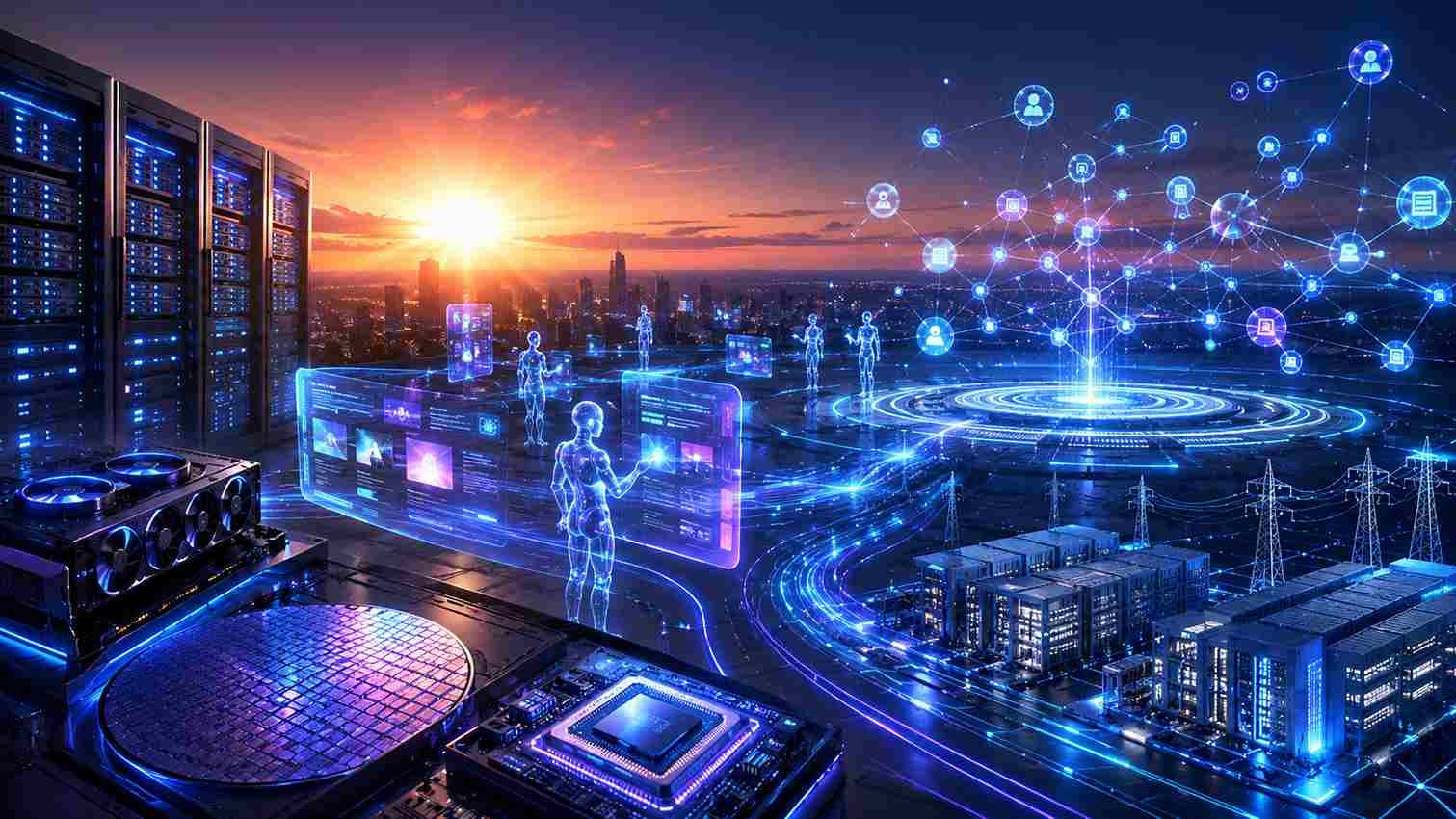
The final week of May 2026 has solidified a massive, irreversible paradigm shift in how humanity interacts with information and the underlying compute infrastructure required to power those interactions. For years, the artificial intelligence industry was locked in a relentless race focused on “models”—increasing parameter counts, expanding context windows, and refining raw language generation. However, the tech landscape has officially moved past the model-centric viewpoint. We have entered the era of “systems.”
This system-level transition is manifesting in two distinct, yet deeply interconnected ways: a monumental software overhaul of consumer-facing tools, led by Google’s transition to agentic search, and a profound backend hardware restructuring, characterized by an industry-wide rebalancing of compute resources. As autonomous agents become the default interface for digital execution, the metrics of hardware efficiency, orchestration latency, and specialized silicon have replaced raw floating-point operations (FLOPs) as the standard benchmarks for technological supremacy.
Google Search: The 25-Year Overhaul Entering the Agentic Era
For over a quarter of a century, Google Search operated on a relatively simple, index-based transaction: a user entered a query, and the search engine returned a ranked list of blue links. Even with the introduction of featured snippets and generative AI previews, the fundamental user loop remained search-and-browse. The user was still responsible for reading, synthesizing, and taking action on the retrieved information.
In the final week of May 2026, Google officially dismantled this legacy framework, initiating an agentic search overhaul that transforms Search from an information retriever into a collaborative agent environment.
Powered by Gemini 3.5 Flash by Default
At the heart of Google’s agentic search overhaul is Gemini 3.5 Flash Search. By integrating this ultra-low-latency, highly dense model directly into the default search engine, Google has enabled real-time, multi-step planning and tool-use during everyday searches. Gemini 3.5 Flash is not just summarizing web pages; it is actively operating as an orchestration engine.
Because agentic workflows require a model to make multiple iterative “thoughts” and tool calls before presenting a final answer, raw speed and token throughput are critical. Gemini 3.5 Flash’s architecture is uniquely optimized for this lightweight, fast-cycling loop, allowing Google to offer complex agent behaviors without degrading the sub-second response times that users expect from a modern search bar.
Collaborative Environments and Delegation
Under the new interface, users no longer simply search for answers; they delegate multi-stage research projects and actionable tasks directly within the search bar. For example, instead of conducting multiple separate queries to plan a business trip—such as searching for flights, checking hotel availability, reading restaurant reviews, and cross-referencing calendars—users can input a single, complex directive:
“Find me a flight to San Francisco for the first week of July under \$600, match it with a highly-rated boutique hotel near the Moscone Center that has a gym, and draft an itinerary that blocks out time for my scheduled client meetings.”
The search engine’s interface shifts into a collaborative workspace. It does not just show links; it spins up sub-agents to execute the planning, handles the complex logic of comparing flight prices, matches the hotel requirements, coordinates with calendar APIs, and presents a fully finalized, interactive itinerary. If the user is satisfied, they can delegate booking actions directly from the search bar, allowing the agent to interface with secure booking APIs and complete transactions autonomously.
Information Agents: Autonomous Web Interaction at Scale
The next phase of this transition is set to roll out in Summer 2026, when Google introduces Information Agents for Pro and Ultra subscribers. This launch represents the true beginning of autonomous web interaction at scale.
Information Agents are designed to run in the background, conducting deep research, monitoring changes across the web, and performing routine digital administrative tasks over days or weeks. This is a dramatic departure from short-term session interactions. By shifting the workload of searching, evaluating, and interacting with websites from humans to autonomous agents, the web’s traffic patterns, SEO dynamics, and data transaction volumes are poised to undergo a complete restructuring.
The AI Hardware Rebalancing Act: From Inference to Orchestration
As agentic search and autonomous workflows become the dominant workload across both consumer and enterprise applications, the physical compute infrastructure under the hood is facing unprecedented bottlenecks. The industry is currently undergoing a massive AI Hardware Rebalancing act.
In the previous era of generative AI, the primary hardware bottleneck was model inference—simply loading a massive model into GPU memory and streaming out tokens as fast as possible. However, agentic systems behave very differently. An autonomous agent does not just stream a single response; it loops. It reads, plans, calls an external API, parses the result, reflects on its progress, and calls another tool.
[User Input] ➔ [Plan] ➔ [Call Tool/API] ➔ [Parse Result] ➔ [Reflect/Verify] ➔ [Final Output]
                     ▲                                      │
                     └────────────────── Loop ──────────────┘
This iterative cycle means that the computational workload has shifted from pure, massive model inference toward orchestration-heavy stacks.
The Orchestration Bottleneck
The “orchestration cost” of an agent includes managing context state, coordinate switching between specialized micro-models, maintaining memory of previous steps, and parsing structured tool outputs. These tasks are highly sequential and rely heavily on CPU execution, memory bandwidth, and low-latency networking, rather than just raw parallel processing power (matrix multiplications) where traditional GPUs excel.
To handle these agentic loops efficiently, hardware systems must be balanced. Stacking more raw FLOPs in monolithic GPU clusters yields diminishing returns when the primary bottleneck is the latency of checking an external API or transferring memory state between the CPU and the accelerator.
Corporate Viewpoints: Imec and Ciena Leading the Charge
This architectural shift is a key point of discussion among hardware builders. Research organizations like Imec and networking infrastructure leaders like Ciena have actively highlighted the need for a new class of specialized silicon.
According to these industry leaders, the traditional compute cluster—where a heavy-duty CPU sits far away from a cluster of power-hungry GPUs connected by legacy copper cables—is fundamentally mismatched with the realities of agentic systems. To reduce the overhead of constant tool-use and planning loops, the industry requires deeply integrated, application-specific architectures that balance memory bandwidth, local CPU control, and high-speed optical networking.
Specialized Silicon and Interconnects: TPU7x and Photonic Processors
To address the high orchestration costs of autonomous web interaction, hyperscalers and silicon designers are deploying highly customized, balanced hardware stacks.
| Hardware Component | Role in Agentic Systems | Key Performance Indicator |
|---|---|---|
| Google TPU7x Pairings | Balances compute, memory, and fast chip-to-chip networking | Low Orchestration Latency |
| Photonic Processors | Uses light instead of electricity to transfer data and execute transformer math | Extremely High Energy Efficiency |
| High-Bandwidth Memory (HBM) | Minimizes the time required to fetch agent context and system state | High Memory Throughput |
Inside Google’s TPU7x Pairings
Google’s response to this architectural shift is the new Google TPU7x pairings. Rather than focusing solely on maximizing the size of the tensor cores, the TPU7x architecture is co-designed to pair tensor processing units directly with high-performance, low-latency CPU and memory subsystems on the same packaging.
This tight integration drastically lowers the time it takes for an agent to transition from “thinking” (running inference) to “acting” (CPU execution, memory state updating, and calling external APIs). By balancing CPU control logic with accelerator power, TPU7x pairings significantly reduce the orchestration latency of agentic loops, making real-time autonomous search and booking delegation feasible at a global scale.
Photonic Processors: Speed of Light Transformer Inference
In tandem with custom silicon like the TPU7x, the hardware revolution is witnessing the rise of photonic processors. Standard copper interconnects are hitting absolute physical limits, generating massive heat and suffering from bandwidth bottlenecks when moving data across large-scale clusters.
Photonic processors use light (photons) instead of electricity (electrons) to move data and perform specific matrix-vector multiplications. By handling transformer inference at a fraction of current energy costs, photonic chips resolve the data transport bottleneck. This allows distributed agentic systems to run continuous planning and tool-use loops without consuming unsustainable amounts of electricity or hitting thermal throttling barriers.
Redefining Performance Benchmarks: Latency, Energy, and Complexity
The shift toward system-level architectures is forcing AI builders to completely redefine how they measure performance. Historically, a model’s quality was judged by its accuracy benchmarks (such as MMLU) or its token-generation speed (tokens per second). In H2 2026, the industry has aligned around new benchmarks:
- Orchestration Latency: The round-trip time required for an agentic system to plan a task, call tools, handle API responses, verify results, and return a completed action. A system that generates tokens at lightning speed but takes five seconds to coordinate a single API call is ultimately too slow for interactive agentic search.
- Energy Efficiency (Performance-per-Watt): As autonomous search agents and persistent Information Agents scale, the total number of inference steps per query is multiplying exponentially. A single traditional search that took a few watt-hours now requires dozens of watt-hours to support multiple agent loops. Consequently, minimizing energy consumption during transformer inference has become an existential requirement for data center operators.
- Deployment Complexity: Managing the orchestration of multiple specialized micro-models, vector databases, tool registries, and external APIs creates immense systems-engineering overhead. Builders are prioritizing stacks that offer integrated, out-of-the-box orchestration capabilities over raw, unoptimized model performance.
H2 2026 Outlook: Actionable Strategies for AI Builders
As we look toward the second half of 2026, the technology landscape will be defined by Edge AI readiness and the optimization of system-level architectures. For software developers, enterprise IT leaders, and AI builders, succeeding in this new era requires a rapid adaptation of development strategies:
- Optimize for Edge AI Readiness: To minimize orchestration latency and energy costs, builders must design agentic workflows that can run hybrid loops—handling lightweight planning and quick tool-use locally on edge hardware (laptops, mobile devices, local servers) while delegating heavy-duty reasoning to specialized cloud-based TPU or GPU clusters.
- Transition from “Model Tuning” to “System Tuning”: Spending months fine-tuning a monolithic model is yielding diminishing returns. High-performance teams are instead focusing on engineering low-latency tool integration, building robust agentic guardrails, and optimizing state-saving protocols to handle long-running, autonomous processes.
- Focus on Photonic and Custom Silicon Compatibility: As cloud providers deploy specialized hardware like Google TPU7x pairings and photonic processors, builders must ensure their model architectures and runtime environments (such as PyTorch or JAX compiles) are fully optimized to take advantage of these balanced, non-GPU-centric compute stacks.
The era of relying on raw hardware scaling to power ever-larger models is officially over. By unifying agentic search interfaces with balanced, orchestration-optimized hardware, May 2026 has marked the true beginning of the Systems Era in artificial intelligence. Builders who adapt to this rebalanced landscape today will define the autonomous digital infrastructure of tomorrow.