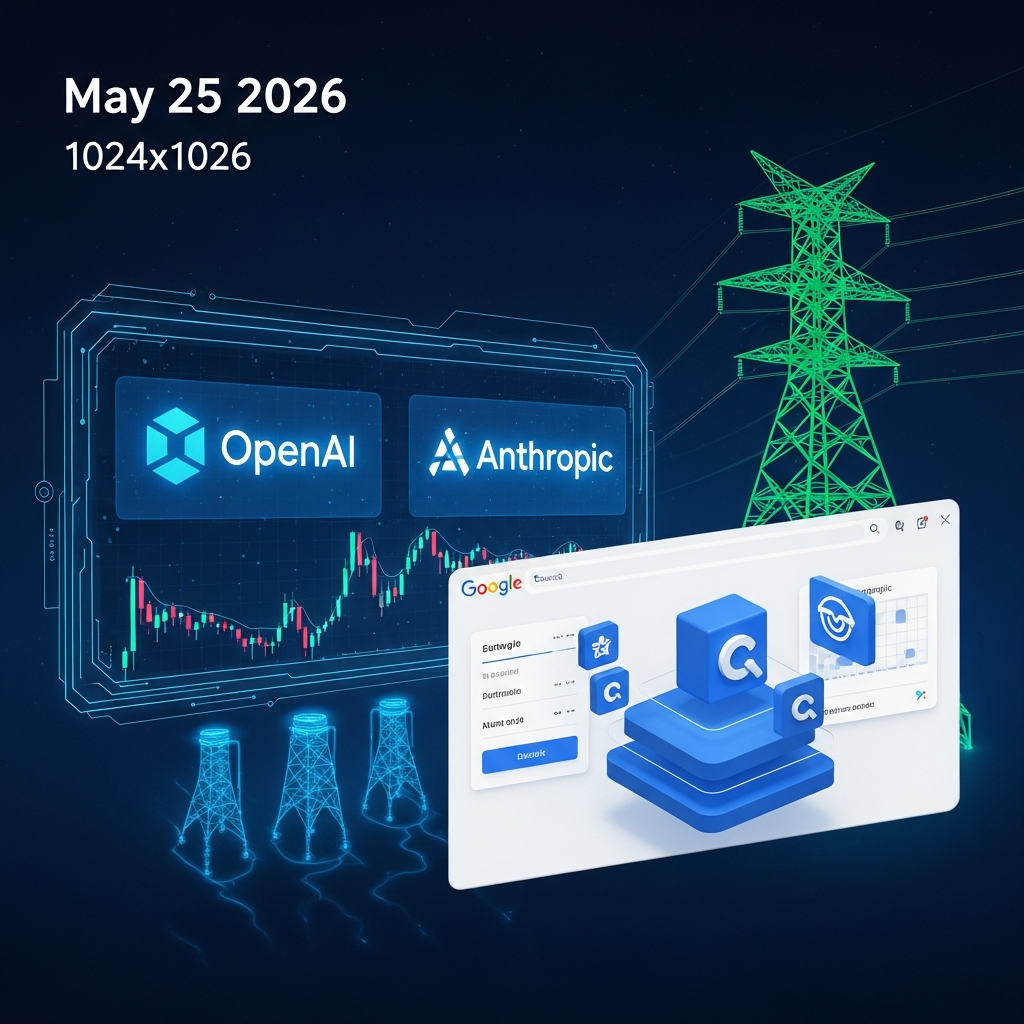
AI Megatrends of May 2026: Infrastructure, IPOs, and the Trillion-Dollar Valuation Race

Executive Summary: What Is Happening in AI Right Now?
In May 2026, artificial intelligence has crossed several historic thresholds simultaneously. Anthropic closed a $30 billion Series G funding round at a $380 billion post-money valuation. OpenAI filed a confidential S-1 with the SEC, setting the stage for what could become one of the largest technology IPOs in history, with analysts projecting a valuation above $850 billion. Google overhauled its search engine to be fundamentally AI-native — replacing blue links with interactive mini-apps, generative visuals, and persistent background agents. OpenAI’s Codex became the first commercial AI agent capable of operating a Mac computer while its screen is locked. A $67 billion utility mega-merger between NextEra Energy and Dominion Energy was announced explicitly to meet surging AI data-center power demand. Chinese open-source models — particularly DeepSeek V4 and Qwen 3 — captured six of the global top ten spots in weekly AI token usage. And Pope Leo XIV released the first papal encyclical dedicated entirely to artificial intelligence, presented alongside an Anthropic co-founder. This article examines each of these developments in depth, explaining what they mean for technology, business, ethics, and the global balance of AI power.
Section 1: The Trillion-Dollar Frontier — Anthropic vs. OpenAI and the Race to Dominate Foundation AI
The phrase “trillion-dollar valuation” once belonged exclusively to legacy technology giants — Apple, Microsoft, Alphabet. In May 2026, two AI-native startups are closing in on that threshold with extraordinary speed, and the methods by which they are getting there reveal as much about the industry’s structure as any benchmark ever could.
Anthropic’s $30 Billion Series G
Anthropic, the San Francisco-based AI safety company founded in 2021 by former OpenAI researchers including Dario and Daniela Amodei, completed its Series G funding round in early 2026, raising $30 billion at a $380 billion post-money valuation. The round was co-led by Singapore’s sovereign wealth fund GIC and asset manager Coatue, and it ranks as the second-largest private funding deal in venture capital history. The capital is earmarked primarily for compute infrastructure — specifically the thousands of next-generation GPU and TPU clusters required to train and serve Claude, Anthropic’s flagship model family.
The valuation figure demands context. Anthropic was valued at approximately $15 billion just 18 months prior. The doubling-plus trajectory reflects both the explosive commercial traction of enterprise AI contracts and the premium the market now places on AI safety credibility. Anthropic’s constitutional AI approach — training models to refuse harmful outputs through a set of explicit principles — has made it the preferred vendor for regulated industries including healthcare, legal, and government. Its commercial API revenue has been growing at triple-digit annual rates, and its Claude model consistently ranks among the top performers in reasoning and coding benchmarks.
However, the $380 billion post-money figure is the number that most directly positions Anthropic in the context of the broader valuation race. Adjusted for secondary market trades and future round projections, some analysts now place Anthropic’s implied value north of $900 billion on a fully-diluted basis — a figure that approaches the trillion-dollar mark that has become, informally, the industry’s new definition of supremacy.
OpenAI’s Confidential S-1 and the Path to a Public Market
While Anthropic was closing its private round, its chief rival OpenAI took an equally significant step: filing a confidential draft prospectus — commonly known as a confidential S-1 — with the U.S. Securities and Exchange Commission in late May 2026. Under SEC rules, companies meeting certain thresholds can submit their IPO documents privately before making them public, allowing them to receive regulatory feedback and plan their roadmap without prematurely disclosing competitive financial details.
OpenAI’s confidential filing signals that its long-anticipated public debut is no longer theoretical. Analysts tracking the deal expect a public S-1 release sometime in summer or early autumn 2026, with a potential listing on either the NYSE or NASDAQ by Q4 2026. The projected valuation range sits between $850 billion and $1 trillion, which would make OpenAI’s IPO one of the top five largest in U.S. market history. The company’s projected annual revenue run rate has exceeded $10 billion, fueled by ChatGPT’s consumer subscriptions, enterprise API contracts, and a rapidly growing suite of agentic products including the Codex platform and the Operator framework.
The simultaneous rise of both companies creates a competitive dynamic unlike anything seen in the technology sector. Google and Microsoft — once considered the permanent gatekeepers of AI — now find themselves navigating a landscape shaped in part by companies they invested in but do not control. The trillion-dollar threshold, if crossed by either Anthropic or OpenAI in the next twelve months, will mark a genuine paradigm shift: the first time a purely AI-native company achieved a valuation equal to or greater than the largest enterprises in human history.
Section 2: Beyond Blue Links — Google’s Fundamental Redesign of Search
For 25 years, Google Search operated on a principle so deeply embedded in the internet’s architecture that it seemed immutable: type a query, receive a ranked list of links. In May 2026, at Google I/O, the company announced that this paradigm is over. The new Google Search is not a search engine in the traditional sense. It is an AI operating environment.
From Query-Response to Generative UI
The most striking change is the introduction of Generative UI — a system in which Search does not return links but instead dynamically builds custom interactive experiences in response to user intent. Ask Google to compare mortgage rates, and it generates an interactive calculator. Ask for a workout plan, and it builds a trackable fitness dashboard. Ask for a travel itinerary, and it produces an editable, day-by-day planner with embedded maps and booking links. These are not pre-built widgets — they are generated fresh for each query, powered by Google’s Gemini 3.5 Flash model running at scale.
This shift has profound implications for the web’s information economy. The traditional SEO model — in which publishers optimized content to rank in a list of ten blue links — depended on users clicking through to external sites. Generative UI closes that loop. The answer is the destination. For content creators, marketers, and publishers, this is an existential challenge: the entire value chain built around attracting Google’s referral traffic is being restructured from the ground up.
Mini-Apps and Background Information Agents
Google also unveiled two additional layers of the redesigned Search that extend its reach far beyond the traditional query session. The first is Mini-Apps — user-created tools, described in natural language, that Search constructs and stores. A user might say “build me a weekly budget tracker” and Google Search will create a persistent, interactive application accessible from the search homepage on subsequent visits. Initially available to Google AI Pro and Ultra subscribers in the United States, Mini-Apps represent Google’s direct entry into the no-code application layer.
The second is Information Agents — persistent background AI processes that monitor the web continuously and deliver proactive alerts. A user can configure an agent to watch for specific developments: changes in a competitor’s pricing, news about a particular investment, updates to a regulatory ruling. The agent monitors blogs, news sources, financial feeds, and social media without requiring the user to return and perform a new search. This feature effectively transforms Google Search from a reactive tool into a proactive one — an always-on research assistant running in the background of a user’s digital life.
Together, these changes represent the most fundamental redesign of search since the invention of the hyperlink. The new Google Search does not describe the web — it actively navigates, synthesizes, builds within it, and reports back continuously.
Section 3: The Power Bottleneck — AI Infrastructure and the $67 Billion Utility Mega-Merger
Every large language model, every inference call, every agentic workflow running in the background of a user’s life requires electricity — vast, reliable, uninterruptible electricity. This physical reality is now reshaping the United States’ energy sector in ways that have no precedent in the modern industrial era.
Why AI is a Power Crisis in Slow Motion
A single large-scale AI data center draws between 100 and 500 megawatts of continuous power — roughly equivalent to the consumption of a small city. The United States is currently building hundreds of such facilities, concentrated in regions with favorable land costs, fiber connectivity, and access to utility infrastructure. Northern Virginia’s “Data Center Alley” — home to more data center capacity than any other region on earth — has become a stress point for the regional grid operator PJM, which has been forced to delay thousands of grid interconnection requests due to insufficient generation capacity.
The NextEra–Dominion Merger: AI as Infrastructure Thesis
Against this backdrop, NextEra Energy announced the acquisition of Dominion Energy in an all-stock deal valued at approximately $67 billion, creating the world’s largest regulated electric utility by market capitalization. The combined entity would serve roughly 10 million customer accounts across Florida, Virginia, North Carolina, and South Carolina, and would command approximately 110 gigawatts of generation capacity with more than 130 gigawatts of identified large-load growth opportunities tied directly to AI data center expansion.
The strategic rationale was stated explicitly in the deal announcement: Dominion’s footprint in Virginia — the nerve center of North American AI compute — combined with NextEra’s world-leading clean energy development capability creates a vertically integrated power platform designed specifically for the AI era. NextEra also announced $2.25 billion in customer bill credits across the three affected states, acknowledging the political sensitivity of utility consolidation in regions where residential customers bear the cost of commercial data-center load growth.
The merger requires regulatory approval from the Federal Energy Regulatory Commission and multiple state public utility commissions, with a projected close timeline of 12 to 18 months. It is widely expected to catalyze further consolidation in the utility sector, as competing data center landlords — Amazon, Microsoft, Meta, and Google — accelerate their own behind-the-meter power strategies including dedicated nuclear procurement, on-site gas turbine installations, and long-term renewable power purchase agreements.
The deeper signal from the NextEra–Dominion deal is structural: AI is no longer just a software industry. It is a heavy industrial industry that requires the same quality of physical infrastructure investment — and the same timescales — as steel mills, petrochemical plants, and semiconductor fabs. The energy bottleneck is now the most binding constraint on the speed of AI deployment, and capital markets are beginning to price that reality accordingly.
Section 4: Agentic Autonomy — How OpenAI Codex Is Taking Over the Operating System
The history of computing can be told as a series of interface revolutions: mainframe terminals, personal computers, graphical operating systems, touchscreens, voice assistants. Each transition expanded the circle of people who could interact productively with computers. The emergence of agentic AI — AI that can perceive, plan, and act within a computing environment autonomously — represents the next such transition. And in May 2026, OpenAI’s Codex crossed a threshold that makes that transition feel immediate.
Working on a Locked Mac
OpenAI introduced a feature called Locked Computer Use to its Codex application on macOS. The capability does exactly what its name implies: Codex can continue executing tasks on a Mac computer even after the machine’s screen locks. The workflow operates through macOS’s standard authorization and accessibility frameworks — it uses screen recording and accessibility permissions granted by the user and does not bypass the operating system’s security model. When the Codex agent is running, the screen remains at the lock screen; if the user touches the keyboard or trackpad, the machine re-locks immediately, preventing any overlap between human and AI sessions.
The practical implications are significant. A developer can assign Codex a multi-hour task — write and test a new feature, debug a failing test suite, refactor a module — and then close the laptop, go to sleep, or take a meeting. Codex works through the night on the local machine. The developer returns to a completed diff, a passing test run, and a summary of decisions made along the way. This is not remote execution in the cloud — it is local, agentic task completion on the user’s own hardware.
The Broader Agentic Landscape
Codex’s Locked Computer Use feature is one data point in a rapidly accelerating trend. Across the industry, AI agents are being given increasing permissions to interact with local operating systems, file systems, browsers, and external APIs. Anthropic’s Claude has its own computer-use API. Google has released Project Mariner, an agent that operates within Chrome. Microsoft’s Copilot is integrated deeply into Windows and Office, capable of orchestrating multi-step workflows across applications.
The key distinction between these agentic systems and traditional automation tools — scripts, macros, robotic process automation — is their ability to reason about novel situations. A traditional automation script fails when the interface changes. An AI agent can observe the changed interface, reason about the most likely correct action, attempt it, and correct course based on the outcome. This makes agentic AI categorically more powerful — and categorically more consequential — than the automation technologies it is beginning to replace.
The question of trust — how much autonomy should an agent have, under what supervision conditions, with what rollback mechanisms — is rapidly becoming one of the most important design problems in computing. The industry does not yet have a settled answer. But the commercial pressure to deploy more capable, more autonomous agents is intense, and the direction of travel is clear.
Section 5: The Global Mosaic — The Surge of Open-Source and Chinese AI Models
The narrative of AI as a fundamentally American enterprise — dominated by OpenAI, Anthropic, Google, and Meta — has been complicated in 2026 by a development that most Western observers did not fully anticipate: the rapid rise of Chinese open-source AI models to global competitiveness, and in some metrics, global leadership.
DeepSeek V4 and Qwen 3: Performance at Scale
DeepSeek V4, developed by the Chinese quantitative trading firm High-Flyer, continues the lineage of its predecessors in combining frontier-level performance with extraordinary compute efficiency. Benchmarks position DeepSeek V4 as competitive with GPT-4o-class models on coding and mathematical reasoning tasks, at a fraction of the training and inference cost. The model’s architecture — which employs a mixture-of-experts design that activates only a subset of parameters per inference call — has become a widely studied template for efficiency-oriented model design globally.
Qwen 3, developed by Alibaba’s DAMO Academy, offers a broader capability profile: strong coding performance, extended context windows, robust tool-use and function-calling capabilities, and effective multilingual handling. The Qwen model family has seen substantial adoption by enterprise developers in Southeast Asia, the Middle East, and Europe who are building applications requiring non-English language support at scale — a domain where American models have historically underperformed.
The Usage Data That Changed the Conversation
Data from OpenRouter — a model-agnostic API aggregator that processes tens of billions of tokens per week — showed that by March 2026, Chinese models had captured six of the global top ten positions in weekly token usage volume. This shift did not happen because Chinese models are universally superior; it happened because they are competitive in key verticals, substantially cheaper per token, available without geographic API restrictions, and increasingly trusted by the global developer community through open weights that allow independent verification and fine-tuning.
The rise of Chinese AI models has significant geopolitical dimensions. The U.S. government’s export controls on advanced semiconductors — designed in part to constrain China’s AI development — have not prevented the emergence of globally competitive Chinese models. This has prompted a reassessment among policymakers of the assumptions underlying the export control strategy and a broader debate about whether open-weights model releases benefit or threaten national security interests. There are no easy answers, but the question is now unavoidable.
For enterprise buyers, the practical message is straightforward: model selection in 2026 is a genuinely global exercise. The best tool for a specific task may be a model produced in Shenzhen, Shanghai, or Hangzhou — and the barriers to using it, whether technical, political, or ethical, vary significantly by geography and use case.
Section 6: Ethics at the Core — The First AI Encyclical and the Moral Architecture of the AI Age
On May 25, 2026, Pope Leo XIV published “Magnifica Humanitas” — Latin for “Magnificent Humanity” — the first papal encyclical in the 2,000-year history of the Catholic Church dedicated entirely to the subject of artificial intelligence. The document was presented at the Vatican in a ceremony notable for one extraordinary detail: Christopher Olah, a co-founder of Anthropic and one of the world’s foremost researchers on AI interpretability and safety, stood alongside the Pope at the podium.
What the Encyclical Says
“Magnifica Humanitas” is a document of Catholic social teaching applied to the AI age. It does not reject artificial intelligence — it does not call for moratoriums, bans, or technology-specific restrictions. Instead, it insists that every AI system must be evaluated against a single foundational question: does it serve, or does it diminish, the dignity of the human person?
The encyclical draws on the Church’s existing social teaching tradition — solidarity, subsidiarity, the preferential option for the poor — to argue that AI systems designed to maximize engagement, extract data, or automate labor without regard for human flourishing are morally problematic regardless of their technical sophistication. It specifically addresses the risk of AI in autonomous weapons systems, calling for international treaty mechanisms to prevent AI from making life-or-death decisions outside of meaningful human oversight. It also addresses labor displacement, urging governments and corporations to ensure that the economic gains from AI automation are distributed equitably rather than concentrated among capital holders.
Building on the Rome Call for AI Ethics — an earlier Vatican document co-signed by IBM, Microsoft, and others — “Magnifica Humanitas” argues that an ethical code alone is insufficient. The Church calls for an “anthropological vision” — a foundational philosophical framework for what it means to be human in an age when machines can think, reason, and act — as the necessary precondition for any durable AI governance architecture.
Why Anthropic and the Vatican Found Common Ground
The presence of an Anthropic co-founder at the encyclical’s launch is not accidental. Anthropic was founded on the explicit thesis that the most capable AI systems are also the most dangerous if their values are not carefully aligned with human welfare. The company’s interpretability research — much of it pioneered by Christopher Olah — aims to understand not just what AI models output, but why: to open the black box of neural networks and make their reasoning legible to human oversight. This commitment to understanding, transparency, and safety-first development created a natural alignment with the Vatican’s concern for human dignity and its insistence that technology must be answerable to human moral authority.
The partnership signals something important about the broader AI governance moment: the most serious ethical thinking about AI is no longer confined to academic philosophy or policy white papers. It is arriving at the intersection of capital allocation, model design, and institutional moral authority — all at once. The trillion-dollar companies being built today are not just financial entities. They are moral actors shaping the values embedded in systems that will interact with billions of people, in billions of contexts, for decades to come.
Frequently Asked Questions
What is Anthropic’s valuation in 2026?
Anthropic completed a $30 billion Series G funding round in early 2026, giving it a post-money valuation of $380 billion. On a fully-diluted basis accounting for secondary market pricing and projected growth, some analysts estimate Anthropic’s implied value exceeds $900 billion, placing it among the most valuable private companies in history.
When will OpenAI go public with its IPO?
OpenAI filed a confidential draft prospectus with the U.S. Securities and Exchange Commission in late May 2026. A public S-1 filing is expected in summer or early autumn 2026, with a potential stock market listing on the NYSE or NASDAQ by Q4 2026. The projected IPO valuation range is $850 billion to $1 trillion.
How is Google Search different in 2026?
Google Search in 2026 is AI-native rather than link-based. It generates interactive visuals, calculators, dashboards, and comparison tables dynamically in response to queries. Users can also create persistent Mini-Apps — custom tools built from natural language descriptions — and configure background Information Agents that monitor the web continuously and deliver proactive alerts without requiring new searches.
What can OpenAI Codex do on a Mac in 2026?
OpenAI Codex introduced a Locked Computer Use feature that allows the AI agent to continue executing tasks on a Mac even after the screen locks. Using macOS accessibility and screen recording permissions, Codex can work autonomously for extended periods while the user is away, completing coding tasks, debugging, or running tests and delivering results when the user returns.
Why did NextEra Energy acquire Dominion Energy for $67 billion?
NextEra Energy acquired Dominion Energy in an all-stock deal valued at approximately $67 billion to capitalize on surging electricity demand from AI data centers, particularly in Virginia’s Data Center Alley. The combined company becomes the world’s largest regulated utility by market cap, with 110 gigawatts of generation capacity and more than 130 gigawatts of identified AI-driven large-load growth opportunities.
What is DeepSeek V4 and why does it matter?
DeepSeek V4 is a large language model developed by Chinese firm High-Flyer that delivers frontier-level performance on coding and reasoning benchmarks at significantly lower compute cost than comparable Western models. It uses a mixture-of-experts architecture and has gained global adoption, contributing to a broader trend in which Chinese AI models captured six of the global top ten positions in weekly token usage volume by early 2026.
How does Qwen 3 compare to other AI models in 2026?
Qwen 3, developed by Alibaba’s DAMO Academy, is a competitive large language model with strong performance in coding, tool use, long-context reasoning, and multilingual tasks. It has seen strong enterprise adoption in Southeast Asia, the Middle East, and Europe, particularly for applications requiring non-English language support at scale — an area where many American models have historically underperformed.
What is the Pope’s AI encyclical “Magnifica Humanitas” about?
Published on May 25, 2026, “Magnifica Humanitas” is the first papal encyclical dedicated to artificial intelligence. Written under Pope Leo XIV, it applies Catholic social teaching to the AI age, arguing that every AI system must be evaluated against its impact on human dignity. It addresses AI in autonomous weapons, labor displacement, data ethics, and calls for an international governance framework grounded in an anthropological vision of what it means to be human.
Why was Anthropic involved in the Vatican AI encyclical?
Anthropic co-founder Christopher Olah co-presented the encyclical alongside Pope Leo XIV at the Vatican. Anthropic has engaged in ongoing dialogues with religious and ethical institutions about responsible AI development. The company’s interpretability research — which aims to make AI reasoning legible and accountable — aligns with the Vatican’s insistence that AI systems must be transparent and answerable to human moral oversight.
Are Chinese AI models a threat to U.S. AI dominance in 2026?
Chinese AI models have become genuinely competitive at the global frontier level in 2026. DeepSeek V4 and Qwen 3 are cost-efficient, high-performing, and openly available, enabling widespread global adoption. Data from AI API aggregators shows Chinese models holding six of the global top ten positions in weekly token usage. U.S. export controls on advanced chips have not prevented this development, prompting a significant reassessment of technology competition strategy in Washington.
What does AEO mean for AI content in 2026?
Answer Engine Optimization (AEO) refers to the practice of structuring content to be surfaced directly by AI-powered answer engines — including Google’s AI Overviews, Bing Copilot, and voice assistants — rather than simply ranked in a list of links. In 2026, with Google Search fundamentally redesigned to generate AI-native responses, AEO has become as important as traditional SEO. Content that is structured with clear direct answers, authoritative sourcing, and FAQ formats is most likely to be cited and displayed by AI systems.
What is GEO and why does it matter for AI content strategy?
Generative Engine Optimization (GEO) is the emerging practice of optimizing content to appear in, and be accurately cited by, generative AI systems such as ChatGPT, Claude, Gemini, and Perplexity. Unlike traditional SEO, which targets algorithmic ranking signals, GEO targets the training data, retrieval mechanisms, and citation patterns of large language models. In 2026, as AI-generated answers increasingly mediate between users and information, GEO has become a critical component of digital content strategy for publishers, brands, and institutions seeking to maintain visibility in the AI-mediated web.