Google I/O 2026 & Google Marketing Live 2026: How Google Became a Reasoning Engine — And What It Means for Everyone
Executive Summary
Google I/O 2026 and Google Marketing Live 2026 collectively marked a decisive turning point: Google is no longer updating its products with AI — it is rebuilding them on AI as the foundation.
- Gemini is now positioned as a Reasoning Engine, not a search tool — handling multi-step, complex queries with context and intent rather than keyword matching.
- Android 17 debuted as “AI-native,” with Gemini Intelligence embedded at the OS level and Neural Processing Units (NPUs) enabling private, on-device inference.
- Google Marketing Live 2026 introduced Agentic Ads — AI systems that autonomously manage campaign creation, asset generation, and optimization within advertiser guardrails.
- The AI startup ecosystem is undergoing a structural shift through Reverse Acquihires — Big Tech absorbing talent and licensing IP without formal acquisitions.
- The era of discrete mobile apps is giving way to autonomous AI agents that orchestrate multi-service tasks in a single conversational flow.
Google I/O 2026: The Search Engine Is Dead — Long Live the Reasoning Engine
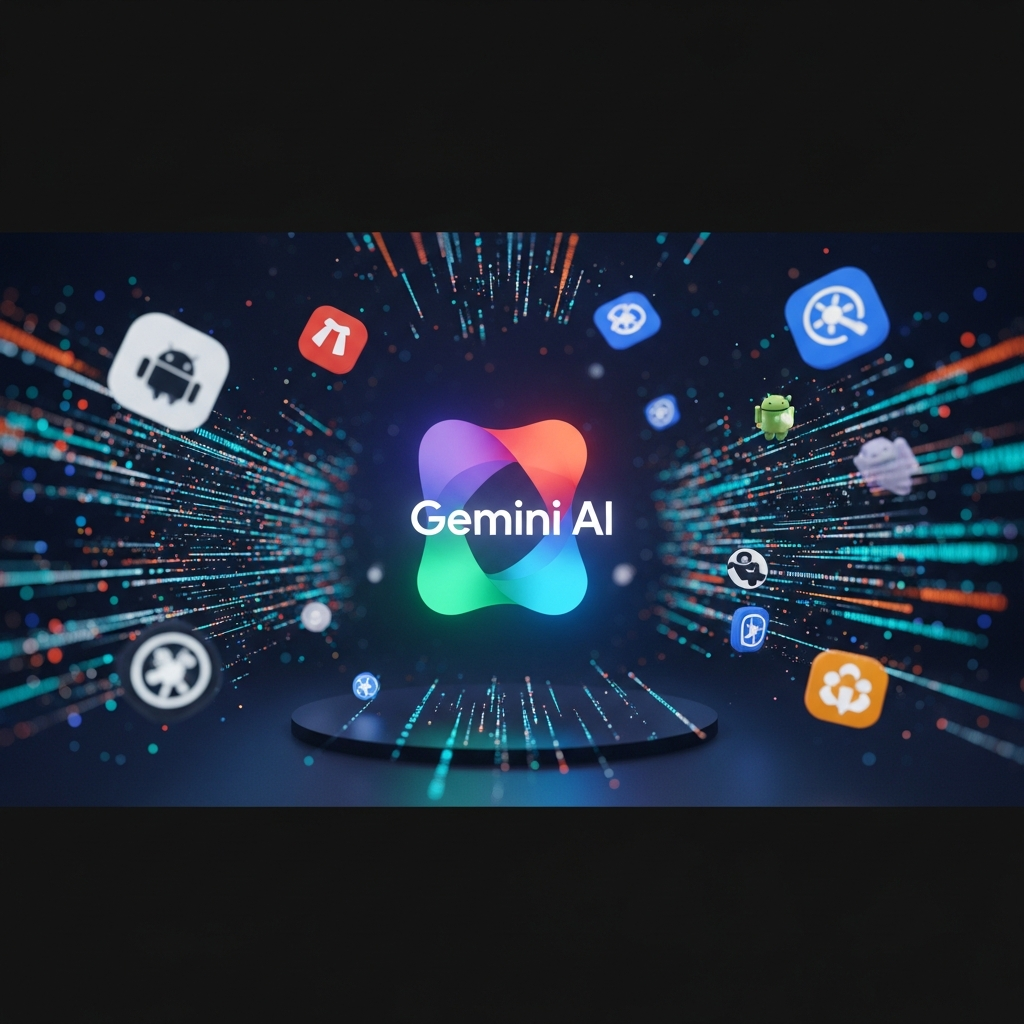
For nearly three decades, Google’s core identity was the search engine — a system that retrieved web pages ranked by relevance to your keywords. At Google I/O 2026, held on May 19–20 at Shoreline Amphitheatre, that identity was formally retired. In its place, Google presented Gemini as a full-stack Reasoning Engine: a system that does not merely match terms but interprets intent, decomposes problems, and synthesizes answers from across the web and device context.
AI Overviews and Multi-Step Query Handling
The centerpiece of Google’s search evolution is AI Overviews, which now covers a broad range of complex, multi-part queries. When a user asks something like “Plan a 10-day trip to Japan in October under $4,000, starting from New York, with a focus on food and culture,” Google’s system doesn’t return ten blue links. It performs what researchers call query fan-out — decomposing the request into sub-questions about flights, accommodation, seasonality, food districts, local transport, and budget allocation — then synthesizes a coherent, actionable response.
This is a profound shift for the web. AI Overviews are now the primary answer surface for hundreds of millions of searches daily. Content creators and brands must now compete not just for a page-one ranking, but to be the cited source inside a Gemini-generated summary. Google’s own guidance emphasizes E-E-A-T (Experience, Expertise, Authoritativeness, Trustworthiness) as the key signal for AI citation selection — essentially, authority determines visibility in the AI-first search era.
From Assistant to Agent: Gemini’s Agentic Leap
Beyond search, Google demonstrated Gemini’s agentic capabilities — the ability to take multi-step actions across apps and services on behalf of users. A single spoken request like “Book me a dinner reservation near my next meeting location” triggers Gemini to read the calendar, identify the location, query restaurant availability, check reviews, and complete the booking — all without the user touching a single app. This is the logical endpoint of the “Reasoning Engine” framing: an intelligence that doesn’t just answer questions but acts on goals.
Android Goes AI-Native: NPUs and the On-Device Intelligence Revolution
Announced at The Android Show: I/O Edition the week before and detailed further at the main keynote, Android 17 represents the biggest architectural shift in the platform’s history. The headline is that Gemini Intelligence is no longer an application running on Android — it is woven into the operating system layer itself, enabled by dedicated Neural Processing Units (NPUs) in modern smartphone silicon.
NPUs are specialized chips designed to run AI inference workloads — the computations that power language understanding, image recognition, and contextual reasoning — with dramatically lower power consumption than general CPUs or GPUs. The result is that AI features that previously required a round-trip to Google’s cloud can now run entirely on-device, in milliseconds, with zero data transmission.
Google’s rollout begins with the latest Pixel and Samsung Galaxy devices, with broader hardware support planned across the Android ecosystem through 2026. For developers, Google is expanding its on-device AI toolchain — LiteRT for edge model deployment, NPU acceleration APIs, and Native Hardware Buffer support — making it easier to build fast, private, locally-intelligent Android applications.
Google Marketing Live 2026: The Age of Agentic Advertising
On May 20, the day after I/O, Google’s annual Google Marketing Live 2026 keynote unveiled what may be the most consequential shift in digital advertising since the introduction of automated bidding: Agentic Ads and the move to fully autonomous campaign management.
What Are Agentic Ads?
Traditional Google Ads automation followed rules — bid strategies, responsive ad formats, keyword expansion. Agentic Ads operate differently. Powered by Gemini, these systems behave like a context-aware AI colleague: they read your landing pages, analyze performance history, understand your audience signals, propose campaign structures, generate creative assets, diagnose problems, and implement improvements — all within guardrails defined by the advertiser.
The practical implications are significant. Campaign setup that once required hours of manual work — asset group creation, keyword theming, creative variant generation, negative keyword logic — can now be substantially automated. Google’s AI Max for Search extends beyond conventional keyword targeting, interpreting broader intent signals and matching ads to queries the advertiser may never have anticipated. Performance Max becomes more agentic with proactive recommendations, feed-aware optimizations, and smarter creative testing across Search, YouTube, Shopping, Gmail, and Discover simultaneously.
The Measurement Imperative
Google was explicit at GML 2026: AI-driven campaigns are only as good as the data they learn from. The event showcased major advances in Data Manager, enhanced conversion tagging, Meridian GeoX for media mix modeling, and stronger first-party data integration. The message was clear — clean measurement infrastructure is no longer a nice-to-have. It is the engine that powers agentic performance.
The Rise of On-Device AI and the New Privacy Baseline
One of the most significant — and underreported — themes of I/O 2026 is the privacy dividend of on-device AI. As NPUs become standard in flagship and mid-range devices, the default execution environment for sensitive AI workloads is shifting from the cloud to the device itself.
This matters enormously in an era of growing data privacy regulation and consumer awareness. On-device inference means personal context — messages, voice, health data, location habits — powers your AI without ever being transmitted to a third-party server. Google framed this as a core feature of AI-native Android, not a trade-off. The fastest AI response and the most private AI response are now the same response, because both happen locally.
For enterprise and developer communities, this opens new categories of applications: AI-powered note-taking, health monitoring, real-time translation, and personal finance tools that users can trust precisely because their data stays on their device. The NPU-first architecture also reduces latency to near-zero for common inference tasks, making AI features feel genuinely native rather than cloud-dependent.
The Changing Landscape of AI Startups: Reverse Acquihires and the Talent Concentration Crisis
Perhaps the most structurally important trend happening around Google’s announcements — rather than within them — is the acceleration of Reverse Acquihires across the AI ecosystem. Traditional acquihires involved a company buying a startup primarily for its talent. Reverse acquihires flip the model: Big Tech firms hire away a startup’s key researchers and license its intellectual property, leaving the startup’s legal shell intact while capturing its most valuable assets.
The FTC and Georgetown’s Kearney Institute have flagged this trend as a potential antitrust concern, noting that it allows dominant players to vacuum up frontier AI talent without triggering merger review thresholds. For the venture capital ecosystem, it represents a new — and troubling — exit pathway: rather than an IPO or acquisition that generates full enterprise-value returns, founders and investors receive compensation structured around employment packages and licensing fees.
The practical effect is a concentration of AI talent within a small number of firms — Google, Microsoft, Meta, and OpenAI — while the startup ecosystem struggles to retain the researchers it trains. By 2026, reverse acquihires are no longer edge cases; they are a recognized strategic tool, and startups are increasingly building talent-centric reputations specifically to attract them.
From Apps to Agents: The Platform Shift No One Can Afford to Ignore
Across both I/O 2026 and the broader trajectory of Google’s product suite, a single architectural shift is reshaping software development: the transition from discrete apps to autonomous AI agents.
For most of the smartphone era, the app was the atomic unit of software. Each task — navigation, messaging, shopping, calendaring — had its own silo. The agent paradigm dissolves those silos. A Gemini-powered agent receives a high-level goal, reasons about the steps required, calls the relevant services (whether native Android apps, web APIs, or Google services), and executes the full workflow. The user interacts with one interface — a conversational agent — and the underlying apps become invisible plumbing.
For developers, this means the most important product surface is shifting from the app’s UI to its agent-callable capabilities. Google’s expanded tooling for Gemini API, Vertex AI, and agentic coding tools positions developers to build in this new paradigm. For businesses, it means that the path to the customer increasingly runs through an AI agent’s decision about which services to invoke — making authoritative, well-structured, machine-readable data more important than ever.