Google I/O 2026 Review: Gemini Agents, AI Search, Smart Glasses, and Google’s Biggest AI Shift Yet
A detailed Google I/O 2026 review covering Gemini 3.5, Gemini Omni, AI Search, Gemini Spark, Antigravity 2.0, Ask YouTube, intelligent eyewear, and Google’s agentic AI future.
Quick Answer: What Happened at Google I/O 2026?
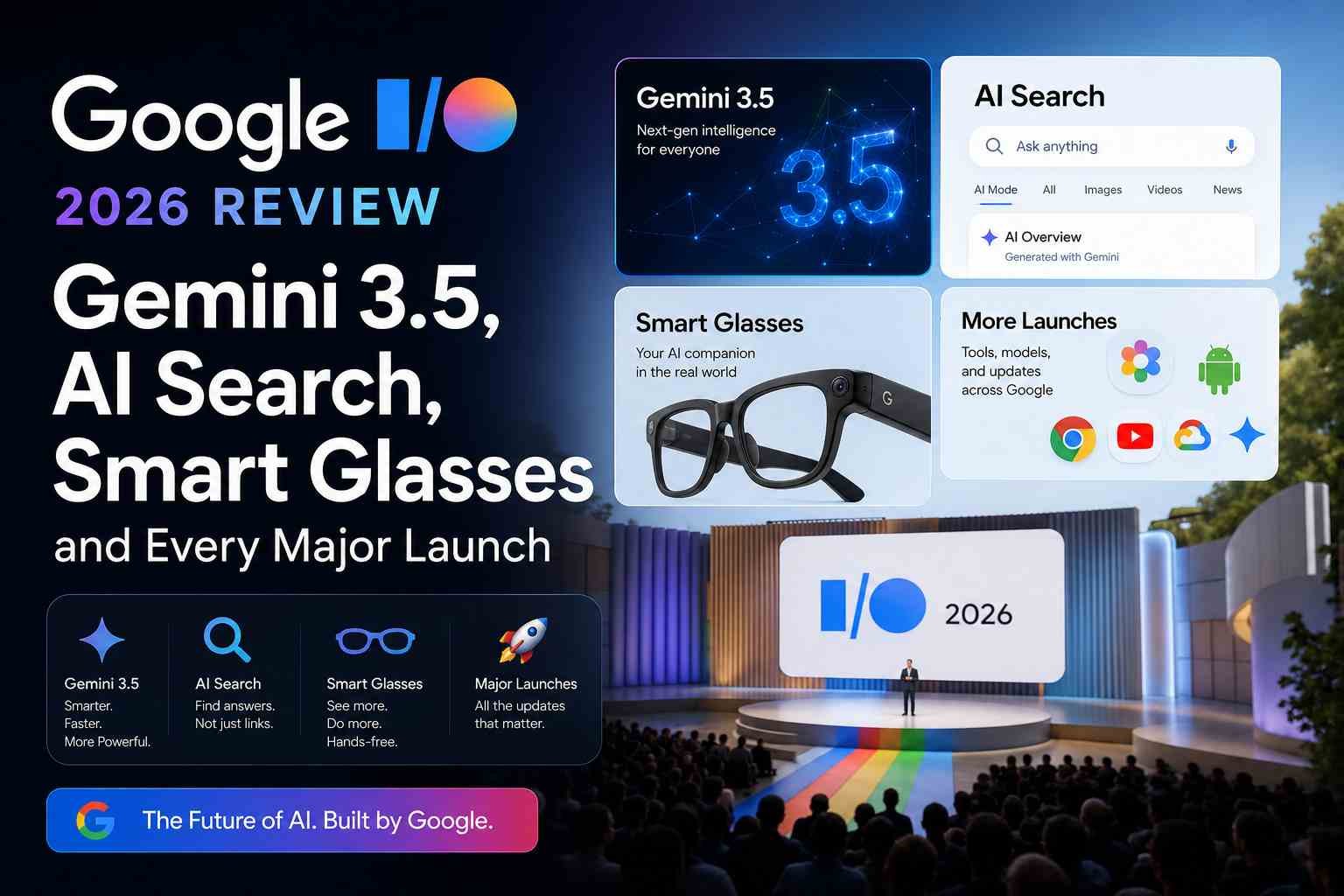
Google I/O 2026 was not just another developer conference. It was Google’s clearest signal that its future is built around AI agents, multimodal creation, intelligent search, and wearable computing. The event introduced Gemini 3.5 Flash, Gemini Omni, Gemini Spark, a redesigned AI-powered Google Search, Antigravity 2.0 for developers, Ask YouTube, Google Picks, upgraded Flow tools, Android XR smart glasses, and new scientific AI systems.
The big theme was simple: Google wants AI to move from answering questions to completing tasks.
Google I/O 2026: The Main Theme Was Agentic AI
The reporter covering the event described Google I/O 2026 as one of the biggest AI update waves released in a single day. That framing makes sense because almost every product shown at the event had one shared direction: AI is no longer being treated as a side feature.
Instead, Google is rebuilding Search, Gemini, Workspace, YouTube, Android XR, developer tools, design workflows, and creative tools around AI models that can understand context, generate media, and take action.
The event’s central shift was from “prompt-based AI” to “agent-based AI.” In plain language, that means Google does not want users to only ask Gemini for answers. It wants Gemini-powered systems to plan, monitor, create, edit, code, notify, and execute tasks across apps.

Gemini Omni: Google’s New Multimodal Creation Model
One of the biggest launches discussed in the video was Gemini Omni, a new AI model designed to combine reasoning, world understanding, and content generation.
Unlike basic AI video tools that only create visually attractive clips, Gemini Omni is positioned as a model that understands the subject behind the prompt. It can accept text, images, audio, video, and other inputs, then generate a complete output.
In the video, the reporter highlighted a demo where Gemini Omni generated a claymation-style explainer about protein folding from a simple prompt. The important point was not just the visual style. The generated narration and visuals matched the scientific concept, showing Google’s push toward AI media that is not only creative but also contextually accurate.
For creators, educators, marketers, and science communicators, this could be a major step forward. It points to a future where a single prompt can produce an educational video, product explainer, training module, or social campaign without requiring a separate script, voiceover, animation workflow, and editing suite.
Google Search Gets Its Biggest AI Redesign
Google Search was another major focus of I/O 2026. The new Search experience expands far beyond typing keywords into a box.
The updated search interface can understand text, images, videos, files, and even browser context. Instead of simply returning links, Google Search can now generate custom interfaces depending on the query. For example, a search about a scientific concept could produce an interactive simulation, while a search about fitness could create a mini dashboard using maps, weather, and relevant live information.
This is a major SEO moment. Search is becoming more conversational, more visual, and more action-oriented. Websites will need to optimize not only for keywords but also for entities, context, structured answers, user intent, and AI-generated summaries.
The biggest change is that agents are coming directly into Search. Users may be able to ask Google to track a product launch, monitor a topic, find a specific local venue, or notify them when something changes.
In short, Search is evolving from a discovery engine into a task engine.
Gemini Spark: A 24/7 Personal AI Agent
Gemini Spark was presented as one of Google’s most practical AI announcements. It is designed as a personal agent that can work continuously under the user’s direction.
The examples shown in the video included family scheduling, grocery planning, school email monitoring, daily reporting, and checking credit card statements for hidden subscriptions. The key idea is that Spark can work across apps like Gmail, Calendar, Docs, and other Workspace tools.
Because it runs through Google Cloud, the user does not need to keep a laptop open for tasks to continue. That makes Gemini Spark closer to a real digital assistant than a chatbot.
For everyday users, this could mean morning summaries, task reminders, email follow-ups, shopping help, and financial alerts. For professionals, it could become a lightweight operations assistant that watches inboxes, calendars, files, and workflows in the background.
Daily Brief and the New Gemini App
Google also introduced Daily Brief, a personalized morning summary inside the Gemini app. Once enabled, it can review Gmail, Calendar, and other connected sources to surface urgent updates, upcoming events, and follow-up items.
The Gemini app itself received a major redesign with a new interface style, smoother animations, stronger creation tools, and easier access to image, video, and music generation.
Gemini Live was also improved. Instead of taking over the full screen, it can now appear inside an ongoing conversation, making it easier to move between typing and speaking. Google also discussed regional dialect options, which could make voice interaction feel more natural for users in different markets.
Gemini for Mac and Advanced Voice Dictation
Another practical launch was the Gemini desktop app for macOS. The video emphasized advanced voice dictation as one of its most useful features.
The idea is that users can speak naturally, including pauses and messy thinking, and Gemini can turn that into a clean draft directly where the cursor is. Because the app can understand screen context, it may become useful for writing emails, documents, notes, summaries, and creative drafts.
Gemini Spark is also expected to come to the desktop app later, which could bring deeper local file and workflow automation.
Google Antigravity 2.0: AI Coding Becomes More Agentic
For developers and builders, Google Antigravity 2.0 was one of the most important announcements. The video showed it as a desktop app that uses multiple AI agents to work on different parts of a problem in parallel.
Instead of looking like a traditional coding environment, the new interface is built around a simple chat experience. In the reporter’s demo, Antigravity was asked to create a self-playing cyber-themed Chrome Dino game. The agent planned the project, generated the code, attempted to run it, found errors, debugged them, and improved the game logic.
The key takeaway is that AI coding tools are moving from autocomplete to autonomous project execution. Developers may increasingly act as directors, reviewers, and architects, while agents handle implementation, testing, and iteration.
Google Flow, Flow Tools, and Flow Music
Google Flow also received major upgrades. Flow Tools lets creators build custom tools using plain English instead of writing code. A creator could describe a video resizer, color shader, effects generator, or editing utility, and Flow could generate it inside the editor.
Flow Agent adds AI help for brainstorming, editing, and creative decision-making.
Flow Music, powered by Lyria 3 Pro, focuses on audio and music editing. Users can edit only a chorus, guitar line, lyric section, beat drop, or style without rebuilding the entire track. Google also showed AI video editing workflows where users can change lighting, outfits, scenes, or character consistency through natural language.
For creators, this is a shift from “AI generates content” to “AI becomes part of the editing timeline.”
Stitch and Google Picks: AI Design Tools Get More Serious
Stitch, Google’s AI UI design tool, received upgrades including live streaming generation, Figma import, codebase import, in-place edits, motion support, and better export options.
This makes Stitch more useful for founders, designers, and product teams who want to move from idea to prototype faster.
Google Picks, described in the video as an AI image creation and editing tool, takes a more object-based approach. Instead of editing an entire image with one prompt, users can select and modify individual elements, change text, preserve fonts, translate visual text, and collaborate on the same canvas.
That makes it feel closer to a real design tool than a simple prompt-to-image generator.
Project Genie and Interactive Worlds
Project Genie was one of the more futuristic announcements. It can generate interactive virtual environments and connect them with real Google Street View imagery.
In practice, that means users could choose a real-world location, apply a creative style, and explore an AI-generated interactive world based on that place. The example mentioned in the video involved reimagining the Golden Gate Bridge underwater.
This has potential for gaming, education, tourism, architecture, cultural storytelling, and virtual experiences.
Ask YouTube: Conversational Search for Video
Ask YouTube is a new conversational search experience for YouTube. Instead of typing short keywords, users can ask full natural-language questions.
For example, instead of searching “teach toddler pedal bike,” a user can ask how to teach a three-year-old to ride a pedal bike if they already know how to use a balance bike.
Ask YouTube can return structured answers, recommend relevant videos and Shorts, and jump directly to the useful timestamp. This could change YouTube SEO significantly. Creators will need clearer topic coverage, better chaptering, accurate captions, and content that directly answers natural-language questions.
Intelligent Eyewear and Android XR
Google and Samsung also showed intelligent eyewear powered by Android XR. The glasses come in two broad categories: audio glasses and display glasses.
Users can ask Gemini questions about what they are seeing, receive turn-by-turn directions, manage calls and texts, capture photos, and get hands-free assistance. Google is also working with eyewear brands such as Gentle Monster and Warby Parker.
This is Google’s clearest move against Meta’s smart glasses strategy. The difference is that Google can combine Gemini, Maps, Search, Android, YouTube, and Workspace into a wearable assistant.
Gemini for Science, WeatherNext, and SynthID
Google also used I/O 2026 to highlight AI for science and trust.
Gemini for Science connects AI agents with scientific databases, helping researchers analyze complex biological and medical problems faster. Google also discussed WeatherNext, a DeepMind weather model used for advanced forecasting.
On the trust side, Google expanded SynthID and content credentials. SynthID watermarks AI-generated content invisibly, while content credentials help verify whether something was AI-generated, camera-captured, or edited. Google plans to expand these verification tools across Search and Chrome.
Conclusion: Google I/O 2026 Was About AI Becoming Infrastructure
Google I/O 2026 showed that Google is no longer adding AI to products one feature at a time. It is turning AI into the foundation of its ecosystem.
Gemini 3.5 powers faster agents. Gemini Omni expands multimodal creation. Search becomes interactive and agentic. YouTube becomes conversational. Antigravity changes how apps are built. Android XR brings AI onto the face. Tools like Flow, Stitch, Picks, and Spark show that Google wants AI to help people create, work, design, research, and manage daily life.
The biggest takeaway is this: Google’s future is not just about smarter answers. It is about AI systems that understand context, act across tools, and help users complete real tasks.
FAQs About Google I/O 2026
What was the biggest announcement at Google I/O 2026?
The biggest announcement was Google’s move toward agentic AI across its ecosystem, led by Gemini 3.5 Flash, Gemini Spark, AI-powered Search, and Antigravity 2.0.
What is Gemini Spark?
Gemini Spark is Google’s 24/7 personal AI agent. It can help manage tasks, monitor information, summarize updates, and work across Google apps under user direction.
What is Gemini Omni?
Gemini Omni is Google’s multimodal AI model designed to understand and generate content from text, images, audio, video, and other inputs. It begins with advanced video generation.
How did Google Search change at I/O 2026?
Google Search became more interactive and agentic. It can understand multiple input types, generate custom interfaces, create simulations, and use AI agents to track or complete tasks.
What is Google Antigravity 2.0?
Google Antigravity 2.0 is an AI-first development platform that lets users orchestrate multiple agents to build, debug, and manage software projects.
What is Ask YouTube?
Ask YouTube is a conversational search feature that helps users ask natural-language questions and find relevant YouTube videos, Shorts, and exact timestamps.
Are Google smart glasses launching in 2026?
Google announced intelligent eyewear powered by Android XR, with audio glasses expected first and partnerships involving Samsung, Gentle Monster, and Warby Parker.
Why does Google I/O 2026 matter for SEO?
Google I/O 2026 matters for SEO because Search is becoming more AI-driven, conversational, visual, and task-based. Content now needs stronger topical authority, structured answers, entity clarity, and natural-language FAQ coverage.
Sources checked: Google I/O 2026 announcement collection, 100 things announced at Google I/O 2026, Google developer highlights, Android XR intelligent eyewear