Published: May 21, 2026 | Reading Time: 6 minutes | Topics: Artificial Intelligence, Agentic AI, Apple Siri, NVIDIA Vera Rubin, AI Healthcare, AI Infrastructure
The Era of Proactive AI: How Siri’s Evolution Is Powering the Rise of Agentic Workflows in 2026
Summary: What Is Proactive AI and Why Does It Matter in 2026?
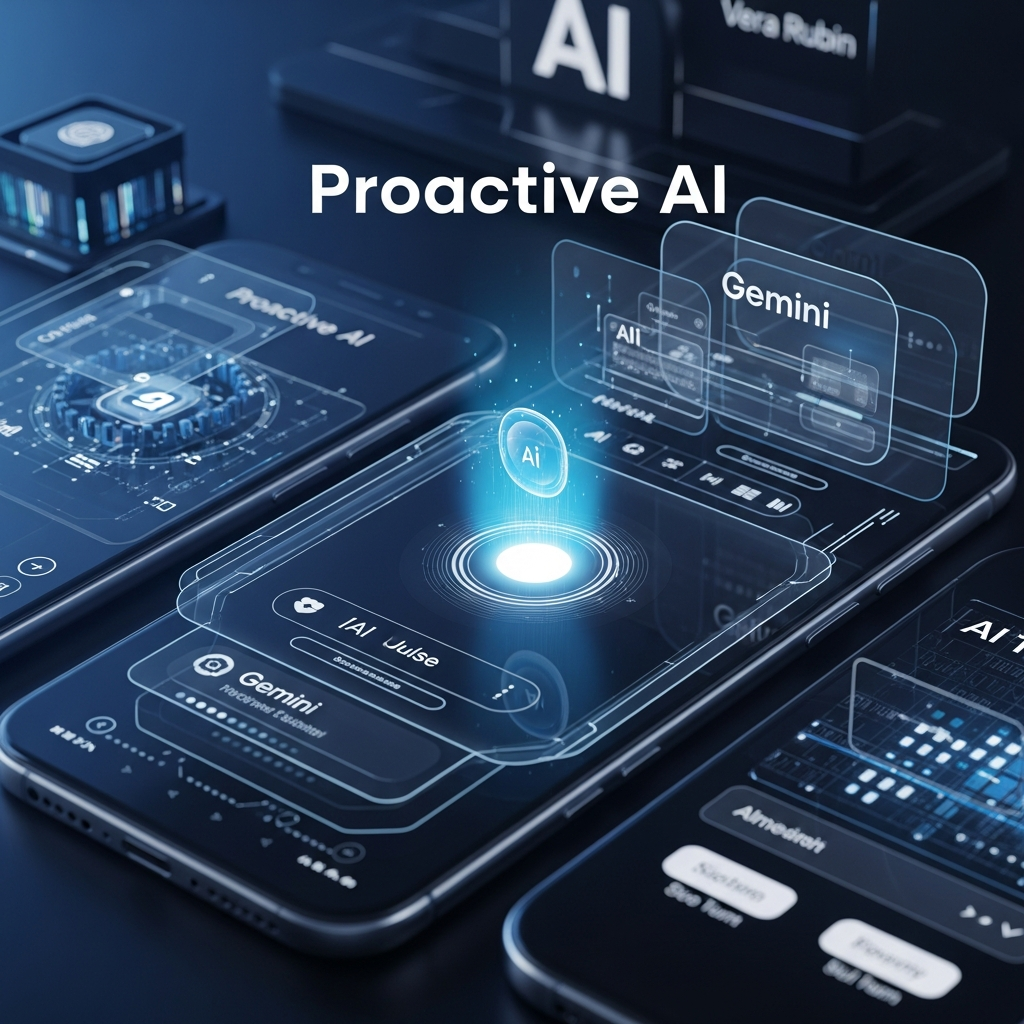
Proactive AI refers to artificial intelligence systems that anticipate user needs, set autonomous goals, and execute multi-step tasks without waiting to be asked. In 2026, the AI landscape has decisively shifted from reactive assistants — tools that respond only when spoken to — toward agentic workflows that observe context, reason across applications, and act independently. Key milestones driving this shift include Apple’s complete reimagining of Siri, NVIDIA’s Vera Rubin AI platform powering next-generation “AI factories,” breakthroughs in medical diagnostics achieving 97% accuracy in dementia detection, and the rise of autonomous agents as the single most-discussed technology trend of the year. This article unpacks each development and explains what the era of proactive AI means for everyday users, enterprises, and the global infrastructure that makes it possible.
From Reactive to Proactive: The Fundamental Shift in AI Behavior
For most of its public life, AI operated on a simple stimulus-response model. You asked; it answered. You typed; it replied. The intelligence was impressive in narrow domains, but the paradigm was fundamentally passive. Every interaction required a human to initiate, frame, and often interpret the output before any real-world action could occur.
That model is now obsolete. The defining characteristic of 2026’s AI landscape is proactivity — the capacity for an AI system to monitor ongoing context, identify opportunities or problems, and take action before a user ever forms a question. Rather than waiting at the end of a prompt box, today’s most advanced AI systems run as persistent background agents, continuously reading signals from calendars, sensors, communications, and data streams.
The practical implications are profound. A proactive AI doesn’t just answer “What’s my next meeting?” — it notices that your flight was delayed, reschedules the meeting, drafts an apology email to attendees, and books a later car, all without a single prompt. This is not science fiction; it is the operational baseline that major platforms are racing to deliver right now.
Siri 2.0: The End of the Simple Assistant
No product transformation better illustrates the reactive-to-proactive shift than Apple’s reinvention of Siri. The original Siri — launched in 2011 — was a voice-activated command terminal. You spoke a request; Siri attempted to parse it; results were hit-or-miss. For over a decade, the assistant remained largely siloed, unable to take meaningful action across the device’s own apps.
The Siri of 2026 is a fundamentally different system. Three capabilities define its new architecture:
Screen Awareness
Siri can now read and reason about everything displayed on the screen in real time. If you are reading a restaurant review, Siri can proactively suggest making a reservation. If you are looking at a product listing, it can compare prices across tabs you haven’t opened yet. The assistant’s context is no longer limited to what you explicitly tell it — it extends to everything your device can see.
Context Awareness Across Time
Modern Siri maintains a persistent, privacy-preserving model of your habits, preferences, and ongoing tasks. It understands that your Tuesday morning is usually blocked for a team standup, that you prefer vegetarian restaurants, and that you are currently in the middle of planning a trip to Tokyo. This temporal context means suggestions are relevant, not random.
Cross-App Orchestration
Perhaps most significantly, Siri can now act as a workflow conductor across third-party applications. It can extract a tracking number from a Messages thread, open the courier’s app, check the delivery status, and add a calendar reminder for the delivery window — all from a single natural-language request. This cross-app orchestration was the missing piece that turns an assistant into an agent, and Apple’s implementation of it marks a watershed moment for consumer AI.
The competitive pressure this creates is enormous. Google, Samsung, and Microsoft are all advancing their own ambient-intelligence layers, but Apple’s tight hardware-software integration gives Siri a structural advantage in on-device, privacy-first agentic execution.
Agentic AI: Why We Are Moving Beyond Chatbots

If Siri’s evolution is the consumer face of proactive AI, agentic AI is its enterprise backbone — and it is unambiguously the #1 technology trend of 2026.
An AI agent is a system that can pursue a goal over an extended sequence of steps, using tools, APIs, and other AI models as building blocks. Unlike a chatbot, which produces a text response, an agent produces outcomes. It browses the web, writes and runs code, calls external services, reads and writes files, and loops back to re-evaluate its own progress against the goal.
The practical deployment of agents has accelerated dramatically. Enterprise teams are using agentic frameworks to automate entire business processes: sourcing qualified leads and drafting personalized outreach sequences, monitoring compliance documents and flagging deviations, synthesizing research from dozens of scientific papers, and managing cloud infrastructure that self-heals when anomalies are detected.
What makes 2026 the inflection point is the convergence of three previously separate capabilities:
- Long-context reasoning models that can hold and synthesize large amounts of information within a single reasoning pass.
- Reliable tool use — modern models call APIs and interpret results with far greater accuracy than their predecessors.
- Multi-agent orchestration — specialized sub-agents can be spun up, assigned subtasks, and their outputs composed by an orchestrating model, enabling complexity that a single model could not handle alone.
The shift from chatbots to agents is not iterative — it is categorical. A chatbot makes communication faster; an agent makes human intervention optional.
NVIDIA and the Infrastructure Arms Race: Enter Vera Rubin
Every layer of the proactive AI revolution runs on silicon, and no company shapes that silicon landscape more than NVIDIA. In 2026, NVIDIA unveiled the Vera Rubin AI platform — named after the pioneering astronomer — representing the most significant architectural leap in the company’s GPU roadmap to date.
Vera Rubin integrates NVIDIA’s custom Vera ARM-based CPU with the next-generation Rubin GPU architecture, connected by a high-bandwidth NVLink fabric. The platform is designed not for individual servers but for what NVIDIA calls “AI factories” — warehouse-scale compute facilities dedicated entirely to training and running foundation models at continuous scale.
The concept of an AI factory is more than marketing language. It reframes AI compute as industrial infrastructure, comparable to electricity generation or semiconductor fabrication. Just as a car factory converts raw materials into vehicles, an AI factory converts raw compute and data into trained models and inference outputs that power downstream products and services.
This framing carries serious implications for national competitiveness. Governments and hyperscalers alike are in an arms race to build AI factories, and Vera Rubin is the engine many of them are betting on. Projected cluster sizes in 2026 range into the hundreds of thousands of GPUs, consuming power loads that rival mid-sized cities.
The Grid Capacity Bottleneck
That power demand reveals one of the most under-discussed constraints on the proactive AI era: electricity and cooling infrastructure. A single Vera Rubin cluster can require hundreds of megawatts of continuous power. Data centers are now among the fastest-growing consumers of electricity globally, and the grid in many regions was not designed for this load.
Cooling presents an equally acute challenge. Traditional air cooling is insufficient for the thermal density of modern AI chips. Liquid cooling — and in some cases full-immersion cooling in dielectric fluid — is becoming standard. The engineering challenge of keeping thousands of high-performance GPUs operating within safe thermal envelopes, 24 hours a day, at scale, is as demanding as the AI problems the hardware is solving.
Power procurement, grid interconnection timelines, and cooling system design are now strategic constraints that determine how fast the proactive AI era can actually expand. The silicon is ready; the infrastructure must catch up.
AI in Healthcare: Saving Lives in Seconds
Beyond enterprise productivity and consumer convenience, proactive AI is delivering its most consequential results in medicine — and the numbers are striking.
97% Accurate Dementia Detection
Researchers in 2026 have validated AI diagnostic models capable of detecting early-stage dementia with 97% accuracy, using a combination of speech pattern analysis, cognitive test scoring, and neuroimaging data. The significance of this cannot be overstated. Dementia currently affects tens of millions of people worldwide, and early diagnosis is the single greatest factor in slowing progression and enabling effective care planning. Human neurologists, even expert ones, operating under time pressure in standard clinical settings, achieve meaningfully lower accuracy on equivalent early-stage cases. An AI model that can flag at-risk patients during a routine GP visit — before symptoms become severe — could reshape the entire trajectory of dementia care globally.
Instant Heart Disease Diagnosis from EKGs
In cardiology, AI models trained on millions of electrocardiograms can now diagnose a range of heart conditions from a standard 12-lead EKG in seconds — a process that previously required a specialist cardiologist and hours of turnaround time. These models detect atrial fibrillation, ventricular hypertrophy, ischemic patterns, and rare conduction abnormalities with accuracy that meets or exceeds board-certified cardiologists in comparative studies.
The deployment model is proactive by design: in hospitals using these systems, every EKG is automatically analyzed at the point of care. A nurse administering the test receives an AI-generated preliminary read within the same minute, flagging critical findings for immediate physician review. Patients who might otherwise wait hours for a diagnosis get actionable information while they are still in the room.
These MedTech advances illustrate the broadest promise of proactive AI: not replacing human expertise, but ensuring that expertise is never the bottleneck between a patient and timely, accurate care.
Frequently Asked Questions About Proactive AI
What is the difference between reactive AI and proactive AI?
Reactive AI responds only when a user provides explicit input — a question, a command, or a prompt. Proactive AI continuously monitors context and takes action autonomously, anticipating needs before a user asks. The shift is from a tool you use to a system that works on your behalf.
What is an AI agent and how is it different from a chatbot?
A chatbot generates text responses to conversational input. An AI agent pursues goals over multiple steps, using tools like web browsing, code execution, and API calls to produce real-world outcomes. Agents are outcome-oriented; chatbots are response-oriented.
What is Apple Siri’s new capability in 2026?
In 2026, Siri gained screen awareness, temporal context memory, and cross-app orchestration. It can read what is on your screen, remember your preferences and ongoing tasks over time, and coordinate actions across multiple third-party apps in a single natural-language request.
What is NVIDIA Vera Rubin?
NVIDIA Vera Rubin is a next-generation AI computing platform that combines NVIDIA’s custom Vera CPU with the new Rubin GPU architecture. It is designed to power large-scale “AI factories” — industrial-grade data centers dedicated to training and running foundation models at unprecedented scale.
What is an AI factory?
An AI factory is a large-scale computing facility designed specifically for AI workloads — training foundation models and serving inference at continuous, industrial scale. NVIDIA coined the term to frame AI compute as strategic infrastructure comparable to power generation or semiconductor manufacturing.
Why is power consumption a challenge for AI infrastructure in 2026?
Modern AI clusters — particularly those using NVIDIA’s latest GPUs — require enormous amounts of continuous electricity. A single large cluster can consume hundreds of megawatts. Many regional power grids were not designed to accommodate this demand, creating bottlenecks in where and how fast AI data centers can be built and operated.
How accurate is AI in detecting dementia?
AI diagnostic models validated in 2026 have demonstrated 97% accuracy in detecting early-stage dementia using speech analysis, cognitive assessments, and neuroimaging data. This exceeds the accuracy of human clinicians in equivalent early-detection scenarios and could enable screening at routine GP visits.
Can AI diagnose heart disease from an EKG?
Yes. AI models trained on millions of electrocardiograms can analyze a standard 12-lead EKG in seconds and detect a wide range of cardiac conditions — including atrial fibrillation, ischemic patterns, and conduction abnormalities — with accuracy comparable to board-certified cardiologists. In deployed hospital settings, every EKG receives an automatic AI-generated preliminary read at the point of care.
Is agentic AI the biggest technology trend of 2026?
Yes. Agentic AI — systems that pursue goals autonomously over extended multi-step workflows — is widely recognized as the #1 technology trend of 2026. The convergence of long-context reasoning models, reliable tool use, and multi-agent orchestration has made it possible to automate entire business processes that previously required continuous human oversight.
How does proactive AI protect user privacy?
Leading implementations of proactive AI, including Apple’s Siri, use on-device processing to perform context analysis and reasoning locally, so personal data never leaves the device. Privacy-preserving architectures ensure that the AI can be contextually aware without transmitting sensitive information to external servers.