AI Research
LLM Optimization
Google
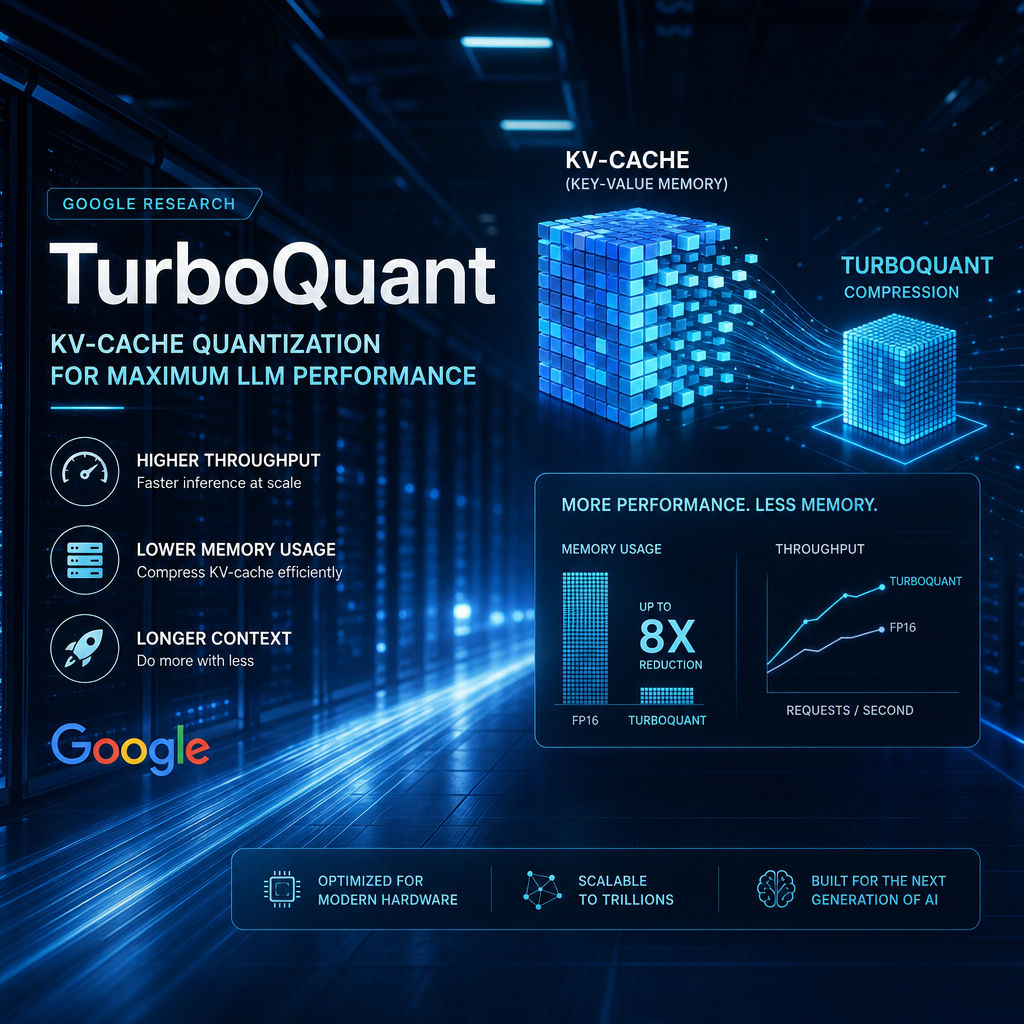
Google TurboQuant: The Training-Free KV Cache Compression That Shrinks LLM Memory by 5–6×
Google TurboQuant is a training-free compression method for the Key–Value (KV) cache of Transformer-based large language models (LLMs). It combines two novel techniques — PolarQuant and Quantized Johnson–Lindenstrauss (QJL) — to compress KV cache data to approximately 3 bits per coordinate, reducing memory footprint by 5–6× with near-zero accuracy loss. On NVIDIA H100 GPUs, TurboQuant achieves up to an 8× speedup in attention-logit computation, enabling longer context windows and more concurrent inference requests without retraining any model.
As large language models push toward million-token context windows, a quiet but crushing bottleneck has emerged at inference time: the KV cache. Every token processed at inference stores a Key and Value vector in GPU memory — and as sequences grow longer, so does the memory bill. For real-world deployments on models like Gemma or Mistral, this can mean dramatically fewer concurrent users per GPU, higher cloud costs, and hard ceilings on context length.
Google’s TurboQuant attacks this problem head-on — and it does so without touching a single training parameter.
How TurboQuant Works: PolarQuant and QJL Explained
TurboQuant is built on a core insight: standard quantization methods treat KV cache vectors as flat numeric arrays, ignoring their geometric structure. TurboQuant instead exploits the intrinsic geometry of transformer attention vectors through two complementary techniques.
PolarQuant — Compressing Keys with Polar Coordinates
Traditional quantization maps floating-point values onto a uniform integer grid. For Key vectors, this is wasteful because Keys are predominantly directional — what matters most is the angle they form in high-dimensional space, not their magnitude.
PolarQuant converts Key vectors from Cartesian coordinates to polar coordinates, then quantizes the angular components (the directions) at high precision while handling the radial component (magnitude) separately with minimal bits. Because transformer attention is computed via dot products that are fundamentally directional, this representation preserves the semantics that matter — at a fraction of the memory cost of naive float16 storage.
Quantized Johnson–Lindenstrauss (QJL) — Compressing Values Stochastically
For Value vectors, TurboQuant applies a different strategy rooted in randomized linear algebra. The classical Johnson–Lindenstrauss lemma states that high-dimensional vectors can be projected into a lower-dimensional space while approximately preserving pairwise distances. QJL takes this further: it applies a randomized projection followed by aggressive quantization (down to ~3 bits), producing compact sketches of Value vectors that retain enough information for accurate attention-weighted aggregation.
Together, PolarQuant (for Keys) and QJL (for Values) compress the full KV cache to roughly 3 bits per coordinate — compared to the 16 bits used in standard half-precision storage — achieving a 5–6× reduction in memory with near-zero degradation in model output quality.
“TurboQuant demonstrates that the geometry of transformer representations can be exploited directly at inference time, without any expensive retraining or fine-tuning pipeline.”
Benefits for Developers and Enterprises: Speed, Cost, and Concurrency
The implications of a 5–6× memory reduction are not just theoretical. For teams deploying LLMs at scale, TurboQuant translates into three concrete operational wins:
| Benefit | What It Means in Practice |
|---|---|
| ⚡ 8× Attention Speedup | Attention-logit computation runs up to 8× faster on H100 GPUs, directly reducing token generation latency. |
| 💾 5–6× Memory Reduction | The same GPU can serve longer contexts or more users simultaneously — without hardware upgrades. |
| 🔁 Higher Concurrency | More parallel inference requests fit in VRAM, reducing per-query cost and improving throughput in batch deployments. |
Critically, TurboQuant is training-free. Engineers can apply it to existing model checkpoints — including Gemma and Mistral — without any fine-tuning. This dramatically lowers the barrier to adoption: no GPU clusters for retraining, no dataset preparation, no alignment re-evaluation. A single deployment configuration change can unlock these gains.
Impact on Long-Context Retrieval: Needle in a Haystack and Beyond
The true test of any KV cache compression method is whether it survives hard retrieval tasks — the cases where models must surface a single precise fact buried deep inside a 128K-token context. TurboQuant was benchmarked across three demanding evaluation suites:
- LongBench — a suite of multi-task long-context understanding benchmarks covering summarization, QA, and code.
- Needle In A Haystack (NIAH) — the canonical stress test where a model must retrieve a “needle” fact from a massive “haystack” of distracting text.
- ZeroSCROLLS — a zero-shot benchmark requiring reasoning over extremely long documents without any few-shot priming.
Across all three benchmarks, TurboQuant maintained accuracy comparable to uncompressed baselines — a remarkable result given its aggressive ~3-bit compression ratio. On NIAH in particular, where degraded key representations typically cause catastrophic retrieval failures, PolarQuant’s angular fidelity proved critical: the model retained its ability to locate precise information even in the longest tested contexts.
The Future of Efficient AI: On-Device Inference vs. Cloud Scale
TurboQuant arrives at a pivotal moment in the AI infrastructure landscape. Two diverging trends are colliding: the push toward on-device inference (running LLMs on phones, laptops, and edge hardware) and the demand for massive-scale cloud inference (serving billions of requests per day across data centers). Both fronts are constrained by the same enemy — memory.
On the cloud side, TurboQuant’s 5–6× KV cache compression directly reduces the cost per token served. For hyperscalers running tens of thousands of H100s, even a 2× reduction in memory-bound latency translates into hundreds of millions of dollars in annual infrastructure savings.
On the on-device side, the math is even more striking. Devices like smartphones carry 8–12GB of shared system memory. Today, running a 7B-parameter model with a 32K-token context on such hardware is barely feasible. With TurboQuant’s compression, the same context length becomes manageable — potentially enabling private, offline, long-context inference directly on consumer hardware.
As the community moves toward multimodal models, agentic pipelines, and RAG (Retrieval-Augmented Generation) systems that routinely process enormous contexts, training-free KV compression methods like TurboQuant may become as foundational as quantization itself — a default optimization layer in every production inference stack.
Frequently Asked Questions About Google TurboQuant
What is Google TurboQuant?
Google TurboQuant is a training-free compression method for the KV (Key–Value) cache used in Transformer-based LLMs. It reduces KV cache memory by 5–6× using PolarQuant and Quantized Johnson–Lindenstrauss techniques, enabling faster and more memory-efficient inference without retraining the model.
What is PolarQuant and how does it work?
PolarQuant is a component of TurboQuant that converts Key vectors in transformer attention from Cartesian to polar coordinates before quantization. Since attention is direction-sensitive, encoding angular information at higher fidelity than magnitude preserves model accuracy while drastically reducing memory usage.
Does TurboQuant require retraining the model?
No. TurboQuant is completely training-free. It can be applied directly to pre-trained model checkpoints, including open models like Gemma and Mistral, without any fine-tuning or additional training data.
How much speedup does TurboQuant provide?
TurboQuant achieves up to 8× speedup in attention-logit computation when tested on NVIDIA H100 GPUs, directly reducing the latency of token generation for long-context inference tasks.
Which benchmarks was TurboQuant tested on?
TurboQuant was evaluated on LongBench, Needle In A Haystack (NIAH), and ZeroSCROLLS — three rigorous benchmarks for long-context understanding and retrieval. It maintained near-baseline accuracy across all three despite compressing the KV cache to approximately 3 bits per coordinate.
What is the Quantized Johnson–Lindenstrauss (QJL) method?
QJL extends the classical Johnson–Lindenstrauss random projection lemma by applying it with aggressive quantization to Value vectors in the KV cache. It creates compact, low-bit sketches of Value representations that still allow accurate attention-weighted output aggregation at inference time.
Which LLMs are compatible with TurboQuant?
TurboQuant has been demonstrated on models including Gemma and Mistral. Because it is a training-free, architecture-agnostic method applied at the KV cache level, it is broadly compatible with any Transformer-based LLM that uses standard multi-head or grouped-query attention.